Core Attributes
| Chinese | 破军 |
|---|---|
| Pinyin | Po Jun |
| English | Breaking Army |
| Archetype | The Breaker |
| Element | Yin Water |
| Category | Major |
Personality & Temperament
People with Po Jun in the Life Palace are born movers: impatient, bold, restless, with a temper that flares and clears quickly. The texts describe the Breaker as the most impulsive of the fourteen major stars, with the sharpest swings in fortune. It is a warrior star and a vanguard — strong at storming a gate, weak at guarding it afterward. Po Jun people do not wait for permission to change things; they feel an old order's wrongness early, and their rebellion is usually principled.
The gift is the courage to demolish. These are the people who walk into stagnant rooms and dismantle them: founders, reformers, surgeons, engineers of the new. They work hardest before success arrives, and the tradition insists that every Po Jun life is labor first and reward later — the 'break first, build later' (先破后立) pattern. In a chart, Po Jun is the engine of change: where it sits, nothing stays the same, and that palace becomes the field on which old structures are cleared.
The shadow is destruction without direction. Without a strong root — Lu Cun, Hua Lu, or Hua Quan — the Breaker can demolish for its own sake: sudden exits, burnt bridges, abandoned projects, money that flows out as fast as it flows in. The texts warn of pride, suspicion, a refusal to be managed, and note that Po Jun people are hard to read: 'the nature of Po Jun is difficult to fathom.' They also struggle to enjoy what they have built, because their instinct is to move on. The mature Breaker learns the star's paradox: to build a lasting life, one must first learn to hold ground.
When Change Becomes a Repeating Pattern
Why do I keep tearing everything down and starting over?
Po Jun, Qi Sha, and Tan Lang: Three Kinds of Change
Po Jun changes life by breaking an outgrown structure so a replacement can be built. Qi Sha changes life through a decisive command under pressure; Tan Lang changes it by following desire, opportunity, and social momentum. If the pattern is repeated demolition, ask what the rebuild requires after the break — not only what must end. Compare Qi Sha (Seven Executives)
Questions to Check in Your Chart
- Name the structure that no longer works; do not confuse boredom with structural failure.
- List what must survive the change: money, relationships, skills, or obligations.
- Define the maintenance phase before you begin, because Po Jun is better at the breach than the guard.
This reflection extends Po Jun's classical role as the star of expenditure and upheaval. Read it together with palace, brightness, transformations, and supporting stars; it is not a prediction that every change will end in loss.
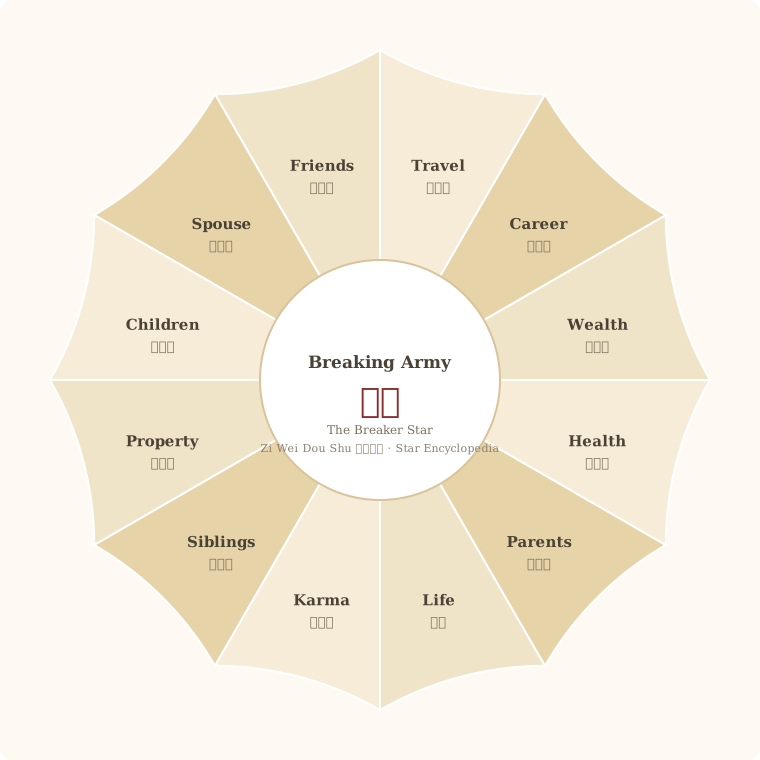
Breaking Army in the Twelve Palaces
| Palace | Meaning |
|---|---|
| Life | A life that is broken open and rebuilt more than once. Po Jun people are impatient, inventive, fearless about confrontation; they attack problems head-on and refuse to stay in arrangements that feel wrong. The classical pattern is sharp and wavy: labor first, results later, every change tied to what came before. |
| Siblings | Sibling bonds tend to be loose and competitive. Brothers and sisters scatter early or quarrel over practical matters, and the texts count Po Jun among the stars that do not favor close kin ties. Each sibling usually walks their own restless path; respect from a distance is the realistic expectation. |
| Spouse | A high-energy, high-drama marriage palace. The spouse is typically strong-willed and independent, and the union passes through storms before settling. Classical guidance favors late marriage and warns that early serious relationships rarely last. With helpful stars, the marriage stabilizes after a turbulent first phase. |
| Children | Po Jun is the classical star of children. Children here are active, opinionated, self-starting — hard to steer, but often capable. In temple positions the chart favors many children and successful ones; in weak positions, fewer children, or children who leave home early and return often. |
| Wealth | Wealth moves in waves: large gains, large outlays, losing ground before gaining it. Po Jun's nature is expenditure, so money is best made through movement, trade, or innovation rather than passive holdings. The classic remedy is Lu Cun or Hua Lu — the 'root' that lets the Breaker profit from upheaval. |
| Health | The body absorbs the Breaker's turbulence. The texts link Po Jun to physical trauma — cuts, surgery, injuries from risk-taking — and warn of water accidents when Wen Qu is afflicted. Recovery is usually complete, but the pattern rewards rest and a little less recklessness. |
| Travel | Travel is where the Breaker often does its best work. Emigration, distant assignments, relocation create the very upheaval Po Jun converts into progress. The texts describe leaving the ancestral home to build anew: a hard start abroad that becomes a strong base in later life. |
| Friends | Po Jun governs friends, colleagues, subordinates. The circle is fluid: allies come and go with projects, and partnerships are energetic but unstable. The shadow is loss through others — lending, joint ventures, borrowed trust need safeguards. In practice, Po Jun people end up relying on themselves. |
| Career | One of the Breaker's strongest placements. Careers suit demolition and creation: engineering, surgery, construction, business development, logistics, the military, film and media — any field that dismantles old arrangements. Steady desk-bound roles frustrate it; a frontier or a problem to crack brings out its best. |
| Property | Property follows the break-and-rebuild pattern: ancestral holdings are hard to keep, and the family home is often sold, renovated, or replaced. Buying, rebuilding, and selling real estate can profit, but passive holding does not. Property built through one's own labor accumulates best. |
| Fortune | A restless inner life that finds peace in motion: the Breaker's spirituality is the clearing of old ground, in beliefs as in careers. Stillness feels like stagnation unless a project gives it purpose; renewal, not rest, is its form of recovery. |
| Parents | An early push toward independence: parents who are either demanding or absent, leaving the child to find their own footing. The bond is real but spare; the Breaker usually leaves the family pattern behind and rebuilds their own. Distance often improves the relationship. |
Star Brightness Levels
Brightness (庙旺平陷) describes how strongly Breaking Army expresses in each palace position. The table below follows the traditional brightness table of the Zi Wei Dou Shu Quan Shu (紫微斗數全書), as compiled in Zi Wei Dou Shu Jing Cheng (紫微斗数精成). Some schools vary.
| Level | Chinese | English | Palaces |
|---|---|---|---|
| Miao | 庙 | Temple | 子, 午, 戌 |
| Wang | 旺 | Prosperous | 丑, 辰, 未 |
| De | 得 | Obtained | 寅, 申 |
| Ping | 平 | Neutral | 巳, 亥 |
| Xian | 陷 | Fallen | 卯, 酉 |
Po Jun's power swings more sharply with position than almost any star: temple positions (Zi, Wu, Xu) can produce the famous Hero-in-Temple configuration, while fallen positions (Mao, You) turn its demolition force inward.
Key Star Combinations
- Po Jun + Purple Star (紫微破军): Zi Wei governs and restrains the Breaker, converting its demolition force into authority and momentum — the texts describe the Emperor taming the Army. The pair is bold, decisive, tireless: founders, reformers, leaders who build through upheaval. But the combination is restless rather than serene — the throne is never quiet, and early life is hard labor. With no malefic stars, effort brings a strong position after middle age; with Left and Right Assistant in support, the turbulence is checked and the chart can rise to real power.
- Po Jun + Martial Music (武曲破军): Two of the chart's hardest-driving stars in one palace: Yin Water and Yin Metal, both uncompromising. The texts say wealth here tilts east and west — gains and losses in quick succession — and the pair is famous for sudden rises and sudden falls. The Breaker works alone: as one commentary puts it, Po Jun charges at the front and can rely on no one else, so the person fights their own battle even at the top. It suits competitive industries and self-built careers; with Lu Cun or Hua Lu anchoring the pair, the swings become profitable rather than ruinous.
- Po Jun + Chaste Purity (廉贞破军): Sensitivity and demolition meet. The tradition treats this as the hardest of Po Jun's pairings: emotional life runs hot, suspicion comes easily, quarrels can flare and sever ties quickly. A folk saying calls the pair 'wolf-hearted and dog-lunged' — crude, but a fair warning about loyalty and temper; with maturity, the same fire becomes charisma. In fallen positions with malefics, the texts warn of disputes, litigation, injury. In temple positions with helpful stars, the sharpness becomes drive: quick judgment, fearless decisions, a career that thrives on crisis. Marriage needs patience — both partners need space to cool down before words become weapons.
- Po Jun + Greedy Wolf + Seven Executives (杀破狼): The three change stars of the chart: Seven Executives (Qi Sha), Po Jun, and Greedy Wolf (Tan Lang) always form a triangle around the chart, and together they define the classical pattern of transformation. Where the three are active — especially when a major life period or year arrives at one of them — the texts promise upheaval and renewal: a change of track, a new career, a departure. Whether the change lands well depends on brightness and helpers: in temple positions the upheaval clears the way; in fallen positions it can clear the person out. Po Jun's role in the trio is the demolition that starts it all.
- Po Jun + Lu Cun + Tian Ma (破军禄马): Lu Cun (Prosperity Guard) and Tian Ma (Heavenly Horse) are the classical remedy for the Breaker. Lu Cun supplies the 'root' that anchors Po Jun's expenditure, and Tian Ma supplies the movement the Breaker needs to earn. A verse runs: 'When Po Jun meets Lu Ma and helpful stars, there is rank and wealth.' Even in fallen palaces, this combination allows steady progress and profit from change instead of loss. Without the root — no Lu Cun, no Hua Lu, no Hua Quan — Po Jun labors without result, weaving clothes for others, as the texts put it.
Breaking Army and the Four Transformations
Po Jun transforms in only two stems: it turns to Prosperity in Gui (癸) years and to Authority in Jia (甲) years. It never transforms to Recognition or Obstruction — the Breaker does not wait for applause, and nothing can permanently stop its work. Its two transformations are both about channeling destruction: into gain, or into command.
Hua Lu (化禄 — Transformation to Prosperity)
Po Jun Hua Lu (化禄) is wealth through upheaval. In a Gui year, the Breaker's demolition turns profitable: gains arrive through change, innovation, or breaking into a new field, often after an earlier loss clears the way. The classical texts praise Gui people with Po Jun — in the Hero-in-Temple configuration, “Gui year people enjoy the double arrival of Lu,” a famously fortunate reading. The money is real but earned the hard way: it comes from dismantling and rebuilding, not from inheritance or patience. Without discipline, the same flow can spend as fast as it earns.
Hua Quan (化權 — Transformation to Authority)
Po Jun Hua Quan (化权) is destruction converted into command. In a Jia year, the Breaker's force becomes authority: the person is given power precisely because they can dismantle what needs dismantling — a reformer's mandate, a founder's drive, a technical authority's standing. The classical texts note that Jia year people with Po Jun in Wu palace gain the double arrival of Lu and a distinctly stronger chart. The shadow is overreach: power used to demolish without building. Mature Hua Quan learns to wield the axe on structures, not on people.
Classical Source
破军属癸水,属阴,北斗第七星。为将星,在天为杀气,在数为耗星,化气曰耗,变动之星。破军主祸福,不利钱财六亲,尤其不利夫、子、部下。耗星,指钱财破损,亦主身体伤灾。司夫妻、子息、奴仆。
Po Jun belongs to Yin Water, the seventh star of the Northern Dipper. It is the General Star: in heaven the qi of destruction, in calculation the star of expenditure, its transformation called Consumption — the star of upheaval. Po Jun governs fortune and misfortune, unfavorable to wealth and the six relatives, especially spouse, children, and subordinates. As the consuming star, it indicates financial damage and bodily injury; it governs spouse, children, and servants.
Common Questions
What does “break first, build later” (先破后立) really mean?
It is Po Jun's core pattern: demolition comes before construction, in every domain it touches. A career may be dismantled before a better one appears; money may be spent or lost before a real base forms; old beliefs must be released before new ones take hold. The texts insist the pattern never disappears, whatever the chart's level — only the scale of the outcome changes. The practical reading is not fatalistic: expect the clearing phase and design for it, rather than treating setbacks as failure.
Is Po Jun a bad or unlucky star?
No — it is a change star, not a curse. Its classical nature is expenditure and upheaval, but that same force powers breakthroughs, invention, reform. Whether the chart reads constructive or destructive depends on three things: brightness (temple positions tame the Breaker and let it build), support (Lu Cun, Hua Lu, or Hua Quan give it a 'root'), and malefics (heavily afflicted, its demolition turns inward). A strong Po Jun is among the most dynamic placements in the system; a weak one simply demands more groundwork and caution.
Which palaces are best for Po Jun?
The classical brightness table gives the Breaker temple positions in Zi (Rat), Wu (Horse), and Xu (Dog), strong positions in Chou, Chen, and Wei, and weaker ones elsewhere. Zi and Wu are the celebrated case: they can form the Hero-in-Temple configuration, the only Po Jun placement that can both attack and defend. Yin and Shen are workable — a skill in hand — while Si and Hai bring unstable gains and losses, and Mao and You, the fallen corners, need the most care and the strongest support.
Why does Po Jun bring sudden changes?
Po Jun is the most impulsive of the fourteen major stars, and the texts give it the widest swings in fortune. It is a gambler's energy: it likes risk, acts on instinct, often commits everything to one throw — which is why events feel sudden: a sudden rise, a sudden exit, a sudden change of direction. Commentators note that its luck tends to arrive abruptly rather than gradually. The stable version is the person who builds systems that absorb their own impulsiveness — deadlines, partners, reserves.
Does Po Jun mean I will lose money?
It describes a pattern, not a promise. Po Jun is the star of expenditure, so money flows in large waves — big outlays, bold investments, losses that clear space for bigger gains. The same chart can produce great wealth when Po Jun is bright and rooted (Lu Cun, Hua Lu, or Hua Quan), especially in careers built on change: trade, development, renovation, innovation. What the star warns against is passive holding and half-hearted ventures: its wealth is made by motion, and spent the same way.
Continue Your Reading
- How to Read a Zi Wei Dou Shu Chart: A 5-Step Guide
Use the five-step order to check Po Jun in its palace, triangle, and timing instead of reading the star alone. - The 12 Palaces of Zi Wei Dou Shu: A Complete Guide
Identify the life area where Po Jun's break-and-rebuild pattern is operating before interpreting the change.
Related Stars
Explore how Breaking Army works with other stars: