Core Attributes
| Chinese | 七杀 |
|---|---|
| Pinyin | Qi Sha |
| English | Seven Executives |
| Archetype | The General of Change |
| Element | Yin Metal |
| Category | Major |
Personality & Temperament
People with the Seven Executives in the Life Palace are built for pressure. The texts describe Qi Sha as the general of the Dipper's army: fierce, decisive, unafraid to carry the consequences of a decision — the rare star that can say yes or no and mean it. In practice this shows up as a commanding presence, a love of competition, a compulsion to build something new. Qi Sha people are the entrepreneurs, surgeons, and crisis managers of the chart: they think fast, act faster, and refuse to be managed. Loyal to their people and famously straight, they flash with anger that passes quickly and does not linger into grudges.
The gift is transformation. The classical system groups Qi Sha with Greedy Wolf and Breaking Army as the three stars of change (杀破狼): wherever it moves, old structures fall and new ones rise. Qi Sha's destruction is constructive — it breaks in order to build — and in strong positions with the Purple Star's authority nearby, its ferocity converts into command (化杀为权). The tradition praises it in the Career Palace, where its risk appetite becomes enterprise, and promises success through hardship, usually late: the general's medals are earned in the second half of life.
The shadow is the cost of the blade. Qi Sha is classically a solitary and punishing star: independent to the point of isolation, impatient with weakness, prone to sudden reversals — the texts say its fortune comes and goes abruptly (横发横破). Its owners can be impulsive, careless of the feelings their bluntness cuts, with at least one major upheaval in their lives. The classical advice: expect the hardship, avoid shortcuts, work in a field with real structure — and let discipline, not temperament, command the army.
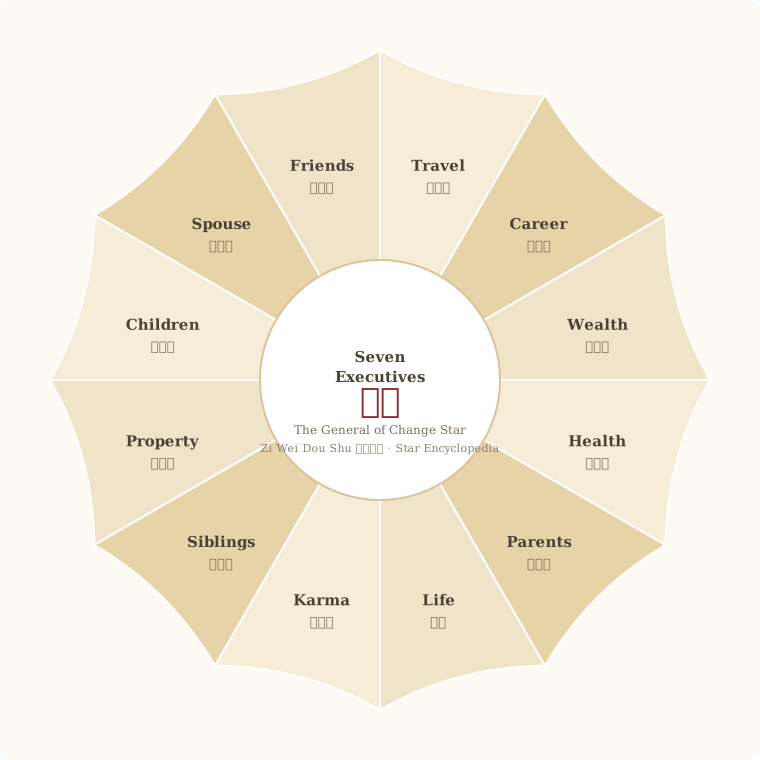
Seven Executives in the Twelve Palaces
| Palace | Meaning |
|---|---|
| Life | A fierce, decisive presence that others instinctively respect and keep at a distance: eyes that do not blink, a temper that flashes and clears. Independence is the identity; solitude is the price. |
| Siblings | Sibling bonds are thin: the texts say brothers and sisters scatter, each going their own way. Fewer siblings, more distance; the General is not built for sibling politics. Rivalry is more common than alliance. |
| Spouse | A marriage of strong wills: the partner is capable, proud, fights back. The texts warn of distance and fluctuation, and recommend late marriage, when the General has learned to compromise. |
| Children | Active, headstrong children who inherit the parent's fire. In strong positions three children are counted; the texts also warn to take special care through pregnancy and early childhood. Early independence training pays off later. |
| Wealth | Money that arrives in bursts and leaves in bursts: the General earns by bold moves and loses by bold moves. The classical remedy is industry over speculation — build real businesses, not leveraged bets. |
| Health | A strong body with a risk profile: accidents, cuts, and surgery are the traditional warnings, focused on the lungs and large intestine (Yin Metal). Discipline and safety habits matter more than for most stars. |
| Travel | A natural exile: the General works best far from home, and the texts repeatedly say to leave the birthplace and build from nothing. Foreign lands and frontier posts suit it best. The frontier suits a fighter. |
| Friends | Few friends, deep loyalty: the General's circle is small, intense, tested by fire. The tradition warns of attracting rivals and of betrayals that sting hardest because loyalty was total. The circle is tested, not crowded. |
| Career | The General's home palace: military, police, law enforcement, engineering, surgery, entrepreneurship — any role that rewards decisive risk. The texts say Qi Sha in the Career Palace turns calamity into fortune. |
| Property | Property bought and sold in cycles of change — several homes, renovations, career-driven moves. Land is self-made rather than inherited; the house often has sharp angles or a martial character. |
| Fortune | A tense, restless inner life beneath the calm exterior: the tradition describes inner fragility behind outer hardness, with philosophy, faith, or martial discipline as the classical stabilizers. Exercise and structure calm the inner fire. |
| Parents | A cool or early-separated bond with the father line; the tradition advises fostering a second parent-figure (拜养父母) to soften the General's orphan-like independence and loneliness. The separation is often geographic rather than emotional. |
Star Brightness Levels
Brightness (庙旺平陷) describes how strongly Seven Executives expresses in each palace position. The table below follows the traditional brightness table of the Zi Wei Dou Shu Quan Shu (紫微斗數全書), as compiled in Zi Wei Dou Shu Jing Cheng (紫微斗数精成). Some schools vary.
| Level | Chinese | English | Palaces |
|---|---|---|---|
| Miao | 庙 | Temple | 丑, 寅, 未, 申 |
| Wang | 旺 | Prosperous | 子, 卯, 午, 酉, 戌 |
| De | 得 | Obtained | 辰 |
| Ping | 平 | Neutral | 巳, 亥 |
The Seven Executives keeps its edge almost everywhere: temple positions in Chou, Yin, Wei, and Shen; thriving in Zi, Mao, Wu, You, and Xu; well-placed in Chen; and balanced, never fallen, in Si and Hai.
Key Star Combinations
- Seven Executives + Purple Star (紫微七杀): The Emperor and the General in one palace — the classical answer to Qi Sha's ferocity: authority disciplines the blade, and the blade enforces the throne. In Si and Hai this is the pattern of the commander under mandate: decisive, principled, capable of leading under fire, with the Purple Star converting the General's killing edge into command (化杀为权). The tradition says only Zi Wei can truly harness Qi Sha; without the Emperor's restraint, the General serves no one and answers to nothing. In career terms the pairing suits executive roles in the military, law enforcement, crisis management, where the Emperor's mandate legitimizes the General's force; it is also praised for founding and turning around organizations, since both stars think in terms of command and consequence.
- Seven Executives + Chaste Purity (廉贞七杀): The Reformer and the General together: passion and force of purpose, refined into ambition. In Chou and Wei this pairing is called the pattern of the valiant camp at dawn (雄宿朝垣) — bold in spirit, extraordinary in courage, capable of sweeping success when auspicious stars support it. The shadow is intensity without outlet: rivalry, legal friction, burnout run high, and the tradition urges structure, physical discipline, and law-abiding careers to channel the fire. Traditional careers: military command, surgery, competitive enterprise. Its discipline is physical — martial arts, sport, heavy training — and its marriage needs an equally strong partner, because a weak one is either dominated or broken.
- Seven Executives + Greedy Wolf + Breaking Army (杀破狼): The three stars of change always stand in a triangle: Qi Sha plans the campaign, Greedy Wolf drives the appetite, Breaking Army charges the breach. The texts say a person activated by this triangle faces decisive life changes at least once — career overhaul, relocation, reinvention — and the system calls it the Bamboo Basket trio (竹萝三限) in passing luck. It is the founder's signature: brilliant for entrepreneurs and reformers, demanding because the General's changes come suddenly and without warning. The changes are not always chosen — they arrive through events: industry shifts, family moves, institutional upheaval — and the General's task is to ride them rather than resist them; those who plan for change survive it better than those who pray for stillness.
- Seven Executives + Martial Music (武曲七杀): Two blades in one sheath: the General beside the star of metal and money. In Mao and You this pairing is called iron-willed and abrupt — decisive in business, finance, or engineering, with a reputation for cutting through problems and a natural talent for managing risk and resources. The classical warning is double-edged: extraordinary force, but friction with people, and a tendency to win battles while losing patience, so deliberate communication is the practical discipline. The tradition adds that the pairing excels at turnaround work — rescuing failing ventures, restructuring, crisis finance — where decisiveness is the whole game; its weakness is the same blade: it can cut people as readily as problems, so communication training is the classical antidote.
- Seven Executives + Heavenly Treasury (七杀朝斗 / 对宫天府): The General facing the Regent across the chart: in Zi, Wu, Yin, and Shen, Qi Sha faces the Heavenly Treasury, and the texts call this 'facing and ascending the Dipper' (朝斗仰斗) — a pattern of rank and honor achieved through patrons and opportunity. The Treasury's stability tempers the General's risk, and the General's drive enlivens the Treasury's caution. With auspicious stars this is the path to high command; without them, the General remains a capable lone wolf. The texts name Zi, Wu, Yin, and Shen as the General's finest seats, and say the Dipper-facing pattern grants its luck through others — patrons, partners, public opportunity — so networking and deference to capable allies are the practical keys.
Seven Executives and the Four Transformations
The Seven Executives has no natal transformation in any stem: it never turns to Prosperity, Authority, Recognition, or Obstruction. Classical writers treat this as fitting — the General carries its own mandate and does not need the four transformations to act. Instead, Qi Sha is tempered externally: by the Purple Star's Authority, by auspicious supporting stars such as Left and Right Assistant, and by the discipline of its own placement. Practically, this means Qi Sha charts are read through the surrounding stars and the annual stems' transformations of other stars, rather than through the General's own changes.
Classical Source
七杀属庚金,属阳,又属火,意为火化之金,南斗第六星。为斗中之上将,实为孤克刑杀之宿,主成败,司生死权柄。与紫微同度或对照则化为威权。
Qi Sha belongs to Yang Metal fired by Fire, the sixth star of the Southern Dipper. It is the supreme general of the Dipper, in essence a solitary and punishing star: it governs success and failure and holds the authority of life and death. Sharing a palace with the Purple Star, or facing it, converts its ferocity into commanding power.
Common Questions
Is the Seven Executives a "bad" star?
It is intense, not evil. The texts call Qi Sha a star of extremes: its destruction is constructive, its risk is the price of its rewards, its success is always earned through hardship. With the Purple Star or auspicious support it becomes command and achievement; pressured by malefic stars it becomes conflict and ruin. The verdict: Qi Sha is the most demanding of the major stars — but also one of the most capable, and never a star of mediocrity. The practical difference is structure: Qi Sha with discipline, law, and real stakes becomes leadership; Qi Sha without them becomes conflict. That is why the texts spend so much space on careers and conduct — the star is a force, and the owner decides its direction.
Why is Qi Sha considered good in the Career Palace?
Because the General belongs on the battlefield: the Career Palace is where its decisiveness, risk tolerance, and execution power are legitimate. The texts say Qi Sha in the career palace turns calamity into fortune (化祸为祥), and list military, police, surgery, engineering, entrepreneurship as its natural fields — roles where bold decisions are the job itself. The same star that disturbs the home palaces becomes an asset where courage is hired. That is also why Qi Sha people often change careers dramatically: the Career Palace is where their appetite for decisive change is legitimate — and a General who fights the battlefield is a General who fights at home, so choosing the right arena is itself the remedy.
What is the 杀破狼 (Sha-Po-Lang) triangle?
The three stars of change — Qi Sha (the General), Tan Lang (the Wolf), and Po Jun (the Breaker) — always form a triangle in the chart. Together they govern transformation: the General plans it, the Wolf drives it, the Breaker executes it. A chart strongly activated by this triangle signals a life of major changes and reinventions — change is the job description. The tradition also notes that the triangle's luck comes in waves: periods of calm are the General's peace between campaigns, and periods of motion are its true element; knowing which phase is active helps its owners time their major decisions instead of being caught by them.
Is it true that "Qi Sha in the body palace means early death"?
That is an old verse (七杀守身终是夭) written in a harsher era, and modern classical commentators treat it as a structural warning rather than a literal sentence. What the tradition still teaches is real: Qi Sha brings risk, upheaval, and a need for discipline — accidents and conflicts are the dangers, not fate. The classical remedy is conduct: lawful work, safety habits, channeling the blade into craft, which the tradition explicitly recommends as the way to soften the General's hardest edges. Modern readers translate the verse into a risk-management warning: Qi Sha people must budget for accidents, legal exposure, and sudden reversals — insurance, safety habits, honest dealings are the contemporary forms of the remedy, and the tradition is clear that conduct, not fate, is the variable that can be changed.
Related Stars
Explore how Seven Executives works with other stars: