
How to Read a Zi Wei Dou Shu Chart: A 5-Step Guide
A Zi Wei Dou Shu chart can look like a crowded square of Chinese characters, palace names, stars, and numbers. The way through it is not to interpret every symbol at once. Read the chart in layers, and in a fixed order.
Key Takeaways
- Verify the chart first: Birth time and location can change the Life Palace and the placement of every other palace.
- Start with the Life Palace: It anchors the chart's temperament, but it never stands alone.
- Read stars in context: A star's palace, brightness, companions, and Four Transformations all change how it expresses.
- Connect the palace network: Use San Fang Si Zheng — the focal palace, its two trine palaces, and its opposite — before drawing a conclusion.
- Add timing last: Decade and annual charts describe changing conditions, not fixed promises.
This guide gives you a practical first reading. It does not turn one star or one palace into a verdict. Zi Wei Dou Shu works as a system: the chart becomes useful when the parts are read together.
1. Verify the Birth Time and Chart Foundation
Before interpreting anything, check the data used to generate the chart:
- birth date;
- exact birth time;
- birthplace and timezone;
- whether the calculator applies the intended calendar and true solar time rules.
Birth time matters because the lunar month and birth hour help determine the Life Palace. When the Life Palace moves, the other eleven palaces move with it. A small uncertainty near an hour boundary can therefore produce a different chart structure.
If the birth time is approximate, generate the plausible neighboring charts and compare them. Treat any conclusion that changes between those charts as uncertain. Rectification is a separate, advanced process; do not force a precise reading from imprecise input.
Generate your Zi Wei Dou Shu chart before moving to the next step.
2. Find the Life Palace and Body Palace
The Life Palace (命宮) is the starting point. It describes your baseline temperament, the way you meet the world, and the recurring style through which you approach life.
The Body Palace (身宮) adds a second emphasis. It is often read as the area where your energy becomes more visible through action and lived experience. Depending on the chart, it may share a position with Life, Career, Wealth, Travel, Spouse, or Karma.
Read these two questions first:
- Which stars occupy the Life Palace?
- Where is the Body Palace, and what life area does it emphasize?
Do not conclude that the Life Palace is your whole personality. It is an anchor, not a summary. The opposite palace and the two trine palaces will modify what you see here.
If the palace names are unfamiliar, use the complete guide to the twelve palaces alongside your chart.
3. Read the Main Stars, Brightness, and Companions
Begin with the major stars in the Life Palace. Each major star provides a broad operating style: Zi Wei organizes, Tian Fu stabilizes, Po Jun breaks and rebuilds, and so on. That broad meaning is only the first layer.
For each important star, check four things:
- Palace: The same star behaves differently in Career, Spouse, Wealth, or Life.
- Brightness: Miao, Wang, De, Li, Ping, Bu De Di, and Xian describe how readily the star expresses in that position.
- Companions: Auspicious, adversity, and minor stars support, sharpen, complicate, or redirect the main star.
- Combinations: Some stars are traditionally read as a pair or group rather than as isolated symbols.
Brightness is not a moral score. A fallen star is not automatically bad, and a temple star is not automatically easy. Strong support can make a difficult placement workable; pressure can turn an apparently favorable placement rigid or excessive.
Use the ZWDS Star Encyclopedia to look up each named star, then return to the chart and ask how the stars interact in that specific palace.
4. Connect San Fang Si Zheng and the Four Transformations
Now widen the frame. San Fang Si Zheng (三方四正) reads a focal palace together with its two trine palaces and the palace directly opposite it. This four-palace network is one of the most important safeguards against single-palace interpretation.
For example, a Career Palace reading is incomplete without the palaces connected to it. The focal palace may show ambition, while the opposite palace shows the private cost of that ambition, and the trine palaces show the resources or tensions that sustain it.
Then add the Four Transformations (四化):
- Hua Lu (化祿): where resources, attraction, or ease tend to gather;
- Hua Quan (化權): where authority, pressure, or control intensifies;
- Hua Ke (化科): where recognition, refinement, or mediation appears;
- Hua Ji (化忌): where friction, attachment, or unresolved work concentrates.
The transformations describe movement through the chart. They are not four grades from good to bad. Hua Ji can identify the area requiring the most attention; Hua Lu can still create excess or dependency. Follow where each transformation begins and which palace it activates.
At this stage, write one sentence that includes the whole network. For example: “The Life Palace seeks autonomy, the Career trine rewards change, and Hua Ji in the opposite palace makes partnership the place where that autonomy must be negotiated.” That is more useful than five disconnected star definitions.
5. Add Decade and Annual Timing Last
Only after the natal chart is clear should you add time.
The natal chart is the map. Decade cycles (大限) shift the foreground for roughly ten years, while annual charts add a shorter layer of conditions and activation. They do not replace the natal chart; they show which parts of it are being emphasized now.
Use this order:
- establish the natal palace pattern;
- identify the active decade palace and its transformations;
- add the annual layer for the specific year;
- look for repetition across layers.
A theme repeated in the natal, decade, and annual charts deserves more attention than a symbol appearing in only one layer. Even then, treat it as a condition or decision context — not a guaranteed event.
A Worked Example: From Birth Data to Your First Three Notes
The five steps are easier to trust once you have watched them applied to real numbers. Below is a complete reading of the structure of one chart.
About this example. The birth record is a deliberately synthetic placeholder, chosen only for being easy to type. It is not a customer, not a real person, and not a case study. It exists so you can reproduce every number yourself. A chart is used here only as a reading exercise; nothing in this example is a claim about anyone's life, health, money, or relationships.
Enter exactly these values in the free calculator — the form takes a Gregorian (solar) date, then converts it to the lunar calendar for you:
| Field | Value to enter |
|---|---|
| Birth Year | 1990 |
| Month | January |
| Day | 27 |
| Gender | Male |
| Hour | The 午 option (11:00–13:00) |
That solar date is 庚午 year, 1st lunar month, day 1 — the calculator itself will display it back to you as "GengWu (Metal Horse), 1st Lunar Month, Day 1". Keep that confirmation on screen; the steps below should reproduce it exactly.
Step A — find the month palace. Number the branches from 寅, which is the first lunar month. Count forward to the birth month. Month 1 lands on 寅.
Step B — find the Life Palace. From the month palace, count backwards, starting at 子 = zero. The 午 hour is six positions from 子, so count back six from 寅: 寅 → 丑 → 子 → 亥 → 戌 → 酉 → 申. The Life Palace is 申.
Step C — find the Body Palace. Same starting point, counted forwards: 寅 → 卯 → 辰 → 巳 → 午 → 未 → 申. The Body Palace also lands on 申 — this chart has Life and Body in the same palace, which is a normal configuration, not an error.
Step D — find the bureau. Read the Life Palace's heavenly stem from the year stem, giving the palace ganzhi 甲申. Its nayin element is 水 (water), and water is the two bureau — so this is the Water 2 Bureau. The bureau number sets the first decade cycle: this chart's first decade runs 2–11.
Step E — read the palace network, not one cell. The Life Palace sits in 申. Its San Fang Si Zheng — the two trine palaces plus the opposite palace — are:
| Position | Branch | Palace | Stars present |
|---|---|---|---|
| Trine | 子 | Career | 天機 Tian Ji (Miao — temple) |
| Trine | 辰 | Wealth | 太陰 Tai Yin (Xian — fallen), 文昌 Wen Chang |
| Opposite | 寅 | Travel | no major star |
Two placements follow from these positions. Palaces at 子, 辰 and 申 form one trine group, while 寅, 午 and 戌 form another, so the network above is structural rather than a judgement about what those stars mean.
Note what the network also shows. The Life Palace (甲申) holds two major stars, 天同 and 天梁, while the two palaces that carry no major star at all are 寅 (Travel, which is the opposite palace) and 亥 (Property). That distinction matters, because an empty palace is read through the major stars in its opposite palace — so 寅 is read through the Life Palace. The same rule applies if your own Life Palace turns out to be empty: read it through its opposite palace, then bring in the supporting stars and the full San Fang Si Zheng network. Either way, the network — not one cell — supplies the reading, which is exactly the kind of thing that stays invisible if you stare at a single palace.
Finally, the birth-year Four Transformations for a 庚 (Geng) year are 太陽 → Fortune, 武曲 → Power, 太陰 → Fame, and 天同 → Challenge. Locate each star on your own chart and record which palace it activates. In this example 天同 sits in the Life Palace, so the birth-year Challenge transformation activates in that palace. Which palace it lands in is a locating step, not a claim about what will happen.
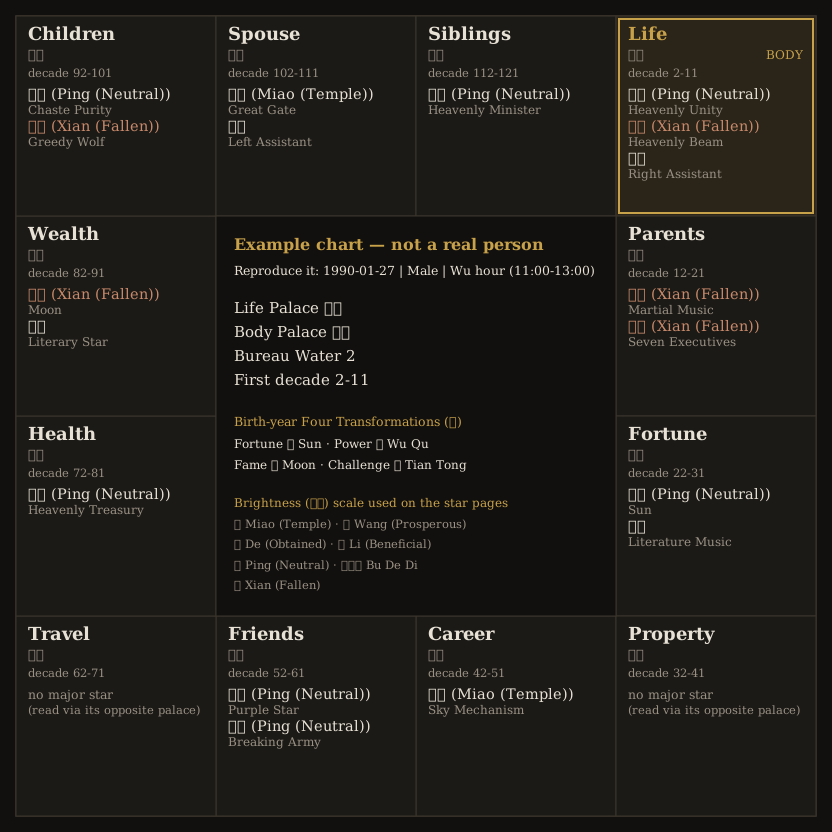
| Palace in the diagram | Branch | Stars (Chinese / English) |
|---|---|---|
| Life & Body | 申 | 天同 Tian Tong (Ping), 天梁 Tian Liang (Xian), 右弼 You Bi |
| Career | 子 | 天機 Tian Ji (Miao) |
| Wealth | 辰 | 太陰 Tai Yin (Xian), 文昌 Wen Chang |
| Travel | 寅 | none — read via its opposite palace, Life |
| Property | 亥 | none — read via its opposite palace, Fortune |
| Spouse | 午 | 巨門 Ju Men (Miao), 左輔 Zuo Fu |
| Friends | 丑 | 紫微 Zi Wei (Ping), 破軍 Po Jun (Ping) |
| Parents | 酉 | 武曲 Wu Qu (Xian), 七殺 Qi Sha (Xian) |
| Fortune | 戌 | 太陽 Tai Yang (Ping), 文曲 Wen Qu |
| Health | 卯 | 天府 Tian Fu (Ping) |
| Children | 巳 | 廉貞 Lian Zhen (Ping), 貪狼 Tan Lang (Xian) |
| Siblings | 未 | 天相 Tian Xiang (Ping) |
Now Do It On Your Chart (a five-minute task)
Open the free Zi Wei Dou Shu calculator and enter your own birth data. Then answer only these questions, in writing:
- Which branch holds your Life Palace? Which palace is marked as your Body Palace?
- Which bureau does your chart use, and what ages does your first decade cycle cover?
- Name the major stars in your Life Palace — or state that it has none.
- Name the three palaces in your Life Palace's San Fang Si Zheng.
- For your birth year, which star carries Hua Lu and which carries Hua Ji — and which palace does each sit in?
Answering these five takes a few minutes and involves no interpretation. When you can do it without looking anything up, you have read the chart's structure, which is the part everything later depends on. For each named star you meet, look it up in the ZWDS Star Encyclopedia — for instance 天同, Heavenly Unity — and then return to your chart to ask how that star behaves in that palace, not in general.
A Simple First-Reading Worksheet
When you open your chart, write down only these six items:
- Life Palace location and its major stars;
- Body Palace location;
- brightness and supporting stars in the Life Palace;
- the Life Palace's two trine palaces and opposite palace;
- natal Hua Lu, Hua Quan, Hua Ke, and Hua Ji;
- the active decade palace.
Then describe the pattern in plain language. Avoid predictions. Look for tensions, resources, repeated themes, and the life areas asking for deliberate choices.
Common Mistakes to Avoid
Reading one star as a personality test. A star page explains vocabulary. Your chart supplies the grammar: palace, brightness, companions, transformations, and timing.
Treating Miao as good and Xian as bad. Brightness describes expressive strength, not moral value or guaranteed outcomes.
Jumping to the annual chart. Timing without a natal foundation produces dramatic but unstable interpretations.
Ignoring contradictory evidence. If the Life Palace and its opposite pull in different directions, keep both. The tension is often the reading.
Using the chart as a verdict. Zi Wei Dou Shu maps tendencies and conditions. It cannot replace judgment, medical advice, financial advice, or the choices that shape a life.
Common Questions
Which palace should I read first? Start with the Life Palace, then read its two trine palaces and opposite palace as one network. Move to Career, Wealth, Spouse, or another palace only when your question requires it.
What if my Life Palace has no major star? An “empty” Life Palace is not empty of meaning. Read the major stars in its opposite palace, then include the supporting stars and the full San Fang Si Zheng network.
Can I read a chart without an exact birth time? You can compare a small set of plausible charts, but you should label the result uncertain. Because the hour can move the Life Palace and alter the palace structure, a confident reading requires reliable birth data.
Does one difficult star mean something bad will happen? No. Stars describe tendencies and modes of expression. Palace context, combinations, brightness, transformations, timing, and personal choices all matter.
What should I learn after these five steps? Study the fourteen major stars, palace pairs, San Fang Si Zheng, natal Four Transformations, and then decade transformations. That sequence builds interpretation without losing the chart as a whole.
Sources and Further Reading
- Zi Wei Dou Shu Quan Shu (紫微斗數全書) — the foundational reference for the star, palace, and brightness framework.
- The rules used in the worked example: 寅 begins the first month, count forward to the birth month, then count hours backwards for the Life Palace and forwards for the Body Palace; the Five-Element Bureau comes from the nayin element of the Life Palace's ganzhi; the trine groups are stated as 申子辰, 亥卯未, 寅午戌 and 巳酉丑; the bureau sequence is 水二、木三、金四、土五、火六, and the bureau number sets the decade start age.
- The birth-year Four Transformations for 庚 are 太陽化祿、武曲化權、太陰化科、天同化忌. Schools differ on some stems, so published tables are worth comparing before relying on the transformation layer.
- What Is Zi Wei Dou Shu?
- The 12 Palaces of Zi Wei Dou Shu
- The complete ZWDS Star Encyclopedia
- ZWDS vs BaZi: Which System Answers Which Question?
Discussion