Core Attributes
| Chinese | 天府 |
|---|---|
| Pinyin | Tian Fu |
| English | Heavenly Treasury |
| Archetype | The Regent |
| Element | Yang Earth |
| Category | Major |
Personality & Temperament
The Regent is the South Dipper's sovereign star, but where the Emperor (Zi Wei) commands, Tian Fu administers. People with this star prominent are steady, trustworthy, conservative — natural managers of money, property, teams, institutions. They keep their word, keep their accounts, keep their homes in order. The texts say it plainly: 'Tian Fu is the treasury of fortune; whoever meets it is always rich.' The gift is security: it protects, preserves, and compounds whatever it is given, and it can tame difficult energies by management rather than force — the tradition says it fears little except emptiness and leakage.
The shadow is over-conservatism. The Regent can become a hoarder: stingy with money and praise, rigid in habits, defensive about status, slow to change. And its interior is less calm than it looks — the Fortune Palace of every Tian Fu chart holds Greedy Wolf (Tan Lang), the star of appetite — so beneath the dignified surface run strong desires, carefully hidden. The classical vocabulary is precise about the shadow states: a treasury without Prosperity is hollow (虚库), a treasury with Emptiness stars drains (空库), and a treasury with afflictions leaks (露库) — money and trust slip away through disputes.
In a chart, the Heavenly Treasury is a stabilizer: whatever palace it occupies becomes a place of storage, protection, and hidden depth. The tradition reads Tian Fu as 'hidden but not exposed' (藏而不露) — a Tian Fu Career Palace may hide a side business; a Tian Fu Life Palace hides a more restless inner self. It is the star that makes institutions last and families keep their inheritance.
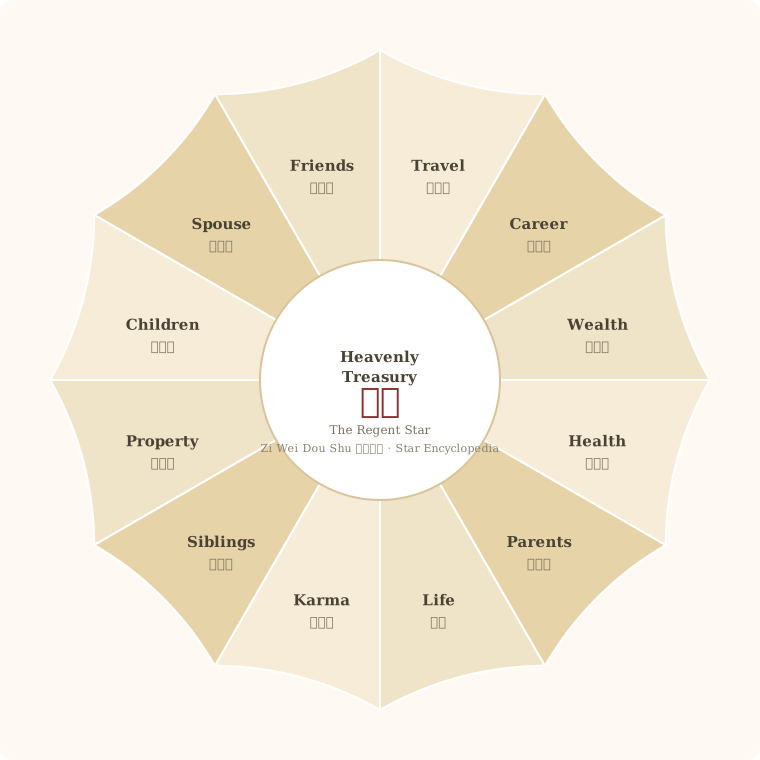
Heavenly Treasury in the Twelve Palaces
| Palace | Meaning |
|---|---|
| Life | Dignified, steady, conservative: trusted early, good with money and systems, proud and private. A calm surface hides real ambition and appetite. People naturally hand this person the keys. |
| Siblings | Few but reliable siblings; the relationship is formal and supportive rather than intimate. Occasional parental favoritism causes quiet friction, but long-term loyalty wins. |
| Spouse | A strong, stable partner, often someone familiar — a classmate, colleague, or family friend. Mutual respect and shared goals anchor the marriage; disagreements are managed, rarely fatal. Late marriage improves harmony. |
| Children | Capable, steady children with natural authority. They respond well to structure and high expectations. They may move slowly, but they move reliably; with auspicious stars they become leaders. |
| Wealth | The Treasury's home ground: savings, property, steady accumulation. This star keeps money better than it makes it; with Lu Cun or Prosperity it becomes real wealth. Without them, frugality can read as stinginess. Speculation is its weakness. |
| Health | Generally robust, with a reputation for recovering well. Ailments cluster around digestion and stomach in the classical mapping. Stress shows as digestive tension; moderation and routine keep the system fine. |
| Travel | Travels well and benefits from elders and superiors abroad. Moves are gradual and well planned; property and status improve with movement when the treasury is full. An empty treasury brings modest results away from home. |
| Friends | A cautious circle: few friends, loyal ones, mostly managers and owners. Support is practical rather than emotional. The Regent attracts respect — and should watch for flatterers drawn to its status. |
| Career | Best in established institutions: government, finance, administration, real estate. Excels as a deputy, department head, or CFO — the person who makes institutions run. Steady promotion; risky startups are not its natural habitat. |
| Property | The natural palace for property: real estate accumulates, inheritance arrives, the home is spacious and orderly. With Lu Cun, property becomes serious wealth; an empty treasury brings disputes or loss. |
| Fortune | Contented and optimistic: enjoys food, comfort, aesthetics, good company. Self-regard is high and inner desires are strong but managed. The danger is complacency — comfort that stops growth. |
| Parents | A warm upbringing with generous, stable parents. Values and property pass down intact; the bond is formal but affectionate. With afflictions, the texts note, inheritance comes with strings attached. |
Star Brightness Levels
Brightness (庙旺平陷) describes how strongly Heavenly Treasury expresses in each palace position. The table below follows the traditional brightness table of the Zi Wei Dou Shu Quan Shu (紫微斗數全書), as compiled in Zi Wei Dou Shu Jing Cheng (紫微斗数精成). Some schools vary.
| Level | Chinese | English | Palaces |
|---|---|---|---|
| Miao | 庙 | Temple | 子, 丑, 寅, 未 |
| Wang | 旺 | Prosperous | 辰, 午, 酉, 戌 |
| De | 得 | Obtained | 卯, 巳, 申, 亥 |
The Heavenly Treasury never falls in the traditional table — it keeps its dignity in all twelve palaces. Its strongest positions are the temple palaces (Zi, Chou, Yin, Wei) and Flourishing positions (Chen, Wu, You, Xu); in the De positions (Mao, Si, Shen, Hai) the treasury is safe but less active.
Key Star Combinations
- Heavenly Treasury + Heavenly Minister (府相朝垣): The most famous Treasury pattern: the Regent and the Minister (Tian Xiang) meeting around the Life Palace. The verse promises that 'when Treasury and Minister come to greet the Life Palace, the whole family is fed by office' — stable employment, institutional standing, a respected public life. The Treasury supplies resources and steadiness; the Minister supplies procedure and reputation. Together they form the classic civil-service or corporate-executive structure of the system. Sha stars pressing on the Minister side can spoil it, but with Lu Cun or auspicious stars the pattern holds.
- Purple Star + Heavenly Treasury (紫微天府): The Emperor and the Regent together in Yin or Shen: two sovereign stars in one palace — authority plus administration. The tradition treats this as a top-tier leadership structure: the person is expected to hold real power and run things well. The shadow is a tug-of-war: the Emperor wants expansion, the Treasury wants safety, and the native can turn proud, indecisive, or over-cautious at the worst moments. With Lu Cun or a Prosperity transformation the pair 'turns into wealth' (化气为财), converting status into fortune; without it, the tradition speaks of the 'solitary' sovereign — respected but alone.
- Martial Music + Heavenly Treasury (武曲天府): The wealth star and the Treasury together in Zi or Wu: precise money management with an execution engine. This is the finance, banking, and engineering combination — decisive in action, meticulous in accounting. The texts praise it for longevity and for fortunes built from discipline. The shadow is stubbornness: Martial Music is rigid and the Treasury is conservative, so the pair can refuse to adapt until the market forces it. With the literary stars or Lu Cun, a top-tier wealth pattern; with afflictions, gains arrive and then leak through disputes.
- Chaste Purity + Heavenly Treasury (廉贞天府): The Reformer's fire stored inside the Treasury's vaults in Chen and Xu — the classical 'Lian Fu seated on the treasury' (廉府坐库). The verse 'when Heavenly Treasury faces Xu with stars to lean on, one wears gold and purple' promises high office and wealth with support: the pairing suits finance, banking, and institutional leadership where ambition is spent inside guardrails. Without auspicious stars, the tradition calls it an 'empty treasury': hidden anxiety, over-caution, missed chances, a frugality that never quite becomes wealth.
- Heavenly Treasury + Sun and Moon (日月夹命): The classical 'Sun and Moon flanking the Life' (日月夹命) pattern: when the two luminaries bracket the Treasury's Life Palace in Chou or Wei, the chart carries parental blessing and inherited advantage. The tradition describes a person raised with support who rises steadily through competence and connections, wealth accumulating through property and office. Both luminaries bright: the blessing is full. Fallen: the advantage is diluted and the person must build from harder ground — though the Treasury's own stability still holds.
Heavenly Treasury and the Four Transformations
The Heavenly Treasury does not participate in the annual Four Transformations in any heavenly stem. It never turns to Prosperity, Authority, Recognition, or Obstruction — its quality depends entirely on position, surrounding stars, and whether the treasury it guards is full, hollow, empty, or leaking.
Classical Source
天府属戊土,象阳,南斗主第一星,在斗司权、号令之星,为帝座之佐,掌管延寿、解厄和权力,在数职掌田宅、财帛、衣禄,为田宅主,又名禄库。秘经曰:天府是禄库,命逢总是富。
Tian Fu belongs to Yang Earth, the chief star of the South Dipper. It governs authority and command, serving as the aide of the Imperial Throne, managing longevity, deliverance from calamity, and power. In the numbers it rules property, wealth, and livelihood — master of the home, also named the Treasury of Prosperity. The secret classic says: Tian Fu is the treasury of good fortune; whoever meets it is always wealthy.
Common Questions
Is the Heavenly Treasury a wealth star?
Yes — but as a keeper, not a maker. It stores, manages, and protects wealth; it does not generate it by itself. Real accumulation needs Lu Cun or a Prosperity transformation to fill the treasury. Without them the texts describe hollow and empty states: careful habits, modest results, a frugality that protects but never multiplies. Read the star by asking which state the treasury is in — full, hollow, empty, or leaking — before judging wealth.
What do 'full, hollow, empty, and leaking treasury' mean?
These are the four classical states of Tian Fu. Full (实库): Lu Cun or hua lu with auspicious stars — genuine wealth and stability. Hollow (虚库): no Prosperity — the appearance of wealth without the substance. Empty (空库): Emptiness stars (Di Kong, Di Jie) drain the treasury — money and momentum leak away. Leaking (露库): afflictions or Emptiness with Prosperity — wealth exposed, disputes eroding it. The same star, four very different readings; this is why Tian Fu is judged by its company. In practice, readers locate the Treasury first, then ask what fills it — a habit that resolves most disagreements about Tian Fu charts.
Why is Tian Fu called a Regent and not an Emperor?
In the traditional hierarchy the North Dipper's Purple Star is the sovereign; Tian Fu, chief of the South Dipper, holds delegated power. The texts are explicit: the Regent bows to the Emperor. Modern analogy: the CEO versus the COO — the Emperor sets direction, the Treasury runs the machine. That is why Tian Fu charts often produce chief financial officers, administrators, and second-in-commands who make institutions work, rather than founders who break new ground.
Is it true that Heavenly Treasury never transforms?
Correct: in the traditional Four Transformations system, no heavenly stem activates Tian Fu. It neither receives Prosperity, Authority, Recognition, nor Obstruction. The practical consequence is stability — the star's behavior changes less from year to year than transforming stars do. Its ups and downs come instead from brightness, the stars around it, and the life periods. This predictability makes Tian Fu a favorite anchor: when it guards a palace, that palace's baseline can be read with unusual confidence, and yearly variation is attributed to the transforming stars around it.
Can afflictions harm the Treasury?
Less than they harm most stars — the tradition says Tian Fu can tame the four sha stars by management: it 'turns Bell Star into fortune' and 'makes Yang Blade and Luo the servants'. What it truly fears is Emptiness and leakage: Di Kong and Di Jie empty the vault, and afflictions with a hollow treasury produce disputes, hidden schemes, money that arrives and then leaves. Lu Cun is the classical cure — a full treasury resists most harm.
Related Stars
Explore how Heavenly Treasury works with other stars: