Core Attributes
| Chinese | 紫微 |
|---|---|
| Pinyin | Zi Wei |
| English | Purple Star |
| Archetype | The Emperor |
| Element | Yin Earth |
| Category | Major |
Personality & Temperament
People with the Purple Star in the Life Palace tend to have presence. It is not something they cultivate; it is the default. Others take them seriously without being asked. The classical texts back that up — the tradition calls Zi Wei the imperial throne (帝座), the most honored star of both dippers, governing rank, reputation, and official standing. In modern terms: the born executive, the natural chair of the room, the person who quietly refuses to be organized by anyone else.
The gift is standards. Zi Wei people know how things should be done, and they hold themselves to that bar first — everyone else is just expected to keep up. When the chart supports it, this turns into real leadership: carrying responsibility without flinching, making decisions others can rely on. The old texts have a nice way of putting it: an emperor is only powerful when there are ministers to execute. Authority alone is not leadership.
Here is where it gets human. Authority without flexibility reads as arrogance, and a Purple Star in a weak position can become a ruler with no kingdom — all dignity, no traction. Zi Wei people can be proud, stubborn, slow to delegate. Not because they are power-hungry. Because deep down, they are not convinced anyone else will do it properly. They expect loyalty and take its absence hard. The tradition also stresses that this is a solitary star. It stands above, and no one stands at eye level with it — that solitude is the quiet cost of the throne.
Because the Purple Star anchors every chart it appears in, it does not need the Life Palace to shape a reading. Whatever palace it occupies becomes the structural center, and the stars gathered around it (or not) decide how its authority expresses. That is why the combinations below matter more than the star's presence alone.
In relationships, Zi Wei people love the way they work: loyal, protective, and deadly serious about commitment. They are not casual partners. Courtship, like everything else, gets measured against standards. The catch is that their authority does not switch off at home — an emperor can forget that a marriage is a partnership, not a court. Classical texts keep pointing at the same remedy: Zi Wei needs softness around it. Moon, Heavenly Unity, or the peach blossom stars in the spouse palace soften the throne without weakening it. With that in place, Zi Wei is one of the most dependable partners in the system — someone who carries the family's standing, defends its interests, and does not walk away from a promise.
When Leadership Turns Into Over-Control
Am I leading, or taking everything on because I will not delegate?
Zi Wei vs. Tian Fu: Setting Standards or Guarding Resources?
Zi Wei leads by defining legitimacy, standards, and direction: it asks what the whole room should answer to. Tian Fu leads through stewardship, preserving resources and making an institution dependable. When Zi Wei takes on every task, authority has slipped into control; the throne needs ministers, while the treasury needs sound administration. Compare Tian Fu (Heavenly Treasury)
Questions to Check in Your Chart
- Separate the standard only you can set from the work another person can own.
- Ask whether people can disagree with you safely and still remain trusted.
- Choose one responsibility to delegate with a clear outcome, authority, and review point.
This reflection develops Zi Wei's classical image as the Imperial Throne and the text's repeated warning that an emperor without assistants keeps dignity but loses traction. Palace and supporting stars show whether authority has a functioning court.
Purple Star in the Twelve Palaces
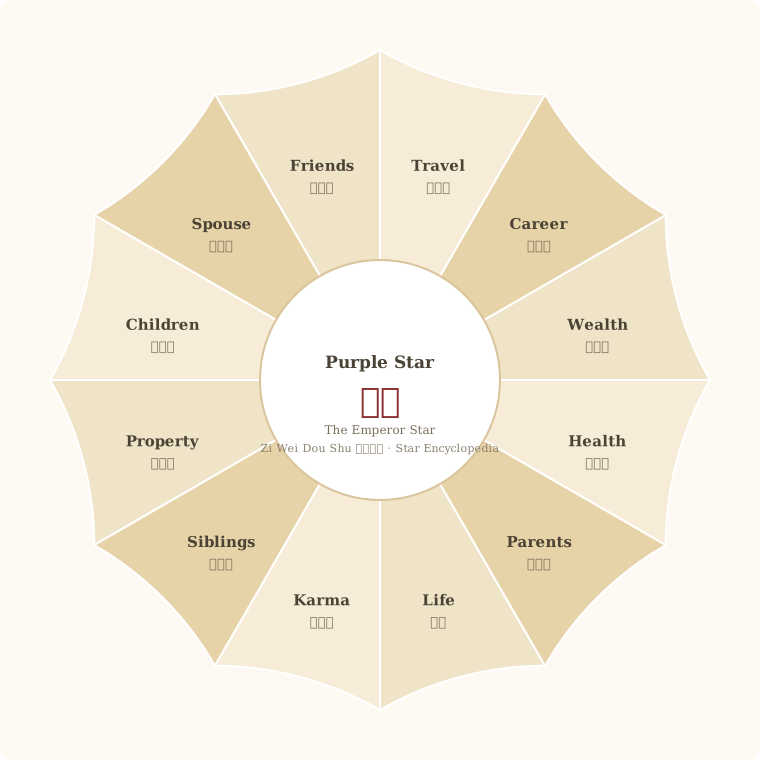
| Palace | Meaning |
|---|---|
| Life | A commanding presence — dignity, pride, and an expectation of being taken seriously. Self-image is strong, leadership instinct natural. The loneliness of the top is real here: respected more often than known. |
| Siblings | Older-sibling energy. Family looks to this person as the anchor, the arbiter. Sibling bonds tend to run formal — respect, yes; easy intimacy, not always. |
| Spouse | A strong, respectable partner; the relationship carries status and structure. Both sides hold the other to standards, which keeps the bond formal. Loyalty runs deep; affection shows up as duty. |
| Children | Capable, ambitious kids raised with high expectations and clear structure. Warm but disciplined — these children often achieve publicly and carry the family name forward. |
| Wealth | Money handled with dignity: steady accumulation through position, reputation, consistency — not speculation. Status protects income; guard the reputation and the money follows. Flashy risk gets a hard pass. |
| Health | Usually a strong constitution. Stress collects around pride and responsibility — neck, back, and the habit of carrying everything alone. Rest matters more than Zi Wei people admit. |
| Travel | Moves with presence and gets recognized abroad. Travel often carries authority — inspections, management, public roles. Dignity travels well; command translates across settings. |
| Friends | A selective circle. Friends respect this person more than they casually befriend them, and support tends to come from people with influence. Few close allies, but powerful ones — the emperor chooses advisors carefully. |
| Career | The best palace for the Purple Star: executive authority, government, management — any role where rank and responsibility are visible. Promotion follows competence and standards. |
| Property | Homes and assets that project status; property stays orderly and becomes a base of authority. Inherited standing often plays a role. The home is a statement as much as a shelter. |
| Fortune | A proud inner life with high moral standards; luck runs through duty and self-respect. Outward confidence can conceal inner loneliness — the emperor trusts few and feels the distance. |
| Parents | A respected family line. Parents are principled and set high expectations; the relationship is formal and admiring rather than openly affectionate. Approval is earned through achievement. |
Star Brightness Levels
Brightness (庙旺平陷) describes how strongly Purple Star expresses in each palace position. The table below follows the traditional brightness table of the Zi Wei Dou Shu Quan Shu (紫微斗數全書), as compiled in Zi Wei Dou Shu Jing Cheng (紫微斗数精成). Some schools vary.
| Level | Chinese | English | Palaces |
|---|---|---|---|
| Miao | 庙 | Temple | 丑, 寅, 午, 未 |
| Wang | 旺 | Prosperous | 卯, 巳, 申, 酉, 亥 |
| De | 得 | Obtained | 辰 |
| Li | 利 | Beneficial | 戌 |
| Ping | 平 | Neutral | 子 |
The Purple Star has no fully fallen position in the traditional brightness table — it keeps its dignity everywhere. But its power to command varies sharply: temple positions maximize authority, while neutral positions need supporting stars to give the throne traction.
Key Star Combinations
- Zi Wei + Heavenly Minister (紫微天相): Authority with someone to execute it — the tradition's most reliable Zi Wei combination. The Minister handles the paperwork of power, so decisions actually land: made, carried out, accounted for. Chairs, boards, people trusted with real responsibility.
- Zi Wei + Breaking Army (紫微破军): Authority used for upheaval. Founders, reformers, people who dismantle old structures to build new ones carry this. The throne is never quiet here — change is the price of power. Works best when the chaos points outward at institutions, not inward at the self.
- Zi Wei + Greedy Wolf (紫微贪狼): The Emperor who wants: ambition, charisma, appetite. High-achieving and pleasure-aware — builds empires and enjoys them. Greedy Wolf supplies the social reach and desire; the Purple Star adds the discipline of rank. Strong support makes it thrive; without support, ambition can outrun ethics.
- Zi Wei + Seven Executives (紫微七杀): The Emperor with the general: authority with an edge. Decisive, demanding, excellent under pressure, where hesitation costs everything. The shadow is rigidity — this combination can overrun people. Auspicious stars that soften the blade help a lot.
- Zi Wei + Left/Right Assistant (紫微左辅右弼): The classical remedy for Zi Wei's solitude. With ministers in support, authority becomes leadership instead of isolation: decisions get executed, allies appear, the throne stops being lonely. The most auspicious addition to any Zi Wei chart.
Purple Star and the Four Transformations
The Purple Star transforms only in specific stems: it turns to Authority in Ren (壬) years and to Recognition in Yi (乙) years. It never turns to Prosperity or Obstruction — the Emperor does not chase money, and is never truly blocked.
Hua Quan (化權 — Transformation to Authority)
Zi Wei Hua Quan (化权) is authority made visible: command, executive power, and the ability to make decisions stick. In a Ren year the Purple Star's leadership is activated — promotion, public responsibility, and a demand for recognition are all intensified. This is the transformation of taking charge: chairs, mandates, and the moment when someone steps forward and the room falls quiet.
Hua Ke (化科 — Transformation to Recognition)
Zi Wei Hua Ke (化科) is authority made respectable: reputation, titles, and institutional honor. In a Yi year the Purple Star gains recognition without conflict — the Emperor is praised rather than feared. Academic degrees, public honors, and quiet credibility all belong to this transformation; it softens the throne's isolation by making it admired.
Classical Source
紫微星,属己土,象阴,为南北斗中至尊至贵之星,故名帝座,即古时的皇帝星,在现代为国家元首;为官禄主,专司官贵地位,掌造化之机枢,人生之主宰。
Zi Wei belongs to Yin Earth and is the most honored star of the Southern and Northern Dippers, hence named the Imperial Throne — the emperor star of old, the head of state in modern terms. It is the ruler of career and rank, governing official dignity and position, the pivot of creation and the master of life.
Common Questions
Is the Purple Star the most important star in Zi Wei Dou Shu?
Most honored, yes — the Emperor, the structural anchor wherever it appears. But importance depends on position: in the Life Palace it shapes your experience most directly, and it expresses best in its temple positions and in the Career Palace, where authority has a stage.
What does it mean if Zi Wei is in the Life Palace?
Natural authority, high standards, a strong sense of legitimacy — you expect to be taken seriously, and usually are. You are a born organizer with an instinct for rank and responsibility. The harder side: pride and solitude. The emperor gets lonely, and delegation does not come naturally.
Does the Purple Star have a fallen position?
No — in the traditional brightness table it never fully falls; it keeps its dignity in every palace. What changes is its power to command. Temple positions (Zi, Chou, Wu, Wei) maximize authority; neutral positions lean on supporting stars. A supported Zi Wei in a neutral palace often outperforms an unsupported one in a temple.
What weakens the Purple Star?
Lack of support is the classic concern. Zi Wei without its ministers — Left and Right Assistant, Heavenly Minister, Heavenly Treasury — is an emperor with no court: dignity stays, traction goes. Adversity stars and the Obstruction transformation can also stiffen it into arrogance. The combination always matters more than the star alone.
Continue Your Reading
- What Is Zi Wei Dou Shu? A Beginner’s Guide to the Purple Star Chart
See why the Purple Star names the system without assuming that one honored star overrides the rest of the chart. - Zi Wei Dou Shu History: From Chen Tuan to the Modern Star Chart
Trace how the imperial language around Zi Wei entered the tradition and how that language should be read today. - How to Read a Zi Wei Dou Shu Chart: A 5-Step Guide
Check Zi Wei's palace, supporting court, triangle, and timing before turning the Emperor image into a personality verdict.
Related Stars
Explore how Purple Star works with other stars: