Core Attributes
| Chinese | 贪狼 |
|---|---|
| Pinyin | Tan Lang |
| English | Greedy Wolf |
| Archetype | The Wolf |
| Element | Yang Wood |
| Category | Major |
Personality & Temperament
The Wolf is the most talented and the most restless of the major stars: a quick mind, a fast learner, magnetic charm, brilliant social instincts. It is the star of artistry (才艺) — music, performance, negotiation, anything that rewards presence and adaptability. Desire drives everything: the Wolf wants, and because it wants, it acts. In strong positions it is the entrepreneurial star par excellence — charming, resourceful, opportunistic. The texts describe it as the master of 'empty-hand' deals, building fortunes from connections and timing. In good charts it produces founders, performers, diplomats, deal-makers.
The shadow is appetite without discipline. The tradition names the Wolf's four temptations — wine, sex, money, temper (酒色财气) — and warns of gambling, indulgence, infidelity, grandiosity when the star is fallen or afflicted. But the shadow is not inevitable; the tradition treats the Wolf as one of the few stars that can be genuinely 'corrected' (制化). Mars and Bell Star turn its desire into drive and sudden success; Emptiness stars turn it toward philosophy, religion, and art. The Wolf's quality is a function of what surrounds it — no major star is more environment-sensitive.
In a chart, the Wolf is one of the change-engine trio with Seven Executives and Breaking Army (杀破狼), the stars that keep life moving. Whatever palace it occupies becomes a stage of wanting, competing, transforming: careers that change shape, relationships that begin dramatically, fortunes that arrive suddenly. Its reading depends on brightness, the four transformations, and the presence of fire or empty stars — the same palace can read as dazzling talent or as an unmanaged hunger.
When Desire Needs a Direction
Is desire giving me direction — or just another distraction?
Tan Lang vs. Po Jun: Desire or Demolition?
Tan Lang begins with attraction: a person, opportunity, pleasure, audience, or ambition pulls it forward. Po Jun begins when an existing structure can no longer hold and must be broken. Tan Lang's risk is scattering energy across too many appetites; Po Jun's is mistaking destruction for completion. Compare Po Jun (Breaking Army)
Questions to Check in Your Chart
- Name the appetite precisely: recognition, intimacy, money, novelty, mastery, or escape.
- Ask whether the next opportunity serves one chosen direction or merely adds another stage.
- Choose one boundary that turns appetite into craft: a budget, a schedule, a promise, or a finish line.
This reflection follows Tan Lang's classical role as the star of desire and its unusual sensitivity to surrounding stars. Palace, brightness, transformations, and companions determine whether appetite becomes talent, opportunity, or excess.
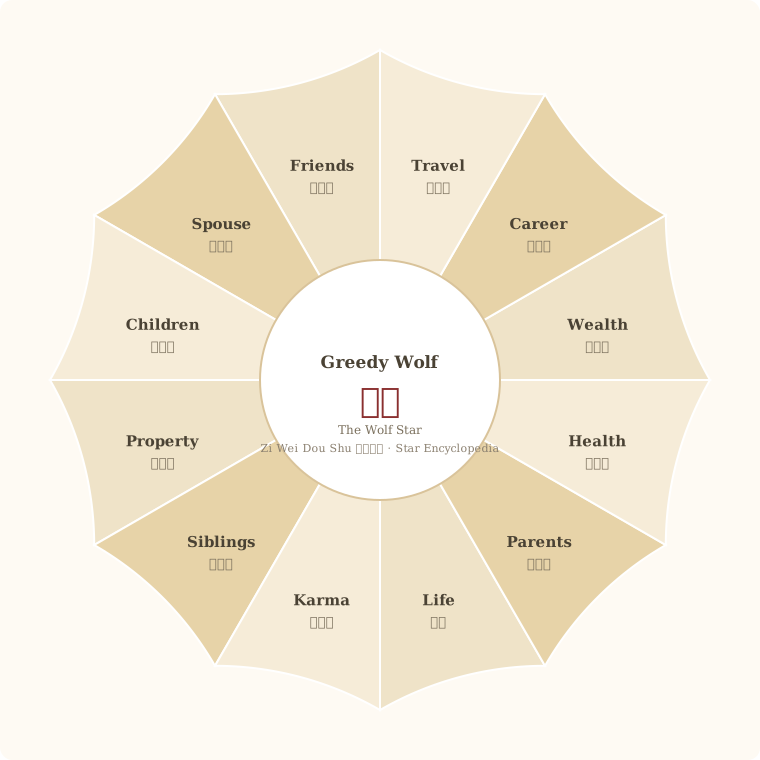
Greedy Wolf in the Twelve Palaces
| Palace | Meaning |
|---|---|
| Life | Magnetic, talented, restless: brilliant first impressions, love of novelty and pleasure, a competitive spirit. Needs a worthy goal; without one, appetite turns inward. Artistic or entrepreneurial leanings are the norm. |
| Siblings | Siblings with strong personalities; rivalry mixed with genuine fun. Better apart than together for long stretches. Conflicts inherited from childhood can resurface, but crises bring real support. |
| Spouse | Romance is sudden, intense, dramatic — the Wolf falls fast and hard. Fidelity requires conscious effort; the texts are frank about multiple relationships. With maturity and a strong bond, the same passion becomes a fierce lifelong partnership. |
| Children | Lively, charming, artistic children with a competitive streak. The parent invests heavily in their talents and delights in their company. Watch overindulgence — the Wolf's children need structure more than they ask for it. |
| Wealth | Money flows in and out with opportunities and schemes: gains from networking, performance, speculation; windfalls and losses in alternating waves. With Mars or Bell Star, explosive wealth; with Obstruction, steady leakage. Discipline is the whole game. |
| Health | Appetite-driven habits are the classical concern: overindulgence in food, drink, pleasure. The weak points are kidneys and the reproductive system in the traditional mapping. Vitality is high when disciplined — the Wolf can burn bright or burn out. |
| Travel | Thrives away from home: adventure, opportunity, luck in new places. Enjoys nightlife and exotic environments; moves often and changes direction with little notice. Travel is where the Wolf's luck usually lives. |
| Friends | A wide, glamorous circle and an excellent networker: friends from every walk of life, useful and entertaining. But fair-weather friendships abound — the Wolf attracts admirers more easily than allies. Loyalty must be tested before it is assumed. |
| Career | Entertainment, marketing, sales, public relations, hospitality, finance, creative industries suit it best. Competitive and opportunistic; rises through charm and connections. Needs structure to avoid chaos; with Mars or Bell Star, sudden fame or fortune. |
| Property | The home reflects taste and indulgence: stylish, lively, sometimes chaotic. Property gains can arrive through connections and sudden opportunities. Speculative real estate is the Wolf's natural game — and its classic trap. |
| Fortune | A rich inner world of desires and fantasies; genuine interest in mysticism, spirituality, the esoteric arts. Inner restlessness is constant. Contentment comes from channeling desire into craft — the Wolf at peace is the Wolf at work. |
| Parents | Warm but permissive parents; a colorful family life. Independence comes early, sometimes with distance from home in youth. Parents are indulgent or distracted, leaving the Wolf to learn appetite management on its own. |
Star Brightness Levels
Brightness (庙旺平陷) describes how strongly Greedy Wolf expresses in each palace position. The table below follows the traditional brightness table of the Zi Wei Dou Shu Quan Shu (紫微斗數全書), as compiled in Zi Wei Dou Shu Jing Cheng (紫微斗数精成). Some schools vary.
| Level | Chinese | English | Palaces |
|---|---|---|---|
| Miao | 庙 | Temple | 丑, 辰, 未 |
| Wang | 旺 | Prosperous | 子, 午 |
| De | 得 | Obtained | 卯 |
| Li | 利 | Beneficial | 酉 |
| Ping | 平 | Neutral | 寅, 申, 戌 |
| Xian | 陷 | Fallen | 巳, 亥 |
The Wolf is strongest in its temple positions, the four tomb palaces (Chou, Chen, Wei), where appetite is contained and productive, and Flourishing at Zi and Wu. In the fallen positions (Si, Hai) its desire is least controlled — classical texts warn of the 'flooded peach blossom' there, calling for strong support or corrective stars.
Key Star Combinations
- Greedy Wolf + Mars (火贪格): The most famous explosive pattern in the system: the Wolf plus Mars in a strong position. The verse — 'the Greedy Wolf with Mars at temple and flourishing, its fame shakes the nations' — describes sudden fame and fortune: a business that explodes, a career that ignites, a reputation that arrives overnight. The tradition recommends it for founders, performers, military careers. The shadow is equally sudden: what explodes upward can collapse downward, so the classical reading insists on restraint at the peak and reserves during the boom.
- Greedy Wolf + Bell Star (铃贪格): The quieter sibling of the Fire-Wolf pattern: sudden wealth through control rather than spectacle. The verse — 'Wolf and Bell standing together, the name of a general and a minister' — describes executives, founders, power-brokers who accumulate quickly and hold what they gain. Less explosive than Mars-Wolf, more sustained. Same volatility warning: the pattern favors those who plan the exit before the entry, because money this fast never warns before it leaves.
- Purple Star + Greedy Wolf (紫微贪狼): The Emperor with the Wolf in Mao or You: authority combined with charm and appetite — a leader who is also a performer. The texts praise the pairing when controlled: high position with charisma, political or cultural leadership of real scale. Without controls — no assistants, no literary stars — the tradition is blunt: 'useless talent', desire scattered across pleasures while status decays. With Wen Chang, Wen Qu, or the Assistants present, the Wolf serves the throne instead of raiding it, producing a powerful public figure.
- Martial Music + Greedy Wolf (武曲贪狼): The wealth pairing in Chou or Wei: the verse promises 'poor first, rich later' (先贫后富) — a fortune built through decisive action, entrepreneurship, patient accumulation after a hard start. The Wolf supplies charm and opportunity; Martial Music supplies discipline and calculation. With Mars or Bell Star the wealth arrives suddenly; with afflictions, money disputes shadow the gains. The tradition treats this as one of the most reliable commercial patterns in the system when supported.
- Chaste Purity + Greedy Wolf (廉贞贪狼): Two peach-blossom stars together in Si or Hai: charm squared, appetite doubled. Chaste Purity adds depth and conscience; the Wolf adds speed and hunger. The result is magnetic, artistic, socially brilliant — natural for entertainment, diplomacy, the arts. The warnings concentrate on Hai, the 'flooded peach blossom' (泛水桃花), where indulgence can overflow into scandal. With Emptiness stars or strong auspicious support, the same pairing produces a disciplined artist rather than a restless hedonist.
Greedy Wolf and the Four Transformations
The Wolf transforms in three heavenly stems: to Prosperity in Wu (戊), to Authority in Ji (己), and to Obstruction in Gui (癸). It never transforms to Recognition — the Wolf is admired rather than honored, winning by presence instead of formal praise.
Hua Lu (化禄 — Transformation to Prosperity)
Tan Lang Hua Lu (化禄) in a Wu year turns desire into resource: social capital, opportunities, and windfalls. The classical reading is wealth through connections and charm — deals, networks, and sudden good fortune, amplified dramatically if Mars or Bell Star is present. The shadow is indulgence inflation: more money feeds more appetite, so the tradition pairs hua lu with a warning about restraint. The Wolf's prosperity is real, but it must be managed like a fire, not a furnace.
Hua Quan (化權 — Transformation to Authority)
Tan Lang Hua Quan (化权) in a Ji year turns desire into power: authority through charm and social control. The native becomes a natural leader of networks, a negotiator who reads the room, a deal-maker whose presence changes outcomes. The classical texts praise it as command plus reputation — the Wolf with authority is the organizer of the pack. The shadow is manipulation: power exercised through charm can become gamesmanship, and the tradition advises honesty as the Wolf's own leash.
Hua Ji (化忌 — Transformation to Obstruction)
Tan Lang Hua Ji (化忌) in a Gui year turns desire into obstruction: appetite turned inward — obsession, addiction risks, relationship drama, and financial leakage. The classical texts soften the blow for the tomb palaces (Chen, Xu), where the Wolf endures hua ji better, and note that the fallen positions concentrate the damage. The constructive reading is preventive: name the appetites, add structure, channel the energy into craft and discipline. Hua ji is the chart's loudest warning that the Wolf's hunger needs a fence.
Classical Source
贪狼外属甲木,但根里属阴水,北斗第一星,化气为桃花,为第一桃花星,为枢扭,主祸福。代表欲望,包括物、色、求知、求生欲,贪狼落宫是欲望之所在。贪狼坐墓守边关,火铃同度震夷邦。
Tan Lang is Yang Wood outside but Yin Water at its root, the first star of the Northern Dipper. It transforms into the Peach Blossom — the first peach-blossom star, the pivot of fortune and misfortune. It represents desire: for things, for love, for knowledge, for survival; the palace where Tan Lang sits is where desire lives. The Wolf seated on the tombs guards the frontier; with Fire and Bell traveling with it, it shakes the foreign nations.
Common Questions
Is the Greedy Wolf a bad star?
No — it is the most double-edged star in the system. The texts say it can make fortune or misfortune (作福作祸), and its quality depends on brightness, support, and control. In temple positions with Mars, Bell Star, or Emptiness stars it becomes drive, talent, entrepreneurship — the star of founders and performers. Fallen and uncontrolled, it becomes indulgence: gambling, scandal, self-destruction. The Wolf is not good or bad; it is hungry, and the chart shows what the hunger is fed.
What is the Fire-Wolf pattern (火贪格)?
The most famous sudden-wealth pattern: Tan Lang together with Mars in a temple position. The verse — 'the Greedy Wolf with Mars at temple and flourishing, its fame shakes the nations' — promises fame and fortune that arrive quickly, ideal for business, entertainment, military careers. The tradition always pairs the promise with a warning: what explodes upward can collapse just as fast, so the pattern demands restraint at the peak and reserves in the boom. Bell Star offers the same fortune with more control.
Why is it called 'Greedy Wolf'?
The name is a frank description: 贪 means greedy and 狼 means wolf. Traditional authors named stars after their most visible behavior, and the Wolf's appetite was the most visible thing about it. The greed is morally neutral in the system's grammar: it is raw desire — the engine that drives ambition, learning, love, creation — and equally the engine of excess. The name is a warning and a compliment at once: the Wolf's hunger can build an empire or burn one down.
Can the Wolf actually be corrected?
Yes — unusually among the major stars, the tradition says the Wolf can be genuinely reformed by the very stars that afflict others. Mars and Bell Star convert appetite into drive and sudden success; Emptiness stars (Di Kong, Di Jie) and Heavenly Punishment (Tian Xing) turn it toward philosophy, religion, art; even the tomb palaces contain it. The one affliction that never helps is Transformation to Obstruction, which concentrates the shadow instead of channeling it.
Why is Tan Lang always changing?
Because it belongs to the change-engine trio with Seven Executives and Breaking Army (杀破狼), the stars that keep a chart in motion. The Wolf's change is personal and social — careers, relationships, environments reshape around it, often dramatically and suddenly. Change is not good or bad in itself; the classical reading asks whether the changes build or destroy. A well-supported Wolf changes upward, reinventing itself at every stage; an uncontrolled one changes sideways, leaving wreckage and starting again.
Continue Your Reading
- What Is Zi Wei Dou Shu? A Beginner’s Guide to the Purple Star Chart
Place Tan Lang's appetite inside the wider star-and-palace system before treating one trait as the whole chart. - The 12 Palaces of Zi Wei Dou Shu: A Complete Guide
Find which life area becomes Tan Lang's stage, because desire in Career is not read like desire in Wealth or Spouse.
Related Stars
Explore how Greedy Wolf works with other stars: