Core Attributes
| Chinese | 天相 |
|---|---|
| Pinyin | Tian Xiang |
| English | Heavenly Minister |
| Archetype | The Minister |
| Element | Yang Water |
| Category | Major |
Personality & Temperament
People with the Heavenly Minister in the Life Palace carry themselves like a trusted deputy: courteous, steady, fair-minded, quietly capable. The texts picture Tian Xiang as the prime minister or the keeper of the imperial seal (掌印官) — the one who makes things official, legal, orderly. In practice this is genuine helpfulness: a strong sense of justice, a protective instinct, the patience to serve without keeping score. Tian Xiang people are well-liked, trusted with responsibility, and often rise through institutions, where loyalty is noticed.
The gift is reliability. It is called the star of clothing, food, and position (衣食之星): in good placement it promises comfort, respect, a stable career path, and its owners make excellent administrators, judges, and public servants. The classical reading also stresses dependence on neighbors: among the fourteen major stars, Tian Xiang is the one most shaped by the palaces that clamp it from both sides. Its two neighbors in the chart are always the Great Gate and the Heavenly Beam — if the Gate brings prosperity, the Minister enjoys the 'Prosperity and Shade clamping the Seal' pattern (财荫夹印); if malefic stars clamp it, the seal is squeezed in the 'Punishment and Obstruction clamping the Seal' pattern (刑忌夹印).
The shadow is the price of service. Because the Minister is shaped by its environment, it can lose itself in it — the tradition says Tian Xiang is good in good environments and compromised in bad ones, and its owners can be gullible and slow to seize opportunity. Small cautions follow: a taste for luxury, and a loyalty that can follow a bad leader too far. The Minister was never designed to be the Emperor; the reading works best when it is honored as the indispensable second-in-command.
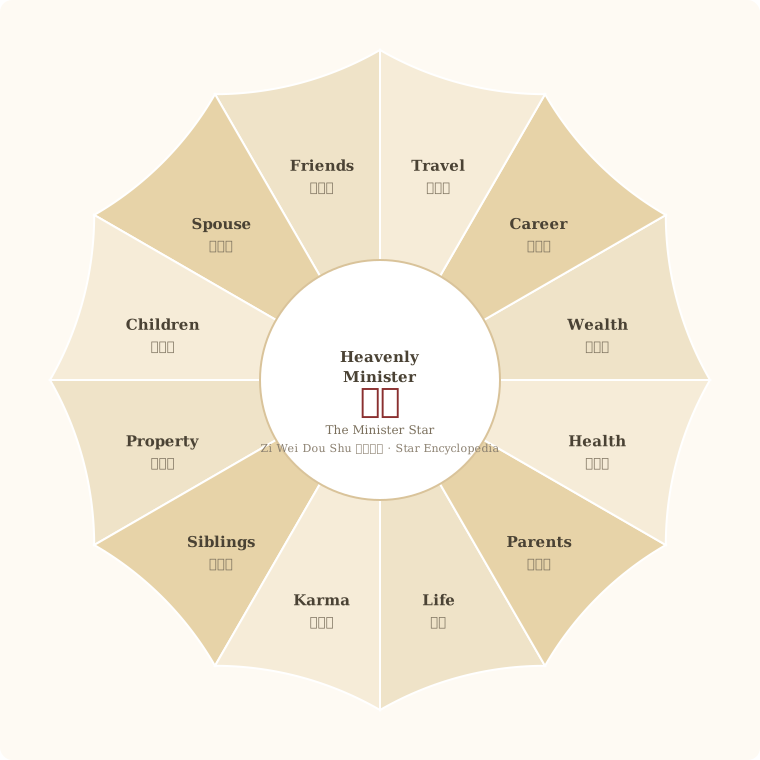
Heavenly Minister in the Twelve Palaces
| Palace | Meaning |
|---|---|
| Life | Courteous, steady, fair-minded. Others instinctively trust this person with responsibilities; the challenge is asserting a will of one's own rather than mirroring the room. Decisiveness improves with practice. |
| Siblings | Close, affectionate sibling bonds; the texts count three to four siblings in strong positions and describe genuine brotherly warmth. In fallen seats the bond thins noticeably. Warmth extends to cousins and in-laws. |
| Spouse | A conscientious, family-oriented partner who speaks carefully and keeps commitments. The marriage has structure and mutual respect; in weak positions, romance cools into comfortable routine. Shared routines and clear roles keep it steady. |
| Children | Honest, good-natured children fond of good food and routine; two or three are counted in strong positions. The parent-child relationship is warm and orderly rather than intense. Mealtimes are the center of family life. |
| Wealth | Steady income from legitimate work, managed conservatively and quietly. The Minister saves — sometimes privately — and dislikes speculation; inherited or family property often appears. Bonuses and titled income are typical. |
| Health | A generally sound constitution with attention to the kidneys and bladder (Yang Water); skin sensitivity appears in weak positions. Illness tends to be minor and slow rather than acute. Regular checkups are the classical recommendation. |
| Travel | Well received wherever this person goes — a natural diplomat abroad, with people gravitating to the Minister's fairness. Relocation is beneficial when the opposite palace carries Prosperity or Authority. Frequent moves suit it more than one long stay. |
| Friends | A wide, sociable circle of like-minded, comfortable friends. Help flows both ways, and the Minister's fairness makes it the natural mediator whenever group conflicts arise. The circle often includes colleagues and neighbors. |
| Career | The Minister's home ground: administration, law, public service, secretarial and executive support roles — any position that holds and applies the seal of the organization. Stability beats risk-taking here. Long tenure in one organization suits it best. |
| Property | Family property or a well-kept home with proper paperwork; the texts warn that malefic stars can bring title, contract, or document troubles, so records deserve extra care. Deeds and leases deserve regular review. |
| Fortune | An appreciation of the good life — fine food, clothing, comfort — paired with a simple, trusting inner world. Happiness comes from security and from being of use to others. |
| Parents | Open-minded parents who act as community peacemakers; in strong positions they are respectable public figures. The relationship is affectionate, supportive, quietly proud. Family gatherings keep the bond alive and warm. |
Star Brightness Levels
Brightness (庙旺平陷) describes how strongly Heavenly Minister expresses in each palace position. The table below follows the traditional brightness table of the Zi Wei Dou Shu Quan Shu (紫微斗數全書), as compiled in Zi Wei Dou Shu Jing Cheng (紫微斗数精成). Some schools vary.
| Level | Chinese | English | Palaces |
|---|---|---|---|
| Miao | 庙 | Temple | 子, 丑, 寅, 申, 戌 |
| De | 得 | Obtained | 巳, 午, 未, 亥 |
| Ping | 平 | Neutral | 辰 |
| Xian | 陷 | Fallen | 卯, 酉 |
The Heavenly Minister is considered auspicious in all twelve palaces, but it is position-sensitive: temple positions in Zi, Chou, Yin, Shen, and Xu; well-placed in Si, Wu, Wei, and Hai; balanced in Chen; and fallen in Mao and You, where its indecisiveness grows.
Key Star Combinations
- Heavenly Minister + Purple Star (紫微天相): The Emperor and the Prime Minister in one palace: the seal of authority backed by the throne. In Chen and Xu this pairing is one of the most respected in the system — dignified, sociable, naturally suited to leadership within institutions, where the Minister's fairness executes the Emperor's mandate. The tradition calls it warm and principled (有情有义), ideal for public office, law, management. The shadow is mutual formality: relationships stay correct rather than intimate, and the pair can feel lonely at the top. Where the pair stands, institutions run smoothly: steady promotion, public trust, a reputation for fairness that outlives any single achievement.
- Heavenly Minister + Martial Music (武曲天相): The seal meets the sword: contracts plus execution, the classic combination for finance, engineering, enterprise management. In Yin and Shen the tradition calls it gentle on the surface and iron underneath — capable of enforcing what it administers, excellent where documents and decisions meet. The caveat is a double-natured streak: principled in public, pragmatic in private, occasionally torn between duty and profit, so clarity about values is the practical advice. Especially strong in banking, engineering, corporate governance, where the Minister's seal authenticates the General's execution and both halves are paid for their distinct strengths.
- Heavenly Minister + Chaste Purity (廉贞天相): The seal meets the reformer: charm and caution in one skin. In Zi and Wu the classical texts say the person looks bold outside but hesitates inside — a natural profile for law, politics, media, and design, where the Minister's fairness disciplines the Reformer's passion. Romance runs warm and complicated, so the reading emphasizes clear commitment and honest communication in marriage, while praising the pairing's talent and public charm. In career terms it favors law, politics, media, and design; in marriage it asks for patience and explicit promises, because charm without clarity produces the classical complications. The pairing rewards steady partnerships in both work and love.
- Prosperity and Shade clamping the Seal (财荫夹印): The Minister's most celebrated pattern: when the Great Gate turns to Prosperity on one side and the Heavenly Beam stands on the other, the seal is blessed from both flanks. The texts call this a pattern of wealth and rank — the person inherits protection, rises through institutions, rarely faces ruin. The luck is environmental: it flows through bosses, patrons, and family as much as personal effort, so choosing the right organizations and mentors is the practical key. The pattern also emboldens the Minister: blessed people dare more because they trust the protection around them — though the shade is only as good as the tree that casts it.
- Punishment and Obstruction clamping the Seal (刑忌夹印): The Minister's hard test: when Blade Star and Spiral Star clamp Tian Xiang, or when the clamping stars carry Obstruction, the seal is squeezed. The texts warn of legal trouble, document disputes, a life of serving inside a flawed system — though they add that the Minister stays a loyal follower, never the instigator of trouble. Auspicious stars on the flanks soften the squeeze considerably, and clean paperwork, contracts, and records are the practical defense. The advice is preventive: clear contracts and legal advice before trouble, not after, because a squeezed seal is easier to protect than to repair.
Heavenly Minister and the Four Transformations
The Heavenly Minister has no natal transformation in any stem: it never turns to Prosperity, Authority, Recognition, or Obstruction. As the seal of the chart, its power is borrowed — it shines through the stars that clamp and flank it, and through the Heavenly Treasury, its always-visible partner in the triangle. Classical readings of Tian Xiang therefore begin with the neighboring palaces, not with the star itself, and its owners are read through the company they keep. The Minister's fate is thus read through the environment: institution, boss, and family all become part of the chart.
Classical Source
天相属壬水,象阳,南斗第五星,化气为印,掌管官禄文星,主文书、印信、契约、支票、单据、车船票、权位、衣食。司爵禄,为福星吉星,十二宫中皆吉。天相三方必会天府,受天府的影响较大,因而有“逢相看府”之说,逢天府吉则富裕,逢紫微吉则贵显。
Tian Xiang belongs to Yang Water, the fifth star of the Southern Dipper; its qi transforms into the Seal, governing official literary stars: documents, contracts, checks, bills, tickets, authority, and livelihood. It governs rank and salary, a fortunate star auspicious in all twelve palaces. Tian Xiang always meets Tian Fu across the three harmonies, so the saying "judge Xiang by Fu" applies: with Tian Fu auspicious it brings wealth; with Zi Wei auspicious it brings eminence.
Common Questions
Is the Heavenly Minister always auspicious?
The texts call Tian Xiang auspicious in all twelve palaces — a star of blessing, food, and position. But its quality is borrowed: the Minister is shaped by its environment, so a strong placement with auspicious neighbors produces a respected, comfortable life, while a pressured placement produces a dutiful life spent serving flawed systems. The practical reading examines the clamping palaces first and the triangle with the Heavenly Treasury second, exactly as the tradition instructs. The rule of thumb: Tian Xiang is only as good as its flanks — blessings on both sides produce the celebrated patterns, pressures on both sides produce the hard ones, and the triangle settles the rest.
What does the "seal" (印) actually mean?
In imperial administration, official documents only took effect when stamped with the seal, and the keeper of the seal was the trusted deputy who made decisions official. In modern terms Tian Xiang governs contracts, credentials, titles, legal standing, institutional legitimacy. The person who holds the seal is powerful precisely because they hold it for someone else — which is why the Minister's career is about authority exercised through procedure, paperwork, and trust. Practically, Tian Xiang rules everything that must be verified and countersigned: diplomas, licenses, court rulings, corporate approvals. Its people often end up certifying rather than deciding — and that certification power is real authority.
Why do readings of Tian Xiang focus on the clamping palaces?
Because the Minister is defined by its flanks. Its two neighbors in the chart are always the Great Gate and the Heavenly Beam, and the texts say to read the clamps before the triangle: when those flanks carry prosperity and protection, the seal is blessed (财荫夹印); when they carry punishment and obstruction, it is squeezed (刑忌夹印). This is the traditional rule for Tian Xiang — the only major star read so heavily through its adjacent palaces. The clamping logic also explains why Tian Xiang charts shift meaning between years: a stem that transforms the Great Gate into Prosperity can turn a squeezed seal into a blessed one, so annual readings matter unusually much for this star.
Is the Heavenly Minister a leader or a follower?
Traditionally a leader's support: the prime minister, not the emperor. Tian Xiang people excel as administrators, deputies, judges, executives who implement and legitimize decisions. They can hold high rank — the seal of the realm is a great office — but the classical pattern suits the second chair, where loyalty and fairness are assets. The key is accepting the role: Tian Xiang people who embrace the deputy's power — the power to make things work, legal, and orderly — often outlast and outperform the chiefs they serve, and the tradition honors them for it.
Related Stars
Explore how Heavenly Minister works with other stars: