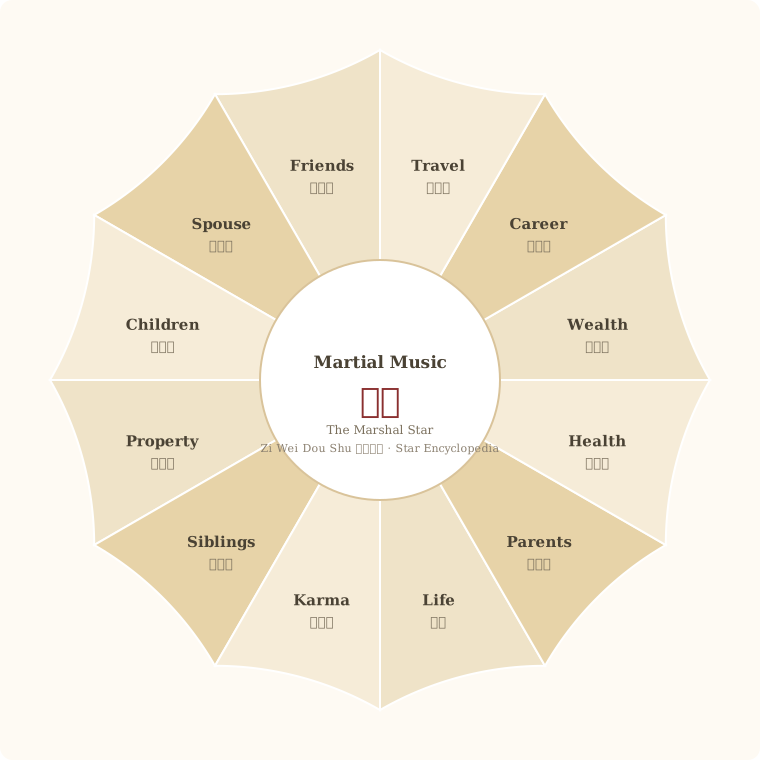
Core Attributes
| Chinese | 武曲 |
|---|---|
| Pinyin | Wu Qu |
| English | Martial Music |
| Archetype | The Marshal |
| Element | Yin Metal |
| Category | Major |
Personality & Temperament
Wu Qu people are built for execution. Direct, disciplined, tireless — the texts describe a serious face, a strong voice, a will that does not stop halfway. They keep promises, respect competence, and expect the same from everyone else. Where other stars deliberate, Wu Qu acts: it is the general who gives the order and the banker who audits the books, often in the same person.
The gift is persistence converted into wealth. The tradition is explicit: Wu Qu is the real wealth star of the chart because it earns. It is the star of industry, commerce, engineering, finance — money that comes from work others cannot sustain. In strong positions it produces executives, founders, financial professionals who build fortunes through focus. It is also a protector: principled, loyal, ready to carry the heavy load.
The shadow is the price of the blade. The tradition calls Wu Qu solitary and austere (孤克): so focused on the task that relationships go hungry — marriage often late, family ties thin, the person most at home at work. Temper is quick, bluntness wounds, and in weak positions discipline hardens into rigidity: the general who wins the campaign and loses the army. The classical remedy is warmth — the softer stars, a deliberate personal life, and the discipline to apply discipline to itself. Wu Qu is the star of the self-made person: born for the hard road, the tradition says, and the fortune built on difficulty lasts longer than any inherited one.
Martial Music in the Twelve Palaces
| Palace | Meaning |
|---|---|
| Life | Serious, capable, unmistakable: strong voice, strong opinions, visible competence. People trust Wu Qu to get things done. The challenge is softening the edges that keep others at a distance. |
| Siblings | Strong-willed, independent siblings, some with a martial or competitive temperament. Relations are honest but cool — help appears in crises rather than daily warmth. The bond strengthens with age and shared duty. |
| Spouse | The classical signature: marriage tends to be late, and the spouse is capable and strong-willed. For women, the tradition advises a gentle partner and a career of one's own; for men, a wife with a will of her own. |
| Children | Fewer children, raised with firm rules and high standards. The bond is real but structured; children respect the parent and inherit the work ethic — and sometimes the stubbornness too. |
| Wealth | The best palace for the Wealth star: steady accumulation through industry, finance, business. Money comes from effort and goes to assets. The classical danger is speculation when inauspicious stars press in. |
| Health | The body of a worker: strong constitution, but strain settles in the bones, joints, lungs, skin (Yin Metal). The tradition warns of overwork, accidents from haste, tension held in the jaw and shoulders. |
| Travel | Movement that pays: business travel, expansion, trade routes, work abroad. The texts say Wu Qu succeeds far from home — strong travel positions make merchants and executives of wide reach. |
| Friends | Few friends, chosen by merit: colleagues and allies rather than companions. Loyalty is fierce once earned, but the circle stays small and opening up is slow. Quality beats quantity, every time. |
| Career | Excellent for finance, banking, industry, engineering, the military — any career of execution and standards. Wu Qu is the doer: management, operations, leadership suit it better than pure creativity. |
| Property | Property built by one's own hands. Strong positions: inherited land kept and expanded. Weak positions: the texts warn of losing the family estate and rebuilding alone. |
| Fortune | An austere inner life: satisfaction comes from accomplishment and material security, not fantasy. Rest feels like waste; the tradition advises learning enjoyment deliberately, or the spirit rusts. Pleasure, like wealth, must be budgeted. |
| Parents | Strict, principled parents, sparing with praise; the relationship is formal and duty-bound. Strong positions: supportive pillars. Weak positions: the texts note friction with authority. |
Star Brightness Levels
Brightness (庙旺平陷) describes how strongly Martial Music expresses in each palace position. The table below follows the traditional brightness table of the Zi Wei Dou Shu Quan Shu (紫微斗數全書), as compiled in Zi Wei Dou Shu Jing Cheng (紫微斗数精成). Some schools vary.
| Level | Chinese | English | Palaces |
|---|---|---|---|
| Miao | 庙 | Temple | 丑, 辰, 未 |
| Wang | 旺 | Prosperous | 子, 午 |
| De | 得 | Obtained | 寅, 申 |
| Li | 利 | Beneficial | 卯, 酉 |
| Ping | 平 | Neutral | 巳, 戌, 亥 |
Wu Qu reaches its temple (庙) in Chou, Chen, and Wei, thrives (旺) in Zi and Wu, is well-placed (得地) in Yin and Shen, useful (利) in Mao and You, and balanced (平) in Si, Xu, and Hai. It has no fully fallen position in the traditional table, but its harsh side grows where it is merely balanced.
Key Star Combinations
- Wu Qu + Heavenly Treasury (武曲天府): The Wealth star with the Treasury: earning power joined to storage power. The texts call this the strongest money structure of the chart — the general who also manages the vault, suited to finance, banking, building lasting assets. Strong positions promise wealth that accumulates and survives.
- Wu Qu + Greedy Wolf (武曲贪狼): The Marshal with the Wolf: ambition, appetite, and drive in one palace. The classical verse says 'Greedy Wolf and Martial Music in the tombs, wealth comes after thirty' — early life is pressured by desire, and fortune arrives late, after discipline has tempered the appetite. With Fire or Bell stars, the pair becomes formidable in business.
- Wu Qu + Heavenly Minister (武曲天相): Execution with courtesy: the stern Marshal dressed in the Minister's manners. The texts praise this pairing for commerce, trade, management — humble in style, decisive in action. Strong positions promise a respected career and smooth relations with authority.
- Wu Qu + Seven Executives (武曲七杀): The sharpest blade in the chart: two metal stars of decisiveness that cut through doubt and opposition. Excellent for the military, surgery, engineering, crisis leadership — but the tradition is blunt that this edge cuts both ways: direct it outward, or it wounds the self and the household.
- Wu Qu + Breaking Army (武曲破军): The general of change: wealth built through upheaval, ventures, breaking ground. The verse warns 'Martial Music with Breaking Army rarely reaches high rank and does not hold wealth' — money arrives and leaves in waves; with strong support it becomes a founder's fortune, built and rebuilt several times.
Martial Music and the Four Transformations
The Marshal is one of the most transformation-sensitive stars in the chart: all four transformations apply — Prosperity in Ji years, Authority in Geng, Recognition in Jia, and Obstruction in Ren. Classical texts state flatly that Wu Qu amplifies whatever transformation it receives, for good or ill.
Hua Lu (化禄 — Transformation to Prosperity)
Wu Qu Hua Lu (化禄) in a Ji year is the money year: the Wealth star becomes wealth itself. Business expands, income rises, and the classical texts promise prosperity from commerce — one of the strongest wealth signals in the system, especially in the Wealth or Career palaces.
Hua Quan (化權 — Transformation to Authority)
Wu Qu Hua Quan (化权) in a Geng year gives the Marshal command: authority, promotion, and control over resources. The personality becomes more dominant and stubborn, and the year favors military, executive, and financial leadership — with the warning that power without warmth creates distance.
Hua Ke (化科 — Transformation to Recognition)
Wu Qu Hua Ke (化科) in a Jia year polishes the blade: reputation through competence, recognition for work well done, and a more cultured, principled public face. Classical texts say it suits civil and administrative roles; the harsh edges of Wu Qu soften into respected authority.
Hua Ji (化忌 — Transformation to Obstruction)
Wu Qu Hua Ji (化忌) in a Ren year is the classic warning of the system: money troubles, disputes over resources, and the breakdown of discipline under pressure. Classical texts say finances suffer and caution is the medicine — no speculation, no contracts signed in haste, and extra care with health and relationships.
Classical Source
武曲属辛金,象阴,北斗第六星,化气为财,为财帛主,又名将星。在天司寿,在数主人财运。旺吉则代表长官、发财、权力;陷凶则为寡宿,有凶暴孤克决裂的特性。
Wu Qu belongs to Yin Metal, the sixth star of the Northern Dipper; its qi transforms into wealth, making it the master of money, also named the General Star. In heaven it governs longevity; in calculation it governs financial fortune. Prosperous, it represents officials, wealth, and power; fallen, it becomes a solitary star with violent, rigid, and destructive traits.
Common Questions
Is Wu Qu the most important wealth star?
It is the primary earned-wealth star: the tradition calls it the lord of the Wealth Palace and the general of action — money from industry, finance, commerce. The Moon governs planned and passive wealth, the Heavenly Treasury governs storage, but Wu Qu is the engine that makes money move and multiply through effort. In the tradition's own phrase: Wu Qu is the action of seeking wealth, the Moon is the intention, the Heavenly Treasury is the capacity to hold it.
Why is Wu Qu associated with solitude and late marriage?
Because it is too focused on the task to tend relationships. The texts call it the solitary star (寡宿): loyal, principled, warm in action, but cool in words and slow to make time. The pattern is late marriage, a capable but distant partner, and the need to build warmth deliberately. The advice: marry later, choose a gentle partner.
Does Wu Qu suit women?
The classical tradition says it suits men more than women, and that a strong Wu Qu woman takes command — competent, independent, better placed as a professional than as a housewife. Its advice for women with Wu Qu: a career of one's own and a patient, gentle partner. Modern readings simply note the star grants equal executive power to anyone.
What does Wu Qu Hua Ji (化忌) mean?
The most feared single transformation in some schools: a Ren year that stresses money, contracts, and the martial temperament. Expect disputes over resources, pressure on savings, a tendency to make hard decisions too fast. The classical remedy is conservative: no speculation, no litigation, no impulsive spending, deliberate care with health and family. It is also the year the general must not fight alone — advisers, accountants, a second opinion are the shield.
What careers suit Wu Qu?
Execution and standards: finance, banking, accounting, industry, engineering, the military and police, surgery, business leadership. Wu Qu is the doer rather than the dreamer, and it excels where results are measurable. The texts note it often succeeds abroad, far from the home that never quite fits.
Related Stars
Explore how Martial Music works with other stars: