The 12 Palaces of Zi Wei Dou Shu: A Complete Guide
Key Takeaways
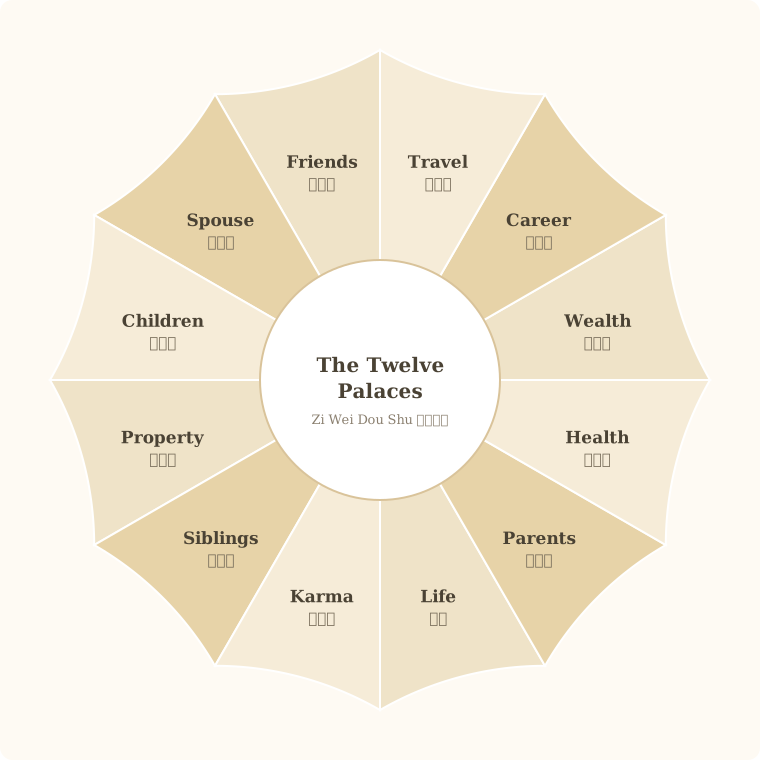
- Twelve boxes, twelve life areas: Life, Parents, Health, Wealth, Career, Travel, Friends, Spouse, Children, Property, Siblings, Karma.
- Life Palace anchors: The other eleven palaces rotate around it in fixed order — which is why exact birth time matters.
- Three layers per palace: Main stars, the palace stem's Four Transformations, and the opposite palace.
- Read palaces in pairs: Each palace faces an opposite (Career ↔ Spouse, Wealth ↔ Karma) — the chart is read as a whole.
- Fixed map, moving weather: Palaces are set at birth; decades and years activate different palaces.
Your Star Chart shows twelve boxes arranged in a square. Each box is a palace. Each palace governs a life area. Each palace contains stars. The pattern these stars make is your chart.
Here is what each palace actually means — in plain English, without the esoteric language, following the twelve-palace framework laid out in the Zi Wei Dou Shu Quan Shu (紫微斗數全書).
Life Palace (命宮)
This is you. Not the you that your parents raised, not the you that your job demands — your core self, your temperament, your default direction in life. The Life Palace is the most important palace in your chart. The stars here describe your fundamental personality and the general arc of your life.
When someone asks "what kind of person are you?", they are asking about your Life Palace.
Parents Palace (父母宮)
This governs your relationship with authority, elders, and origins. It describes not just your literal parents but your relationship with anyone in a position of authority over you — teachers, bosses, institutions. It also describes your relationship with rules and tradition.
A strong Parents Palace suggests you understand and navigate hierarchies naturally. A challenged Parents Palace suggests you resist or struggle with external authority — and may need to build your own structure.
Health Palace (疾厄宮)
Your physical body and well-being. This palace describes your constitutional tendencies — not specific illnesses, but the general pattern of your physical resilience and vulnerability. It also describes your relationship with your body — whether you are attuned to its signals or disconnected from them.
Wealth Palace (財帛宮)
Your relationship with money, resources, and earning. This palace does not predict your net worth. It describes your default orientation toward resources — whether you accumulate, spend, invest, share, or ignore. It describes the role money plays in your life, not the amount.
Some people think about money constantly and have nothing. Others rarely think about it and are well-resourced. The Wealth Palace describes the relationship, not the balance.
Career Palace (官祿宮)
Your work, your public role, and your life calling. This is not just about your job — it is about what you are here to do in the world that is visible to others. A strong Career Palace suggests a life where work and public identity are central. A quieter Career Palace suggests fulfillment comes through other channels.
Travel Palace (遷移宮)
The world outside your door. This palace describes your relationship with the external world — travel, relocation, strangers, and the environments you encounter outside your familiar territory. It also describes how you present yourself to people who do not know you yet.
Friends Palace (交友宮)
Peers, subordinates, colleagues, and community. Not your intimate partners — those go in the Spouse Palace. This is your wider social circle. It describes the quality and character of the people you attract into your life and your role within groups.
Spouse Palace (夫妻宮)
Romantic partnership and marriage. This palace describes the energy you are drawn to in a partner — not who you will marry, but the pattern of partnership that feels natural to you. It also describes what you need from a relationship and what you bring to one.
If you keep attracting the same person with a different face, look here.
Children Palace (子女宮)
Creativity, offspring, and what you bring into the world. This includes literal children, but also creative projects, teaching, mentorship, and anything you nurture from idea to reality. It describes your generative energy — what you make and what you leave behind.
Property Palace (田宅宮)
Home, assets, and your inner sanctuary. This describes your living environment, your relationship with property and ownership, and your need for a secure base. It is also about your inner home — your sense of safety and belonging in your own skin.
Siblings Palace (兄弟宮)
Siblings, close collaborators, and communication. This describes your relationship with peers of equal standing — the people you work alongside, argue with, learn from. It governs your communication style with those closest to you.
Karma Palace (福德宮)
The invisible forces: luck, spirituality, inner peace, and what you find meaningful. This is the most subtle palace — the one that governs your relationship with things larger than yourself. A strong Karma Palace suggests a natural sense of purpose and inner stability. A challenged Karma Palace suggests a restless search for meaning.
Putting It Together
Your chart is the pattern of stars across all twelve palaces. No single palace tells the whole story. The Wealth Palace interacts with the Career Palace. The Spouse Palace interacts with the Life Palace. Reading a chart means seeing the connections.
The free calculator gives you the outline. A complete reading traces every connection.
How the Twelve Palaces Are Placed
The palaces are not assigned randomly. Your Life Palace is located by your lunar month of birth and your birth hour — the same two inputs that fix your chart's foundation. From the Life Palace, the remaining eleven palaces are arranged in a fixed sequence around the twelve positions of the chart, one for each Earthly Branch.
This placement rule is worth knowing for one practical reason: it is why the exact birth hour matters so much in Zi Wei Dou Shu. Change the hour, and the Life Palace moves to a different position — which shifts every other palace with it. Two people born on the same day in different hours are not reading the same chart.
It also explains a common confusion. The twelve palaces are always in the same order around the chart — Parents, Health, Wealth, Career, Travel, Friends, Spouse, Children, Property, Siblings, Karma — but the positions rotate depending on where the Life Palace falls. The map is fixed; your starting point is not.
How to Read a Single Palace
Every palace carries three layers of information, and beginners usually start with the first:
- The main stars. Each palace can host one or more of the fourteen major stars, plus supporting stars. The main stars set the tone: the Emperor Zi Wei (紫微) in your Career Palace reads very differently from a quiet, minor star in the same position.
- The palace stem and the Four Transformations. Each palace has a stem that activates the Four Transformations (四化) — which stars in the chart light up, and in which direction. This is where the chart stops being a still image and starts moving.
- The opposite palace. Every palace faces an opposite across the chart, and the two are read together. Your Wealth Palace and your Karma Palace are opposites, for example — how you make money and how you feel about your life are two halves of one conversation.
The palace meanings above are the vocabulary. These three layers are the grammar.
The Palaces in Pairs
The classical reading convention pairs each palace with its opposite:
- Life ↔ Travel — who you are inside versus who you become outside your familiar world.
- Wealth ↔ Karma — what you accumulate versus what you find meaningful.
- Career ↔ Spouse — your public role versus your private partnership; the two great domains of adult life.
- Health ↔ Parents — your body versus your origins; where constitution meets inheritance.
- Children ↔ Property — what you generate versus what you secure.
- Friends ↔ Siblings — the community you choose versus the peers you were given.
When one palace in a pair is strong and the other is quiet, the pairing shows the trade-off: energy spent on career is energy not spent on partnership, and so on. The pairs are why the chart is read as a whole rather than palace by palace.
Common Questions
Which palace is the most important? The Life Palace, for overall temperament — but the answer changes with the question. For career questions, the Career Palace and its opposite (Spouse Palace) matter most. For money questions, the Wealth Palace and Karma Palace pair. The palace that matters is the one that matches the life area you are asking about.
Can the palaces predict marriage or death? No. The Spouse Palace describes the pattern of partnership you are drawn to and the dynamics that repeat inside relationships — not the identity of your partner or the date of a wedding. The Health Palace describes constitutional tendencies and resilience patterns, not specific illnesses. The palaces map patterns, not events.
Do the palaces change over time? The twelve palaces are fixed at birth. What changes is the weather: each decade of life activates a different palace as your chart progresses, and annual and monthly charts overlay new star movements on the same twelve positions. The map stays; the seasons turn.
How do the palaces relate to BaZi? They are parallel maps of the same life. BaZi reads the same life areas through stems, elements, and Luck Cycles; ZWDS reads them through palaces and stars. When both maps point the same direction, the signal is strong — that is the logic behind cross-validation and the reason the two systems are best read together.
Sources and Further Reading
- Zi Wei Dou Shu Quan Shu (紫微斗數全書) — the foundational text for the twelve-palace framework, traditionally attributed to Chen Tuan (陳摶) of the Song dynasty.
- Zi Wei Dou Shu (Wikipedia) — for the history and variants of the palace system: https://en.wikipedia.org/wiki/Zi_wei_dou_shu
- The palace meanings above are plain-English paraphrases of the classical descriptions, kept deliberately non-technical.
- What Is Zi Wei Dou Shu? A beginner's guide to the Star Chart
- ZWDS vs BaZi: which system answers which question
- Best ZWDS calculator: free vs paid, tested
Explore your Star Chart → - Chinese Astrology (Wikipedia) — overview of the Chinese astrological tradition: https://en.wikipedia.org/wiki/Chinese_astrology
Discussion