Core Attributes
| Chinese | 太阴 |
|---|---|
| Pinyin | Tai Yin |
| English | Moon |
| Archetype | The Moon |
| Element | Yin Water |
| Category | Major |
Personality & Temperament
The Moon governs what is gentle, caring, refined: sensitivity, memory, aesthetic sense, nurture. In traditional society it was the star of mother, wife, and daughter; a modern reading is emotional intelligence, caretaking, design, home management. People with this star prominent are usually kind, discreet, observant, detail-oriented. They plan before they act, save before they spend, and beautify whatever they touch. They prefer harmony and lead by listening — the texts describe the bright Moon as 'glorious and shining' (光辉显): quiet competence that earns respect without noise.
The shadow is the Moon's borrowed light. Receptivity without confidence turns into dependence: over-sensitivity, secrecy, moodiness, postponed decisions, feelings hidden until they leak sideways. The texts are especially careful with the fallen Moon: effort without recognition, an emotional life that runs heavy, a tendency to stay in situations that dim the spirit. The remedy is practical rather than fatalistic — a dim Moon benefits from movement, a change of environment, and honest expression, because the Moon gains strength in new skies.
In a chart, the Moon's power depends on brightness and on the time of birth: night-born charts favor it, day-born charts discount it, and the waxing and waning phases color its expression. Wherever it sits, Tai Yin softens and refines: a Wealth Palace becomes savings and property, a Career Palace becomes service, finance, or the arts, and a Life Palace becomes a person who makes a home of anywhere.
When Quiet Strength Is Misread
Why does handling things quietly get mistaken for passivity?
Tai Yin vs. Tai Yang: Reflection or Illumination?
Tai Yin gathers information, plans, and accumulates before moving; Tai Yang makes purpose visible through public action and service. Quiet becomes passive when no decision, boundary, or signal follows the reflection. Visible action becomes empty when it outruns care and preparation. Compare Tai Yang (Sun)
Questions to Check in Your Chart
- Give private processing a deadline, then name the decision or next step it produced.
- Tell the people affected what you are considering so silence is not mistaken for consent or withdrawal.
- Ask whether quiet is protecting something valuable or postponing a necessary boundary.
This reflection develops Tai Yin's classical themes of receptivity, planning, quiet accumulation, and reflected light. Birth time, brightness, palace, transformations, and the Sun's condition determine whether quietness reads as strength, caution, or delay.
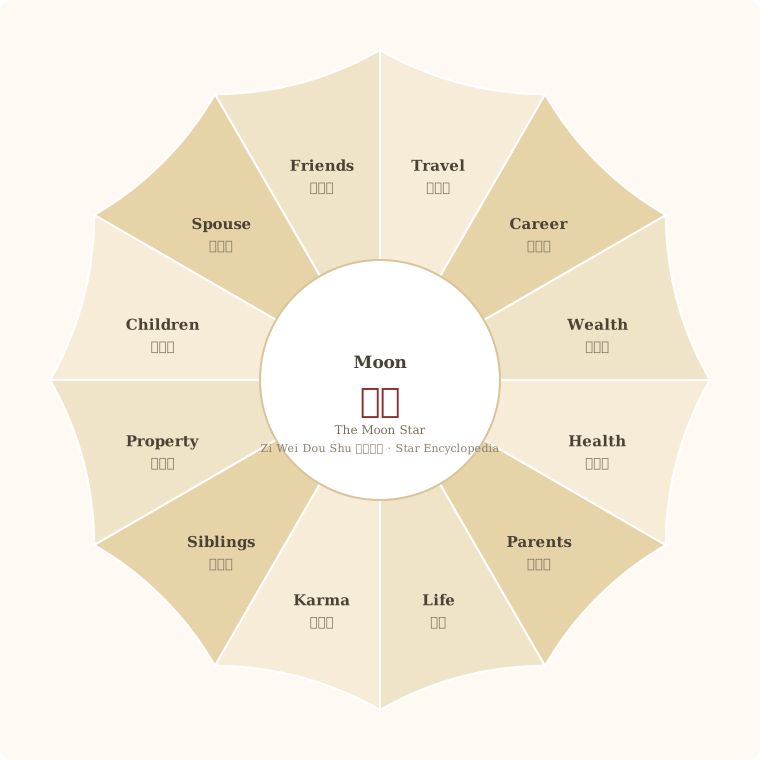
Moon in the Twelve Palaces
| Palace | Meaning |
|---|---|
| Life | Gentle, refined, observant, deeply feeling: strong inner life, excellent memory, a gift for making things beautiful. Prefers harmony to conflict; can be reserved to the point of invisibility. |
| Siblings | Warm relationships, especially with sisters; family care flows quietly and reliably. The bond is emotionally complex — love with unspoken expectations — but enduring. |
| Spouse | A devoted, sensitive partner; the relationship deepens slowly and needs emotional security. Open communication matters more than grand gestures. With a bright Moon: an elegant, faithful marriage. |
| Children | Gentle, artistic children who respond to care and teaching. The parent invests heavily in refinement and education. Children are sensitive themselves — they flourish with encouragement rather than pressure. |
| Wealth | The Moon's second home: savings, property, planned growth. Wealth accumulates through real estate, steady income, careful budgeting. With Prosperity it flourishes; impulsive speculation is its classic leak. |
| Health | The constitution is tied to fluids, hormones, kidneys, and eyes in the classical mapping. Stress surfaces as low mood or fatigue; sleep and daylight are genuine medicine. Routine protects the system. |
| Travel | Prefers familiar ground but flourishes with a well-planned move. The texts encourage a change of scene when the Moon is dim — relocation, study abroad, a new city often lifts the chart's fortunes. |
| Friends | A few deep friendships, mostly with women or gentle souls. Supportive but private; gives more than it receives. The Moon needs boundaries, or it quietly becomes everyone's caretaker. |
| Career | Service, finance, real estate, design, education, hospitality suit it best. Works best in supportive environments; diligent, precise, reliable. Rises through care and accuracy rather than aggression. |
| Property | Naturally strong: home ownership, inherited property, comfortable tasteful interiors. The home is the emotional center, so light, order, and beauty genuinely matter to this star's wellbeing. |
| Fortune | A rich inner life: spirituality, aesthetics, quiet contentment. Prone to melancholy when the Moon is dim; art, music, contemplation restore it. The Moon is the chart's poet. |
| Parents | A deep bond with the mother or mother-figure; maternal influence is formative and lasting. Family tradition matters. With afflictions, distance or a caregiving burden shadows the relationship. |
Star Brightness Levels
Brightness (庙旺平陷) describes how strongly Moon expresses in each palace position. The table below follows the traditional brightness table of the Zi Wei Dou Shu Quan Shu (紫微斗數全書), as compiled in Zi Wei Dou Shu Jing Cheng (紫微斗数精成). Some schools vary.
| Level | Chinese | English | Palaces |
|---|---|---|---|
| Miao | 庙 | Temple | 子, 丑, 戌, 亥 |
| Wang | 旺 | Prosperous | 酉 |
| Li | 利 | Beneficial | 申 |
| Ping | 平 | Neutral | 未 |
| Bu De Di | 不得地 | Unobtained | 寅 |
| Xian | 陷 | Fallen | 卯, 辰, 巳, 午 |
The Moon is the most position-sensitive major star. Its temple positions (Zi, Chou, Xu, Hai) and Flourishing position (You) produce quiet brilliance; the fallen positions (Mao, Chen, Si, Wu) dim it — classical texts say the Moon in daylight loses its glow, and night-born charts bring out its best.
Key Star Combinations
- Sun + Moon (太阳太阴): The two luminaries together in Chou or Wei — the classical 'Sun and Moon in the same palace' (日月同宫), praised in the verse 'when Sun and Moon arrive together, one ranks among lords and marquises'. Action and reflection, public and private, balanced in one personality: day-born charts lean on the Sun side, night-born charts on the Moon. With Recognition and Prosperity transformations it is a pattern of wealth plus standing. The shadow is internal contradiction — hesitating between advancing and withdrawing. The texts add that afflictions here cut deeper, so the balance must be protected.
- Bright Moon at Heaven's Gate (月朗天门): The Moon's most honored pattern: Tai Yin in the Hai palace, the Gate of Heaven, where it reaches temple brightness. The verse — 'the Moon in temple holds its radiance; wealth entering the wealth palace is wonderfully extraordinary' — promises brilliance, elegance, fortune. With the Sun and Heavenly Beam in the Career Palace, fame and wealth reinforce each other. Night-born charts carry the full blessing; a Prosperity-to-Obstruction contrast (the moon 'clouded') describes a difficult middle stretch that clears with time, like clouds passing the full moon.
- Sky Mechanism + Moon (天机太阴): The Strategist and the Moon together in Yin or Shen: clever, artistic, meticulous — the classic 'machine, moon, unity, beam' (机月同梁) family that produces the system's technocrats: accountants, engineers, analysts, administrators. The combination thinks before it moves and plans before it spends. The shadow is overthinking: indecision, anxiety about change, analysis that never quite concludes. With Authority or Recognition present it becomes a powerful professional structure; with Obstruction, the worry-loop tightens.
- Heavenly Unity + Moon (天同太阴): Joy and the Moon together in Zi or Wu: the gentlest pairing among the major stars — artistic, affectionate, pleasure-loving. The tradition treats it as fortunate: a refined life of comfort, aesthetics, warm relationships. The shadow is drift: comfort slides into laziness, harmony into conflict-avoidance. This is the pairing that needs a goal — with a clear purpose it produces artists, healers, and designers of real achievement; without one, it naps beautifully.
- Moon + Melody of Literature (太阴文曲): The classical 'Moon and Wen Qu wealth formula' (太阴文曲财富公式): literary grace married to financial talent. Skilled at both aesthetics and accounts — design with a budget, publishing with a business plan, finance with an artistic touch. With both stars bright it is a formula for elegant, sustainable wealth. The shadow is emotional spending and romance complications; the tradition advises a clear separation between feeling and money decisions.
Moon and the Four Transformations
The Moon is the only star that transforms in all four ways across the heavenly stems: to Prosperity in Ding (丁), to Authority in Wu (戊), to Recognition in Geng (庚), and to Obstruction in Yi (乙). It is among the most responsive stars in the chart.
Hua Lu (化禄 — Transformation to Prosperity)
Tai Yin Hua Lu (化禄) in a Ding year turns care into prosperity: wealth grows quietly through savings, property, and steady income, and the emotional life warms — family, home, and nurture all prosper together. The classical reading pairs money with feeling: this is wealth you can live in, not just count. The shadow is self-indulgence in comfort; the tradition notes that the Moon's prosperity is generous but asks for moderation in return.
Hua Quan (化權 — Transformation to Authority)
Tai Yin Hua Quan (化权) in a Wu year gives the Moon authority expressed as soft power: influence through competence, control through care. The classical image is the moon commanding the tides — quiet, but decisive. This suits managing family fortunes, leading teams by nurture, or holding real responsibility in finance and administration. The shadow is manipulation through gentleness: power that never shows its hand can become control that others feel but cannot name.
Hua Ke (化科 — Transformation to Recognition)
Tai Yin Hua Ke (化科) in a Geng year is recognition for refinement: academic or artistic honor, a reputation for elegance and trustworthiness, praise earned without conflict. The classical texts treat Recognition as the Moon's most comfortable transformation — reputation arrives on schedule and stays. It is excellent for education, the arts, finance, and any public role where character is the product.
Hua Ji (化忌 — Transformation to Obstruction)
Tai Yin Hua Ji (化忌) in a Yi year concentrates obstruction on the emotional plane: worry, over-sensitivity, hidden sadness, and money anxiety. The classical texts weigh it more heavily for day-born charts, where the Moon is already discounted. The constructive reading is preventive: structure, daylight, honest expression, and refusing to hide problems. The clouded moon clears with time and action — hua ji here is a weather report, not a verdict.
Classical Source
属癸水,象阴,中天主星,在天为月之精,化气为富,为田宅主宰,主家宅、财富。为财星,但偏重于计划性的理财。太阴庙旺光辉显,加权加禄进朝房。
Tai Yin belongs to Yin Water, the central star of the chart's middle heaven; in the sky it is the essence of the Moon, and it transforms into Wealth. It rules the home and property, governing house and fortune. It is a wealth star, but one that leans toward planned, careful finance. When the Moon is bright at its temple positions, its glory shines; with Authority and Prosperity added, one enters the halls of office.
Common Questions
Why is the Moon considered a wealth star?
Because it governs property, savings, and planned accumulation — the classical phrase 'transforms into Wealth' (化气为富) says it directly. The Moon does not make money fast the way fire-flavored stars do; it builds wealth through real estate, steady income, careful budgeting, long horizons. Its wealth is the kind that survives: the house that is paid off, the account that grows, the inheritance that is kept. It is the star of compound interest.
What does 'night-born' mean for the Moon?
The tradition weighs the Moon more heavily for people born at night and the Sun for people born in daylight: night-born charts get the Moon's full benefit, while a day-born chart's Moon is discounted by one degree. A bright Moon at night is the ideal; a fallen Moon in a day-born chart is the hardest lunar placement, softened by a change of environment. This is a timing factor in the chart's grammar, not a judgment about the person.
Is a fallen Moon a disaster?
No — it is a dimming, not a curse. The texts describe the fallen Moon as effort without recognition: a person who works as hard as others but is seen less, feels emotions more heavily, and benefits from movement — a new city, a different field, deliberate change. The tradition's own image is hopeful: the moon waxes and wanes, so even a dim placement describes a cycle rather than a fixed fate, and supportive stars or Recognition can relight it substantially.
Why is Tai Yin linked to mother, wife, and daughter?
Traditional society assigned the Moon to the feminine: mother, wife, and daughter, in that order of precedence in the classical texts. A modern reading keeps the substance without the gender framing: the Moon represents nurture, interior life, and emotional caretaking — the work of holding a family and a home together. A man with strong Tai Yin often shows refined emotional intelligence and a caring domestic role; the star's meaning travels with the person, not the biology.
How do the Sun and the Moon interact in a chart?
They are paired opposites: activity and reflection, public and private, assertion and response. When both are bright — the 'Sun and Moon both shining' (日月并明) pattern — the chart is balanced and the native acts and reflects with equal skill. When both are fallen — the 'Sun and Moon reversed' (日月反背) pattern — the texts warn of effort without recognition and advise strategic change rather than resignation. The two stars are read as a couple: each gains meaning from the other's condition.
Continue Your Reading
- The 12 Palaces of Zi Wei Dou Shu: A Complete Guide
Locate where Tai Yin's quiet accumulation is working, because reflection in Wealth, Career, and Spouse asks for different action. - How to Read a Zi Wei Dou Shu Chart: A 5-Step Guide
Read Tai Yin with brightness, its palace, the opposite Sun, supporting stars, and timing before calling quietness either strength or delay.
Related Stars
Explore how Moon works with other stars: