Core Attributes
| Chinese | 天梁 |
|---|---|
| Pinyin | Tian Liang |
| English | Heavenly Beam |
| Archetype | The Mentor |
| Element | Yang Earth |
| Category | Major |
Personality & Temperament
People with the Heavenly Beam in the Life Palace grow up early. The texts picture Tian Liang as the imperial censor (风憲之职) — the official behind the throne who reviews, disciplines, and protects — and as the star of elders: dignified, principled, quietly formidable. In practice this is a strong sense of justice, a protective instinct, and a compulsion to fix other people's problems. Tian Liang people are the natural mentors, mediators, guardians of their circles: generous with advice, fearless in criticism, genuinely kind — but often carrying others' burdens while feeling alone in their own.
The gift is shelter. The tradition calls it the star that dissolves calamity and extends life (消灾解劫、延寿添福): in strong positions it promises protection, longevity, and help from elders, patrons, the family line. Careers in medicine, law, education, religion, and public service fit it naturally. Its luck is famously late — the Beam does not bless youth; it blesses the middle years and after, which is why its owners often feel slow to bloom.
The shadow is the solitude of the watchman. Tian Liang is a solitary star: proud, stubborn, quietly lonely. Its protection arrives only after hardship — the classical rule is that the Beam turns calamity aside only after the calamity has appeared — and its owner can be preachy, meddling, and hard to advise, resenting any challenge to their judgment. The tradition also notes the cost of the guardian's role: wherever the Beam sits, that area of life tends to thin, as if protection required distance. Learning to mentor without managing, and to protect without possessing, is the Beam's life lesson.
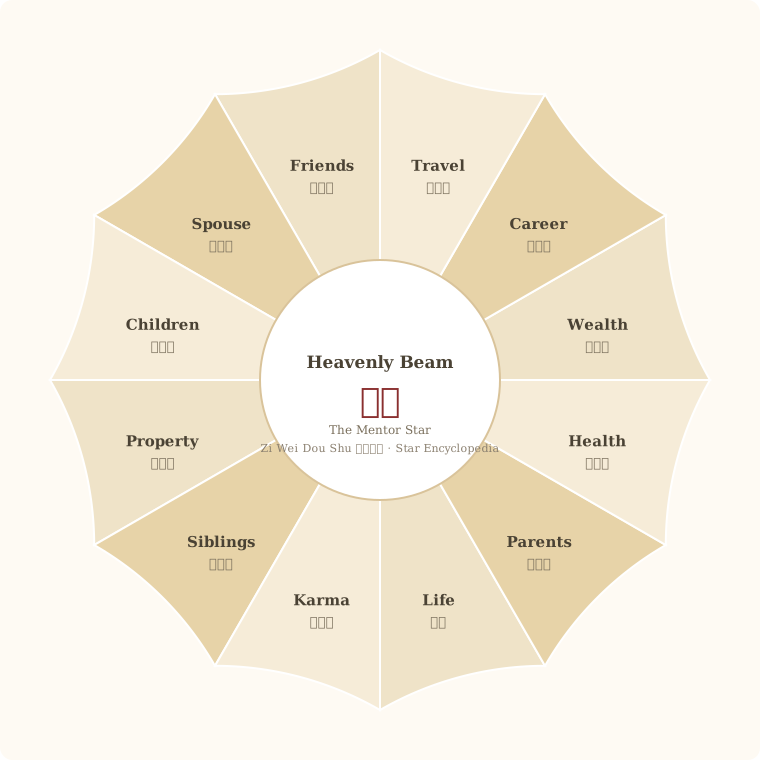
Heavenly Beam in the Twelve Palaces
| Palace | Meaning |
|---|---|
| Life | A dignified, principled presence with a guardian's instincts: others turn to this person for advice and protection. The risk is a proud, preachy streak and a lonely sense of responsibility. |
| Siblings | The Beam's shading tendency makes sibling bonds fewer and more distant; often this person becomes the responsible eldest figure. In strong positions, one loyal elder-sibling dynamic endures. An early sense of duty marks the eldest. |
| Spouse | A marriage that needs maturity: the texts warn of emotional changes and friction, improving later in life. The partner is often a practical, steady person who needs companionship more than mentoring. |
| Children | Fewer children, raised with high moral standards and strong protection. The bond is loving but reserved; children respect the parent's principles even when they find them heavy. Legacy and values matter more than ambition. |
| Wealth | Money matters less than honor: the texts call Tian Liang rich in reputation and poor in appetite. Income flows from service, medicine, law, or institutional salary; speculation and commerce are discouraged. |
| Health | A strong, long-lived constitution in good placements, with attention to the stomach and spleen (Yang Earth). The Beam is a medical star, and its owners are often unusually health-conscious and self-healing. |
| Travel | Travel abroad often brings recognition and patrons: the Beam is helped by elders and by being far from home. In fallen seats, wandering grows aimless and homesickness runs deep. Patrons are often found on the road. |
| Friends | Respected more than befriended: the good like this person, the petty resent them, true intimates are few. Friends tend to be younger people who seek the Beam's protection and advice. |
| Career | The Beam's natural offices: law, regulation, medicine, education, religion, charity, public administration — any role that reviews, protects, and disciplines. A star of rank and honor rather than wealth. |
| Property | Inherited property and ancestral shade are common: the texts say Tian Liang receives from the family line. Homes tend to be older, larger, or quietly dignified. The house carries family history and memory. |
| Fortune | A deeply philosophical, even religious inner life with strong intuition — the tradition calls Tian Liang the star of sacred protection, and its owners often find peace in faith, study, or service. |
| Parents | The best palace for the Beam: Tian Liang governs the parents palace, and in strong positions the parents are protective, principled, long-lived, extending the family's shade. Respect, not intimacy, defines the bond. |
Star Brightness Levels
Brightness (庙旺平陷) describes how strongly Heavenly Beam expresses in each palace position. The table below follows the traditional brightness table of the Zi Wei Dou Shu Quan Shu (紫微斗數全書), as compiled in Zi Wei Dou Shu Jing Cheng (紫微斗数精成). Some schools vary.
| Level | Chinese | English | Palaces |
|---|---|---|---|
| Miao | 庙 | Temple | 子, 寅, 辰, 午, 戌 |
| Wang | 旺 | Prosperous | 丑, 卯, 未 |
| De | 得 | Obtained | 酉 |
| Xian | 陷 | Fallen | 巳, 申, 亥 |
The Heavenly Beam is strongest in its temple positions of Zi, Yin, Chen, Wu, and Xu, thriving in Chou, Mao, and Wei, well-placed in You, and fallen in Si, Shen, and Hai — the fallen seats amplify its solitary and restless tendencies.
Key Star Combinations
- Heavenly Beam + Sun + Literary Star + Prosperity (阳梁昌禄): The most celebrated pattern of the Beam: Sun, Tian Liang, Wen Chang, and Lu Cun meeting in the triangle. The verse runs 'when Sun, Beam, Literary Star, and Prosperity meet, the candidate tops the examination list' (阳梁昌禄会,传胤第一名). It promises academic excellence, public examinations, careers in law, medicine, teaching, government — rank won by scholarship and integrity. The caveat is a fixed, conventional path: brilliant inside the system, less at home outside it, and in need of supporting auspicious stars to hold the pattern. The tradition adds that the pattern favors the honest scholar: its luck comes through merit, not connections, and renews with continued study.
- Heavenly Beam + Sky Mechanism (机梁同宫): Wisdom plus shade: the classical pattern 'the good and the shaded face the court' (善荫朝纲), set in Chen and Xu. Tian Ji supplies strategy and insight; Tian Liang supplies protection and principle. The result is a deep, calculating, well-meaning mind — the traditional profile of the consultant, judge, scholar, or physician who sees through people and problems. The shadow is isolation: the wise are rarely popular, and the pairing can turn cynical if malefic stars press it, so warmth and humility are the practical remedies. It is also a guardian's mind, good at seeing consequences before they arrive — natural for risk review, ethics, long-term planning.
- Heavenly Beam + Heavenly Unity (梁同同宫): Protection meets ease in Yin and Shen: one of the softest combinations of the major stars, usually part of the broader Machine-Moon-Unity-Beam pattern (机月同梁). The person is gentle, helpful, fond of a settled life, often serving in stable institutions or mastering a craft. The texts praise its longevity and reputation, and warn of inertia: comfort can become idleness, and the Beam's guardian duty can dissolve into avoidance. It suits advisory and technical roles more than command — the danger being the unearned rest that boredom breaks.
- Heavenly Beam + Heavenly Horse (梁马同宫 / 会照): The wandering shade: when the Beam meets the Heavenly Horse, the texts say the two 'drift without doubt' (天梁天马,飘荡无疑). This is the pattern of the perpetual traveler — the overseas student, the aid worker, the international consultant — whose protection works best far from home. In fallen seats the drifting loses direction and roots are hard to grow; with auspicious stars it becomes a successful life in motion, with reputation built wherever the Beam lands. The tradition also warns that the Horse cancels the Beam's rest, so its owners must plan for movement — foreign study, relocation, mobile careers — rather than fight it.
- Heavenly Beam + Moon (天梁太阴): Two shades in one chart: the Beam's solitude deepens beside the Moon. In the fallen seats of Si and Shen this pairing is called the drifting guest (飘篷之客) — a life of departures, loneliness, late settlement, softened by the Moon's brightness in strong positions. In the Sun-and-Moon-Enlightened pattern (日月并明) set in Chou, the same pair becomes a pattern of rank and wealth. The difference is all in the light: the Moon must be bright for the Beam to rest. In practice the pairing asks for light — Sun or Moon in temple positions turns the solitude into independence; fallen light makes it exile.
Heavenly Beam and the Four Transformations
The Heavenly Beam transforms in three stems: Prosperity in Ren (壬), Authority in Yi (乙), and Recognition in Ji (己). It never transforms into Obstruction — the protective star is never blocked — though the tradition adds that its protection only arrives after difficulty. This is why Tian Liang readings emphasize the stem years: Ren, Yi, and Ji activate the Beam, while other years leave it to its own devices. The activated years are when its shade is strongest, and the time to step forward as a protector.
Hua Lu (化禄 — Transformation to Prosperity)
Tian Liang Hua Lu (化禄) in a Ren year turns shelter into substance: service becomes income, reputation becomes position, and elders and patrons extend real help. Classical texts note a paradox — the Beam with Prosperity is content with what it has and can neglect enterprise — and warn that inherited wealth may scatter while health needs attention. It is the transformation of the respected professional whose name opens doors. It is also the year for protective roles — mentorship, trusteeship, or charity — where the Beam's shade becomes public service.
Hua Quan (化權 — Transformation to Authority)
Tian Liang Hua Quan (化权) in a Yi year gives the guardian authority: this is the year the mentor becomes the enforcer — regulatory power, disciplinary roles, or a commanding voice in institutions. The tradition praises it for career and standing, calling the person a natural for supervision, inspection, and leadership in principled organizations. The danger is rigidity: power without warmth makes the Beam's solitude worse, so fairness must temper the authority it grants. Yi years are the window for promotion into oversight, suiting those who hold others to standards without cruelty — the Beam's justice is its best weapon.
Hua Ke (化科 — Transformation to Recognition)
Tian Liang Hua Ke (化科) in a Ji year is the Beam's most natural transformation: reputation, scholarship, and moral authority. Classical texts describe fame earned through virtue and learning — the professor, the judge, the respected elder — and call it a shield against misfortune, since a good name protects the Beam better than wealth. It is the transformation that suits examination success, publishing, and public honor, and it softens the Beam's solitary edge. The year favors degrees, certifications, publications, and public honors, and the tradition says reputation earned under Tian Liang Hua Ke endures longest of all.
Classical Source
天梁属戊土,象阳,南斗第二星,化气为荫,司寿禄,父母宫主,是父母星、老人星、医药星,能消灾解厄、延寿添福,得祖荫、长辈及上司的助力,福德惠及家庭及子孙。
Tian Liang belongs to Yang Earth, the second star of the Southern Dipper; its qi transforms into Protection. It governs longevity and salary, and is the master of the parents palace — the star of parents, elders, and medicine, dispelling calamity, extending life, and adding blessings, with the support of ancestors, elders, and superiors, its virtue reaching family and descendants.
Common Questions
Is the Heavenly Beam really protected from disaster?
With an important caveat: the texts say Tian Liang dissolves calamity only after the calamity has arrived. Its protection is remedial, not preventive — the tradition is explicit that blessing comes after difficulty, which is why the Beam's luck runs late and its owners endure real hardship before help arrives. In strong positions the resolution is reliable and often life-saving; in fallen positions the protection thins and the hardship grows louder, so preparation matters more than expectation. The practical advice is to build reserves in good years — health, savings, relationships — because the Beam's protection works best for the prepared.
Why is Tian Liang called the star of elders and parents?
Because it rules the parents palace and embodies the parental function: protection, discipline, inheritance. The texts emphasize the character of the elder — dignified and principled, generous with advice, reluctant to admit fault — and note that the Beam's luck runs strongest in the second half of life. Its blessings arrive through age, rank, and legacy: the mentor becomes the mentor only after years of practice. This is why Tian Liang children mature early and why elders, teachers, and patrons play outsized roles — and why, in time, the Beam person becomes the elder others lean on.
Is the Heavenly Beam good for wealth?
For rank and reputation, yes; for money, only indirectly. The tradition calls Tian Liang honorable rather than rich — it inherits, protects, and distributes wealth more than it creates it, and the texts explicitly discourage commerce and speculation. Its owners do best in salaried, licensed, or public roles where integrity is the product, and where wealth, when it comes, arrives as the by-product of a respected name. The classical advice: let wealth come through service and status — salary, fees, institutional benefits — and leave speculation to other stars. The Beam's property is usually inherited or acquired late, and meant to be passed on.
Related Stars
Explore how Heavenly Beam works with other stars: