Core Attributes
| Chinese | 文曲 |
|---|---|
| Pinyin | Wen Qu |
| English | Literature Music |
| Archetype | The Artist |
| Element | Yin Water |
| Category | Six Auspicious |
Personality & Temperament
Wen Qu people are the performers and persuaders of the chart: witty, musical, verbally gifted, quick on their feet. The texts describe it as the star of wit — fame won not through the orthodox examinations but through special talent: music, art, eloquence, craft. Where Wen Chang is the steady system of the scholar, Wen Qu is the fluid agility of the artist; modern readers often map the pair as the orthodox track versus the creative track.
The gift is charm plus skill. It learns fast, improvises well, and communicates in ways people remember — the classic fame that spreads by word of mouth. It carries a genuine artistic spark and a peach blossom quality that draws attention and affection. In career terms it favors media, entertainment, marketing, education, and any craft where talent itself is the product. The tradition also connects it with alternative-path fame (异途功名): recognition outside official ladders — the self-taught master, the popular artist, the specialist the establishment never certified.
The shadow is slickness and entanglement. Corrupted by bad stars, Wen Qu's eloquence becomes glibness — the classical tongue-debater who argues beautifully and delivers nothing. Its romance quality runs hotter than Wen Chang's, and the texts tie Wen Qu Hua Ji to emotional complications and relationship trouble. The star can also be fussy and restless, chasing stimulation; without substance underneath, charm becomes a career in itself — and a fragile one.
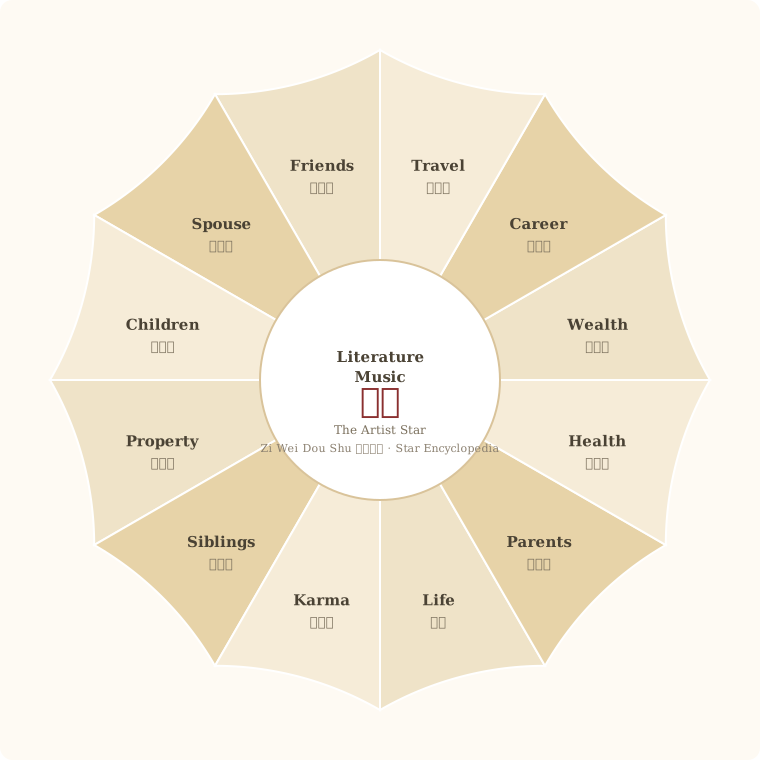
Literature Music in the Twelve Palaces
| Palace | Meaning |
|---|---|
| Life | Witty, charming, artistically gifted; a natural talker with presence. Quick and adaptable, with a perfectionist-fussy streak; the same charm that opens doors can blur boundaries when romance stars crowd in. |
| Siblings | Cultured, talkative siblings; a mother with artistic or musical taste. Family conversations are entertaining, dreams are vivid, and artistic interests run through the family. |
| Spouse | An attractive, clever partner with small talents and cultural flair; the marriage has romantic aesthetics. With too many peach blossom stars, the readers caution about emotional complications and recommend honest communication. |
| Children | Bright, artistic children with musical or performing talent; creative training pays off. The texts add a health caution for women with Hua Ji here — the practical reading is attention to reproductive health, not alarm. |
| Wealth | Money through art, media, communication, entertainment; talent is the asset and the product. Income follows reputation and can be brilliant but irregular — discipline turns flashes of success into a career. |
| Health | The nerves and the emotions: over-thinking, restlessness, emotional strain. As a Water star it draws attention to kidneys and circulation; sleep and stillness are the remedies. |
| Travel | Popularity travels with the native; artistic or professional recognition often arrives away from home. New places bring admirers, mentors, and occasional romantic encounters. |
| Friends | Friends in media, art, and entertainment; a lively, influential circle. Self-media and performance attract followers through talent; with Hua Ji, watch words and documents among friends. |
| Career | Media, entertainment, music, marketing, education — any communication-driven field. Fame often comes through the alternative path — skill recognized outside formal ladders — and career advances through reputation. |
| Property | An artistic, well-decorated home with music and collections. The readers note that with strong Water main stars, plumbing deserves occasional attention; more broadly, the home reflects taste more than investment. |
| Fortune | A rich inner world of music, reading, aesthetics; emotional depth and a lively imagination. With Hua Ji, the inner life can turn turbulent — mood follows thought, so thought needs structure. |
| Parents | Refined, cultured parents with traditional values; early artistic or verbal training is common. Teachers along the way are memorable; documents signed under this star's influence deserve care. |
Star Brightness Levels
Brightness (庙旺平陷) describes how strongly Literature Music expresses in each palace position. The table below follows the traditional brightness table of the Zi Wei Dou Shu Quan Shu (紫微斗數全書), as compiled in Zi Wei Dou Shu Jing Cheng (紫微斗数精成). Some schools vary.
| Level | Chinese | English | Palaces |
|---|---|---|---|
| Miao | 庙 | Temple | 丑 |
| Wang | 旺 | Prosperous | 未 |
| De | 得 | Obtained | 辰, 酉 |
In the classical brightness table Wen Qu is rated in only four palaces: temple in Chou (庙丑), strong in Wei (旺未), and decent in Chen and You (得辰酉). The remaining palaces carry no rating in the traditional table, so the star's expression there depends on the main star and transformations.
Key Star Combinations
- Literary Star + Literature Music (昌曲同宫): The artist and the scholar: the complete literary endowment — writing plus performance, theory plus craft. The texts call it the pattern of literary refinement (文华文桂): brilliant and famous, with a temperament to match — restless moods, a genius's sensitivity. Best in Chou or Wei with auspicious support; broken by adversity stars, it becomes fame without substance.
- Moon + Literature Music (太阴文曲): The classical line: 'Moon with Literature Music in the same palace surely makes a master of the nine arts' (太阴文曲同宫,定是九流术士). The technician-practitioner: specialized crafts, esoteric or technical expertise, income from a skill others cannot replicate. Modern translations include healers, analysts, artists, specialists.
- Greedy Wolf + Literature Music (贪狼文曲): Desire and beauty expressed through words: entertainment, public relations, media marketing. The Greedy Wolf supplies appetite and reach, Wen Qu supplies the voice — the combination that makes trends, not just art. Its shadow is overstimulation: pleasure and reputation can outrun substance.
- Martial Music + Literature Music (武曲文曲): The business professional with style: finance, contracts, commercial writing done with logic and polish. Where Wen Qu plus Greedy Wolf entertains, Wen Qu plus Martial Music professionalizes — documents, negotiations, detail work that carries a personal stamp. Case literature links the pair to financial documents and careful deal-making.
Literature Music and the Four Transformations
Wen Qu transforms to Recognition (Hua Ke) in Xin (辛) years and to Obstruction (Hua Ji) in Ji (己) years. It never transforms to Prosperity or Authority — the artist's currency is fame, not force, and its danger is reputational rather than structural.
Hua Ke (化科 — Transformation to Recognition)
Wen Qu Hua Ke (化科) is fame through talent: artistic recognition, public speaking, teaching, and media presence. A Water star's Recognition spreads by word of mouth — the name circulates faster than the work. Classical readers treat it as gentle fame with a romantic glow: admired, remembered, and often followed by offers.
Hua Ji (化忌 — Transformation to Obstruction)
Wen Qu Hua Ji (化忌) is the reputation wounded: gossip, slander, speech disputes, and emotional entanglement. Classical tradition ties it to relationship trouble and warns about words said in haste and documents signed without care. The practical translation: in Ji years, choose words deliberately, keep records clean, and protect the heart from dramatic attachments.
Classical Source
文曲星属癸水,象阴,北斗第四星,司科甲、名声、功名,又叫文华星,主文艺才华、异路功名之星。文曲为辩智,偏重口才及特殊才艺,不由科甲出身,多由才艺或偏科出身,偏爱文艺技艺,如音乐艺术等。
The Literature Music star belongs to Yin Water, the fourth star of the Northern Dipper; it governs examinations, fame, and achievement, and is also called the Star of Literary Elegance — the star of artistic talent and unconventional paths to success. Wen Qu is the star of eloquence: it favors speech and special skills, succeeding through artistry rather than the orthodox examination route, with a love of music and the arts.
Common Questions
Is Wen Qu only about art and music?
No — Wen Qu governs any special skill and any form of persuasion: negotiation, performance, teaching, technical craft, even business development through charm. Its classical signature is fame outside the orthodox path (异途功名): recognition won through demonstrated talent rather than formal credentials. In modern terms, think of the self-taught expert whose name travels by word of mouth.
What does Wen Qu Hua Ji mean?
Classically: emotional complications, gossip or slander, trouble with words and documents. Traditional texts tie it to relationship problems and warn of careless speech. The practical reading is a reminder rather than a judgment: in the activated year, keep records clean, choose words carefully, avoid dramatic attachments.
Why is Wen Qu called a peach blossom star?
Because its charm is warm and visible: Wen Qu attracts attention, admiration, romance — the tradition calls it the romantic peach blossom, stronger than Wen Chang's restrained appeal. This same magnetism powers its charisma and popularity; the shadow is entanglement, especially when romance stars crowd the same palace or when the star is activated by Hua Ji.
Related Stars
Explore how Literature Music works with other stars: