Core Attributes
| Chinese | 太阳 |
|---|---|
| Pinyin | Tai Yang |
| English | Sun |
| Archetype | The Light |
| Element | Yang Fire |
| Category | Major |
Personality & Temperament
Sun people are the natural givers of the chart. Warm, generous, straightforward, genuinely public-spirited — the texts say their nature is to love people broadly and help without being asked. They speak directly, act boldly, and carry a sense of mission. The Sun illuminates others before it illuminates itself, which is why the tradition insists its power comes from selfless intention.
The gift is influence through radiance. In strong positions it rises like the morning sun: reputation, leadership, recognition follow, especially in public service, politics, education, media — any role that serves a crowd. It is also a star of endurance. Sun people keep working for the cause long after others rest, and their optimism is remarkably durable.
The shadow is the price of burning for others. The tradition warns that the Sun casts its light outward and neglects its own: family ties — especially to the father, and in turn the husband and sons, the male figures of the chart — often run thin or distant. Sun people can also be proud, blunt, wasteful with money and energy, and their generosity can quietly become a hunger for recognition. When the Sun is fallen, the same drive turns into overwork, resentment, and a quiet sense of being unappreciated — the light that forgot to shine home.
Across every position, the Sun keeps one lesson constant: its power is real only when shared, and its light is healthiest when some of it is aimed home. The tradition reads it as the star of the statesman and the public servant, and its best years often arrive after thirty, once the blaze has been disciplined into a beam.
Sun in the Twelve Palaces
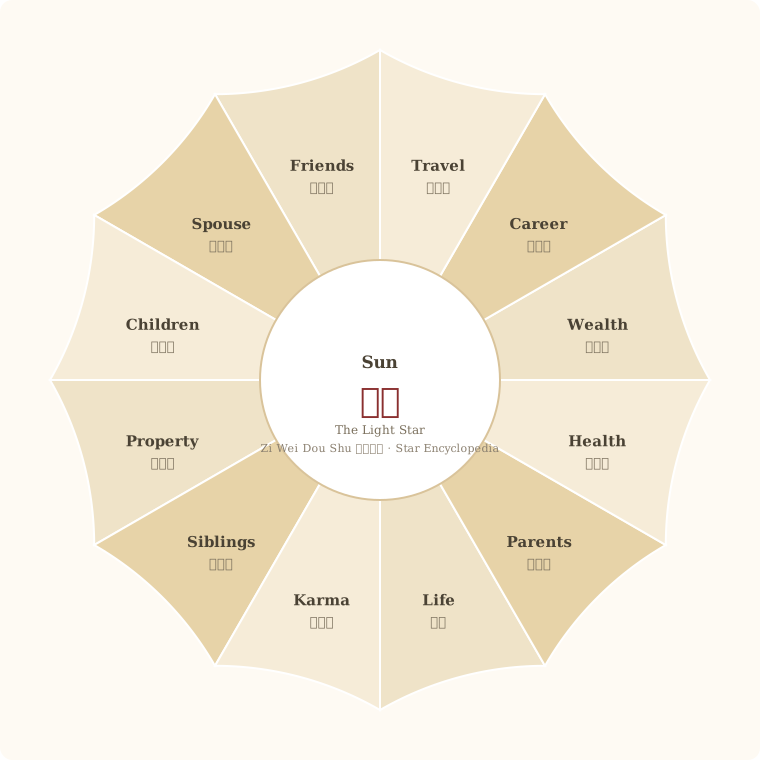
| Palace | Meaning |
|---|---|
| Life | Bright, generous, outgoing — warm, principled, impossible to ignore. Strong positions: natural leaders, public figures. Fallen positions: tireless givers who forget to receive. The Sun never disappears from the room. |
| Siblings | Capable, independent siblings. In strong positions they achieve publicly, though each builds their own life and property. The bond is warm at a distance rather than intimate day to day. |
| Spouse | A capable, hard-working partner. The Sun native is loyal and giving but can be emotionally reserved; the texts advise later marriage for harmony — especially for women with the Sun in the Life Palace. |
| Children | Active, lively children who do well with encouragement and public recognition. Strong positions: several healthy, spirited kids. Weak positions: fewer children, a more distant bond. |
| Wealth | Wealth through reputation, position, and service rather than hoarding: fees, awards, public work, businesses built on a name. The Sun is a star of honor, not treasure — money follows the light, and spending stays generous. |
| Health | Watch the eyes, heart, and blood pressure — the organs of fire and radiance. The Sun also drives overwork: exhaustion shows up as eye strain, tension, circulatory complaints that ease with rest. |
| Travel | Travel brings recognition: public roles, inspection tours, diplomacy, study abroad. The Sun travels well and is received warmly wherever it goes — and distance often improves the family relations it struggles with at home. |
| Friends | A wide circle: friends, admirers, colleagues who come for the warmth and stay for the generosity. Support is broad but diffuse. The classical caution: being deceived by people the Sun trusted too quickly. |
| Career | One of the best career stars in the chart: government, politics, education, media, law, service industries. Strong positions: rank and reputation. Fallen positions: hard work without the title, and late recognition. |
| Property | Bright, open homes lived in generously — often the gathering place for others. Property cycles with reputation: a good name brings good real estate, and renovation projects come with the energy. |
| Fortune | A magnanimous inner life that finds meaning in serving others; ideals and public spirit are the inner light. When fallen, the inner world dims — self-worth measured only by others' approval, and rest feeling like failure. |
| Parents | The classical signature of the Sun: a distant or complicated bond with the father, and with the husband and sons in turn as life shifts. Respect exists, but emotional closeness must be deliberately built over time. |
Star Brightness Levels
Brightness (庙旺平陷) describes how strongly Sun expresses in each palace position. The table below follows the traditional brightness table of the Zi Wei Dou Shu Quan Shu (紫微斗數全書), as compiled in Zi Wei Dou Shu Jing Cheng (紫微斗数精成). Some schools vary.
| Level | Chinese | English | Palaces |
|---|---|---|---|
| Miao | 庙 | Temple | 卯, 午, 戌 |
| Wang | 旺 | Prosperous | 寅, 辰, 巳 |
| De | 得 | Obtained | 未 |
| Li | 利 | Beneficial | 申 |
| Ping | 平 | Neutral | 酉 |
| Bu De Di | 不得地 | Unobtained | 丑 |
| Xian | 陷 | Fallen | 子, 亥 |
The Sun is at its temple (庙) in Mao, Wu, and Xu, thriving (旺) in Yin, Chen, and Si, well-placed (得地) in Wei, useful (利) in Shen, balanced (平) in You, fallen (陷) in Zi and Hai, and at its worst (不得地) in Chou. Day-born natives always read brighter than night-born ones.
Key Star Combinations
- Sun + Moon (太阳太阴): Light and shadow together — day and night in one palace. The pair is called changeable, yin-yang alternating (忽阴忽阳): generous one moment, private the next, with doubled scale in whatever the palace governs. Strong for careers that need both public presence and behind-the-scenes management. The classical note: ceaseless labor, because the sun and moon never rest.
- Sun + Great Gate (太阳巨门): The lamp that lights the gate of speech: radiance meeting the dark star of language produces communication, trade, diplomacy, law. The verse 'Great Gate opposite the Sun brings fame through food and office' (巨日对照,食禄驰名) applies in strong positions; in weak ones, the pair runs on disputes, gossip, and exhausting verbal battles.
- Sun + Heavenly Beam (太阳天梁): Light tempered by the Beam's gravitas: the Sun turns more inward, scholarly, protective. This is the classical structure of service, charity, education, healing — the texts say it loves to relieve the world. With Wen Chang beside it, the scholar's pattern of early fame and public respect forms.
- Sun + Prosperity Star (太阳禄存): Radiance with reserves: Lu Cun gives the Sun substance and converts fame into fortune. The texts call this the combined-prosperity pattern (合禄) — reputation monetized, excellent for business, a sign that giving has become sustainable rather than self-consuming.
- Sun + Wen Chang & Wen Qu (太阳昌曲): Brightness with brilliance: Wen Chang and Wen Qu add learning, eloquence, and literary polish to the Sun's public energy. The classical verse promises early fame and youthful success — a name known before thirty, through writing, media, examination, or the arts.
Sun and the Four Transformations
The Sun transforms in three directions only: Prosperity in Geng years, Authority in Xin years, and Obstruction in Jia years. It never takes Recognition (化科) — the classical logic is that the Sun already shines publicly, so it needs no added reputation.
Hua Lu (化禄 — Transformation to Prosperity)
Tai Yang Hua Lu (化禄) in a Geng year turns radiance into reward: fame and money arrive together, and strong positions produce promotion, honors, and public recognition with real benefit attached. Classical texts call it the double harvest of name and gain, best in temple positions.
Hua Quan (化權 — Transformation to Authority)
Tai Yang Hua Quan (化权) in a Xin year is authority made bright: the Sun's leadership becomes explicit, forceful, and somewhat stubborn. Day-born natives in strong positions hold real power; the caution is the Sun's pride — power exercised without listening scorches the people around it.
Hua Ji (化忌 — Transformation to Obstruction)
Tai Yang Hua Ji (化忌) in a Jia year is the burnt-out light: overwork, disputes, eye trouble, and the feeling of giving without return. In temple positions the Sun survives the obstruction with effort; in fallen positions the classical texts are blunt — hardship, waste, and the urgent need to stop and shine on oneself.
Classical Source
太阳属丙火,象阳,中天第一主星,化气曰贵,日之精,为官禄主。代表光明、博爱、权贵、政治、法规、无私。……太阳入男命吉凶诀:太阳入命最聪明,慈爱宽大福寿长。若逢羊陀目昏伤,火铃相逢多苦楚。
Tai Yang belongs to Yang Fire, is the first and chief star of the central heavens, and transforms into honor: it is the essence of the sun and governs official rank and career. It represents light, universal love, rank and power, politics, law, and selflessness. Verse for the Sun in a man's chart: The Sun in the Life Palace marks the most intelligent and compassionate, broad-minded, with long fortune and life; meeting Goat and Whirlwind brings eye injuries, and Fire Bell brings much suffering.
Common Questions
Is the Sun a wealth star?
Not primarily. The tradition is explicit: the Sun governs honor (贵) before wealth (富) — it is a star of rank, reputation, and service. It becomes wealthy when wealth stars join it: Lu Cun, Hua Lu, or the Moon in support convert radiance into income. Alone, it produces a respected but often modest purse, generous to others and careless with itself.
What does it mean when the Sun is 'fallen' (失辉)?
The Sun's power follows the hours of the day. In Zi, Hai, and Chou it sits at night, its light dimmed, and the chart's tone turns to overwork, late success, effort without recognition. Day-born natives soften this — the classical rule is that a day-born Sun is never fully fallen, while a night-born Sun in strong positions is still somewhat muted. Fallen Suns often do their clearest work at night, when the world is quiet and the light has no competition.
Why is the Sun associated with distance from father, husband, and sons?
The Sun governs the male figures of the chart — the father in childhood, the husband and the self in adulthood, the sons in later years. Because its nature is to shine outward for everyone, its own household often runs thin: separation, differing values, emotional distance. The classical remedy is deliberate time at home; with auspicious stars the effect fades nearly to nothing.
Does the Sun fear Hua Ji (化忌)?
In temple positions, no — the strong Sun burns through obstruction, though effort and stress rise noticeably. In fallen positions, yes: Hua Ji darkens the light, bringing exhaustion, disputes, eye strain, money that slips away. The advice for a Jia year: scale back commitments, protect health, and shine on yourself before others.
What careers suit the Sun?
Public-facing service roles: government and politics, education, media, law, medicine, diplomacy, charity, organizational leadership. The Sun is also a star of the soldier, athlete, and builder in classical lists — anywhere visibility, warmth, and endurance convert into reputation. The old lists even put it in banking and construction: anywhere the person becomes the visible face of the work.
Related Stars
Explore how Sun works with other stars: