Core Attributes
| Chinese | 巨门 |
|---|---|
| Pinyin | Ju Men |
| English | Great Gate |
| Archetype | The Gate |
| Element | Yin Water |
| Category | Major |
Personality & Temperament
People with the Great Gate in the Life Palace are wired for words. The texts call Ju Men the finest speaker among the fourteen major stars: articulate, quick, penetrating, with a memory for detail and a compulsion to break every question to its root. This is the analyst, negotiator, or teacher who thinks aloud. The same energy fuels a strong research instinct — a need to see what others cannot see — that thrives in investigation, media, and academia.
The gift is precision: it sees the seam in an argument, the hidden clause, the unstated motive; with the Sun's light nearby, this sharpness becomes eloquence and insight. The tradition adds that Ju Men people are loyal underneath the edge: hard-mouthed but soft-hearted, quick to forgive after a quarrel. Success comes through language and knowledge, and almost always arrives late — a Ju Men life is one long apprenticeship in speaking well.
The shadow is the darkness itself. Ju Men is called the star that veils others: it breeds suspicion, sarcasm, words that wound. Fallen or pressured, the sharp tongue turns cutting, investigation turns to paranoia, and the person becomes quarrelsome and isolated — disputes begin with the mouth, and loneliness follows. The tradition warns against leading from the front: the Gate guards borders; it was not made for the throne. Humility is the practical remedy; light — the Sun, prosperity, or recognition — is the cure.
When Clarity Sounds Like Conflict
Why does explaining myself more clearly sometimes create more conflict?
Ju Men vs. Tian Ji: Scrutiny or Strategy?
Ju Men presses a claim until hidden assumptions are named; Tian Ji moves among options, reframing and changing tactics. More explanation helps when a dispute is about facts. It can intensify conflict when the real issue is trust, status, timing, or whether the other person feels heard. Compare Tian Ji (Sky Mechanism)
Questions to Check in Your Chart
- Decide whether the conversation needs evidence, a decision, repair, or simply acknowledgment.
- Separate what you observed from the motive you inferred before making the case.
- Ask what a useful ending looks like: clarity, agreement, a boundary, or permission to disagree.
This reflection draws on Ju Men's classical roles in speech, discernment, suspicion, and dispute. It does not make every disagreement a Ju Men event; palace, brightness, transformations, and the Sun's condition change how the Gate speaks.
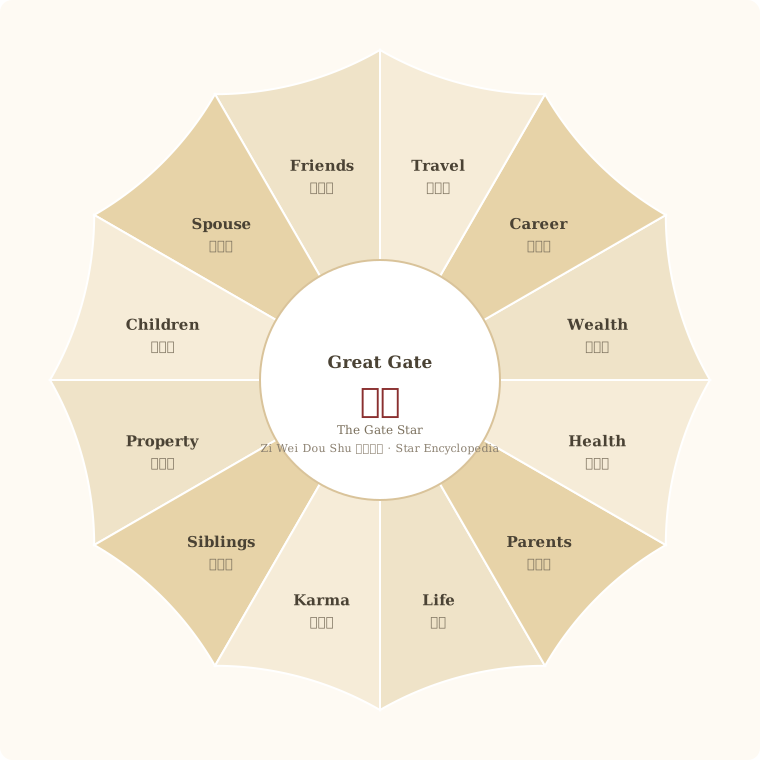
Great Gate in the Twelve Palaces
| Palace | Meaning |
|---|---|
| Life | A sharp, articulate presence with a probing mind and strong personal boundaries. Others hear confidence and intelligence; the risk is a tongue faster than the judgment, and suspicion that turns conversation into cross-examination. |
| Siblings | Sibling relationships tend to be distant and hard to negotiate: different opinions, poor communication, occasional estrangement over practical matters. In strong positions, one loyal sibling stays close through the years. |
| Spouse | A marriage tested by words: debate, friction, mutual sharpness, both sides quick to defend their views. The classical remedy is a partner who also works with language, so that talking together becomes a shared profession. |
| Children | Bright, argumentative children who question everything — discipline becomes verbal sparring, and teaching is done through dialogue. In temple positions, children inherit the sharpness and often excel in debates, writing, law. |
| Wealth | Income that flows through speech and service — teaching, law, trade, media, mediation — rather than inheritance. Money arrives in careful amounts and is guarded closely; the note is that the Gate's wealth is earned, never given. |
| Health | Tension gathers around the mouth, stomach, and esophagus; worry and suppressed anger are the typical complaints, with insomnia when the mind churns at night. Rest, digestion, and talking things out are the traditional remedies. |
| Travel | A natural traveler for trade and exchange: the Gate governs borders, ports, stations, the crossing between cultures. Working abroad, in foreign trade, or cross-cultural negotiation suits it unusually well. |
| Friends | Friendships start warm and cool over time; the texts warn of a solitary streak and of attracting petty rivals who resent the sharp tongue. A few durable allies matter far more than a wide circle. |
| Career | The best careers are voice-based: teacher, lawyer, judge, diplomat, presenter, journalist, consultant, intermediary. The tradition advises against top leadership — deputy and specialist roles protect the Gate from the controversies its own words attract. |
| Property | Homes near roads, stations, markets, or waterways, with corridors and corners where clutter gathers. Property is usually self-bought after middle age rather than inherited, and documents deserve careful filing — clear filing prevents the Gate's typical losses. |
| Fortune | An anxious, searching inner life that questions everything, including itself, with a natural bent toward philosophy and religion. A good Fortune Palace is considered essential for this star, because inner peace is its hardest currency. |
| Parents | A distant or verbally strained relationship with the father figure — the texts call Ju Men a star that weakens the father bond. Early independence and leaving home are common and often beneficial. |
Star Brightness Levels
Brightness (庙旺平陷) describes how strongly Great Gate expresses in each palace position. The table below follows the traditional brightness table of the Zi Wei Dou Shu Quan Shu (紫微斗數全書), as compiled in Zi Wei Dou Shu Jing Cheng (紫微斗数精成). Some schools vary.
| Level | Chinese | English | Palaces |
|---|---|---|---|
| Miao | 庙 | Temple | 寅, 卯, 申, 酉 |
| Wang | 旺 | Prosperous | 子, 午, 亥 |
| De | 得 | Obtained | 戌 |
| Ping | 平 | Neutral | 辰, 巳, 未 |
| Bu De Di | 不得地 | Unobtained | 丑 |
Ju Men has no fully fallen (陷) seat in the traditional table, but its power swings widely: temple positions in Yin, Mao, Shen, and You; thriving in Zi, Wu, and Hai; useful in Xu; balanced in Chen, Si, and Wei; and only its seat in Chou is poor (不得地).
Key Star Combinations
- Great Gate + Sun (巨日同宫 / 巨日拱照): The classic cure for the Gate's darkness: the Sun's light dispels Ju Men's shadow, and the verse calls the pairing 'the Gate and Sun shining as a marvel' (巨日拱照亦为奇), promising fame first and profit after. When the two share a palace in Yin or Shen, or face each other from opposite palaces, eloquence becomes reputation and reputation becomes income — a natural signature for public speaking, academia, trade, law. The pair works only if the Sun is bright and well placed; with the Sun fallen, the light fails and disputes multiply instead of dissolving. Traditionally the pattern of the eloquent official (食禄驰名), whose name travels ahead of them.
- Great Gate + Sky Mechanism (机巨同宫): Two talking minds in one palace: strategy plus eloquence. In Mao and You this pairing is called the counselor's seat (公卿之位), and the texts praise it for debate, media, foreign affairs, trade — the person argues well, thinks fast, and turns language into a profession, often with success arriving after middle age. The caveat is doubled restlessness: Tian Ji's slippery cleverness can deepen Ju Men's suspicion, so the pair needs a stable career anchor and honest habits to avoid scheming, gossip, scattered effort. The tradition counts articulate people among its successes: those who make a living from interviews, negotiation, or commentary.
- Great Gate + Heavenly Unity (同巨同宫): In Chou and Wei the Gate shares a palace with the star of ease, and the reading softens Ju Men considerably: a gentler manner, real sociability, fewer cutting words — the temperament of a negotiator rather than a prosecutor, with Heavenly Unity lending patience to the sharp tongue. But the mouth is still the mouth: disagreements and gossip remain possible, and the pairing works best when the person works with language for a living, where sharpness is an asset instead of a wound. In practice it suits service professions and small trade, where patience and words together build a lasting client base.
- Great Gate + Prosperity transformation (巨门化禄): The Gate's best single upgrade: speech becomes a source of income and goodwill. The texts praise Ju Men Hua Lu for turning the mouth into wealth — smoother relations, fewer disputes, careers in sales, teaching, law, or entertainment that pay for words. In the Zi and Wu seats with Recognition or Authority also in the triangle, this forms the Hidden Jade in Stone pattern (石中隐玉): talent stays concealed through early hardship and then emerges strongly around middle age — but only if the owner resists showing off too early. The pattern rewards patience: those who rush to display the talent break the jade; those who wait let it shine around middle age.
- Great Gate + Fire Star and Blade Star (巨火羊 / 巨门会煞): The dangerous flank: when the Gate meets Fire Star and Blade Star together, classical texts call it "bearing the malefic stars to form a pattern" (挟煞成格). It can forge extraordinary drive — a fighter who wins through sheer intensity, especially in competitive speech, sales, or litigation. But the same energy risks open conflict, legal trouble, or sudden ruin, and everything depends on how the Prosperity and Obstruction transformations are triggered in the annual stems: with good triggers the pattern vaults upward, with bad ones it collapses. The tradition urges lawful work and honest competition: the same configuration that ruins the reckless builds the remarkable.
Great Gate and the Four Transformations
The Great Gate transforms in three stems: Prosperity in Xin (辛), Authority in Gui (癸), and Obstruction in Ding (丁). It never transforms into Recognition (科) — the traditional reading is that reputation is exactly what the dark star must borrow from others, never hold by itself. This makes the annual stems unusually important for Ju Men charts, and classical readers always check which of the three gates is open in a given year. A Ju Men reading is therefore incomplete without checking the year stem.
Hua Lu (化禄 — Transformation to Prosperity)
Ju Men Hua Lu (化禄) in a Xin year turns words into assets: smoother speech, wider goodwill, and income through communication, teaching, sales, or law. Classical texts say the mouth becomes a money-maker and disputes soften into negotiation, though the Gate's workload and competition remain as demanding as ever. It is the gentlest of Ju Men's transformations and the one most recommended for career change into people-facing work, where the sharp tongue is paid rather than punished. The Xin year is the window for launching a speaking, teaching, or consulting practice.
Hua Quan (化權 — Transformation to Authority)
Ju Men Hua Quan (化权) in a Gui year gives the voice authority: speech carries weight, arguments persuade, and the person can command through language — a natural signature for litigation, negotiation, public speaking, and leadership in opinion-driven fields. The tradition notes it also hardens the temper and sharpens rivalry, so the power needs conscious restraint; used well, it is the transformation that makes the Gate feared and respected in equal measure, and it particularly favors competitive industries. Gui years reward public debates, publishing, and positions where the voice is the instrument of office.
Hua Ji (化忌 — Transformation to Obstruction)
Ju Men Hua Ji (化忌) in a Ding year is the dark turn: suspicion, gossip, legal disputes, and words that backfire. Classical advice is to stay low-key, avoid litigation and speculation, and channel the tension into research or craft — the mouth that serves a purpose wounds no one. The effect is strongest when the Gate is fallen; in temple positions the same year reads as heavy debate and rivalry rather than disaster, and the Sun's presence softens it further. Ding years call for extra care with documents, contracts, and what is said about others — and about oneself.
Classical Source
巨门属癸水,又属金,但根属水,属阴,北斗第二星,为阴精之星,化气为暗。在天司品万物,在数则掌管是非。代表刻薄、疑惑、猜忌、是非、争执、口舌、欺骗、虚伪、黑暗、奸诈。
Ju Men belongs to Yin Water, with Metal nature rooted in Water — the second star of the Northern Dipper, the essence of Yin. Its qi transforms into Darkness. In heaven it governs the discernment of all things; in calculation it governs disputes. It represents harshness, suspicion, gossip, quarrels, deception, hypocrisy, darkness, and cunning.
Common Questions
Is the Great Gate an auspicious or inauspicious star?
Neither by itself: it is a neutral star of words and shadows whose result depends entirely on position and company. With the Sun, Prosperity, or Authority nearby, Ju Men becomes eloquence, research, earning power; fallen and pressured, it becomes suspicion, slander, disputes. The texts add one constant: regardless of placement, Ju Men brings hardship early and reward later, and it always favors a career built on language over one built on rank. In temple positions the darkness is managed; in the balanced seats it must be managed by the owner. The Sun is the Gate's traditional lamp: with the Sun bright, most of the darkness is neutralized, which is why the reading checks it first.
Why is Ju Men called the star of darkness, and what does that mean in practice?
Not because it is unlucky, but because it veils other stars: it sees what is hidden, suspects what is unspoken, and governs secrets, disputes, the unlit corners of life. That is why its best careers are investigation, law, journalism, research — professions built on bringing hidden things to light. The tradition is explicit that the darkness is a function, not a curse: the Gate that reveals is the same Gate that conceals. In daily life the translation is simple: think before speaking, and let curiosity work for a purpose rather than against people. A simple daily discipline — pause before replying and ask whether the words add light or shadow — is the modern equivalent.
What careers suit the Great Gate, and what should it avoid?
Anything that pays for the voice and the mind: teaching, law, judging, diplomacy, broadcasting, journalism, sales, mediation, translation, trade. The tradition also lists scholarship and research, where the Gate's compulsion to dig below the surface becomes a virtue. It should avoid the top seat of an organization — the Gate leads best as the spokesperson, negotiator, or authority in its own field rather than as the chief — and it should avoid fields that reward secrecy and scheming, which feed its shadow instead of disciplining it. Under pressure, the Gate's enemy is the argument won at the cost of the relationship; knowing when to let a point pass is part of the craft.
Continue Your Reading
- How to Read a Zi Wei Dou Shu Chart: A 5-Step Guide
Use chart order to distinguish a Ju Men speech pattern from the palace, companions, and timing that turn scrutiny into insight or dispute.
Related Stars
Explore how Great Gate works with other stars: