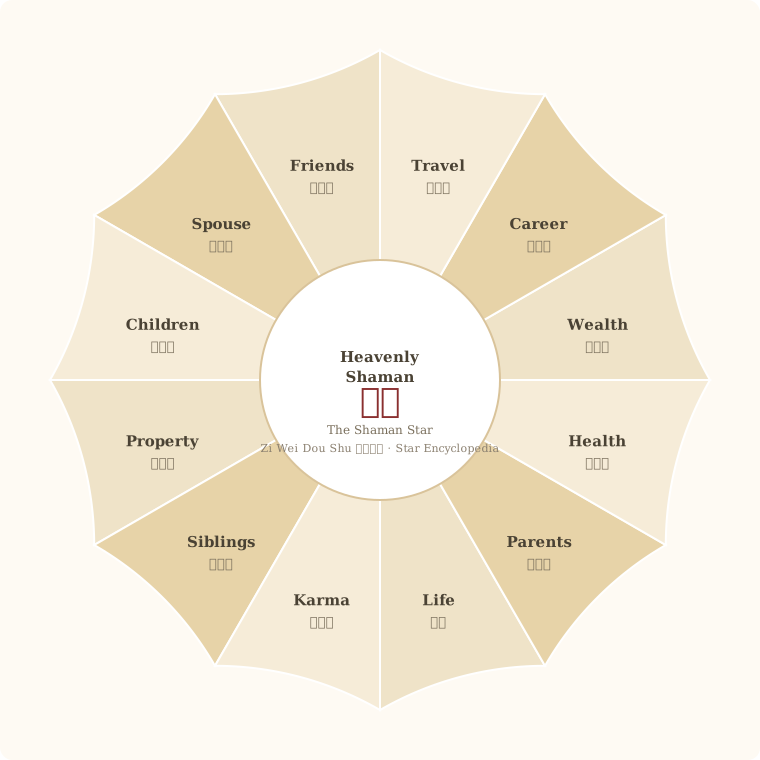
Core Attributes
| Chinese | 天巫 |
|---|---|
| Pinyin | Tian Wu |
| English | Heavenly Shaman |
| Archetype | The Shaman |
| Category | Minor |
Personality & Temperament
Tian Wu people carry an instinct for the unseen: strong intuition, a spiritual temperament, and a natural pull toward religion, healing, and the five arts. The classics call it the shaman's star and the physician's star - someone who learns esoteric and medical techniques quickly and feels called to pass on inherited knowledge. Whatever palace it occupies, the tradition says, someone in that sphere of life is drawn to metaphysics: in a six-relations palace it marks a relative with spiritual interests, in the Career Palace it points to a field where such skills can be exercised.
Its effect is strictly conditional. A minor star with no independent voice, Tian Wu turns auspicious with auspicious stars and inauspicious with inauspicious ones: with the Heavenly Beam (Tian Liang) in the Life or Wealth Palace it promises inheritance from elders; with the Horse star (Tian Ma) it forms the pattern called 'the shaman driving the horse,' a sign of transfer, travel, and promotion; with the noble aides it gains the favor of superiors. With weak or adverse stars the same energy colors the chart with dark imagination - suspicion, spirit-talk, and hidden harm done in the name of fate.
The shadow sits close to the gift: Tian Wu people can be superstitious rather than spiritual, reaching for ritual and mystery while ordinary work goes unattended, and the tradition warns that revealing heaven's secrets carelessly brings its own trouble. The remedy is the star's own teaching - study the arts seriously, practice healing, and let intuition serve discipline.
Heavenly Shaman in the Twelve Palaces
| Palace | Meaning |
|---|---|
| Life | Intuitive, curious, and quietly spiritual: quick to learn technical and esoteric skills, with a feeling of being guided. Needs a strong main star to convert insight into achievement rather than superstition. |
| Spouse | A partner with depth and possibly spiritual or medical interests - the classical rule says the palace Tian Wu occupies marks someone in that sphere drawn to the five arts. The bond carries an old-soul quality. |
| Wealth | Inheritance and elder-generated wealth are the classical promises - with the Heavenly Beam in the Wealth Palace, legacy property is the traditional reading. Otherwise money tends to arrive through skill and favor rather than commerce. |
| Health | A genuine medical affinity for the bearer: good access to healers and remedies, and a body that responds to traditional or alternative care. Intuition about one's own condition is usually reliable. |
| Travel | Movement with purpose: pilgrimages, study abroad, healing retreats, or relocation for advancement. With the Horse star, the classical 'Tian Wu drives the horse' pattern reads as transfer and promotion through travel. |
| Career | The star's 'place to display talent': careers in medicine, religion, healing, research, and the technical arts. With the Horse star it signals transfer and promotion; a strong main star makes the difference between recognition and stagnation. |
Key Star Combinations
- Tian Wu + Tian Liang (天巫天梁): The classical inheritance pairing: with these two in the Life or Wealth Palace, the tradition promises property or support from elders. It also deepens religious affinity - the Beam's compassion plus the Shaman's calling forms a devout, service-oriented spirituality.
- Tian Wu + Tian Ma (天巫赶马): The famous 'shaman driving the horse' pattern: transfer, relocation, and promotion, especially when the Treasury star (Lu Cun) joins - the texts say this combination marks advancement with fortune attached. Without supporting stars it loses most of its power.
- Tian Wu + Hua Gai (天巫华盖): The monk-and-eccentric signature: both stars mark talent in the five arts - Hua Gai leaning toward literature and metaphysics, Tian Wu toward medicine and ritual. Together they describe genuine esoteric skill and a calling to the unseen.
- Tian Wu + Tian Xing / Yin Sha (天巫天刑阴煞): The classical triad for metaphysical causation: the texts say Tian Wu with the Punishment and the Dark Spirit makes 'something very mysterious' - strong psychic sensitivity, karmic themes, and an intense spiritual life. Powerful for study; demanding on the psyche.
Common Questions
Does the Heavenly Shaman make a person a shaman?
No - it describes affinity, not profession. Tian Wu marks a person with intuition, spiritual curiosity, and quick hands for esoteric and medical arts; whether that becomes a vocation depends on the main star, the Career Palace, and the person's choices. Many bearers simply have a rich inner life and a knack for healing themselves and others.
How is the Heavenly Shaman placed?
Tian Wu is a month-based star of the lunar group. It cycles through the Si, Shen, Hai, and Yin palaces in a fixed pattern, repeating every four months from the first lunar month. As a fixed personal star it always occupies the same palace in a given chart.
What does 'Tian Wu drives the horse' mean?
The classical phrase (Tian Wu gan ma) describes Tian Wu meeting the Horse star (Tian Ma): a sign of transfer and promotion, traditionally strongest when the Treasury star (Lu Cun) is also present. The textbooks add that in such a period the useful directions are those for seeking teaching and healing - seeking the Way and seeking medicine.
Related Stars
Explore how Heavenly Shaman works with other stars: