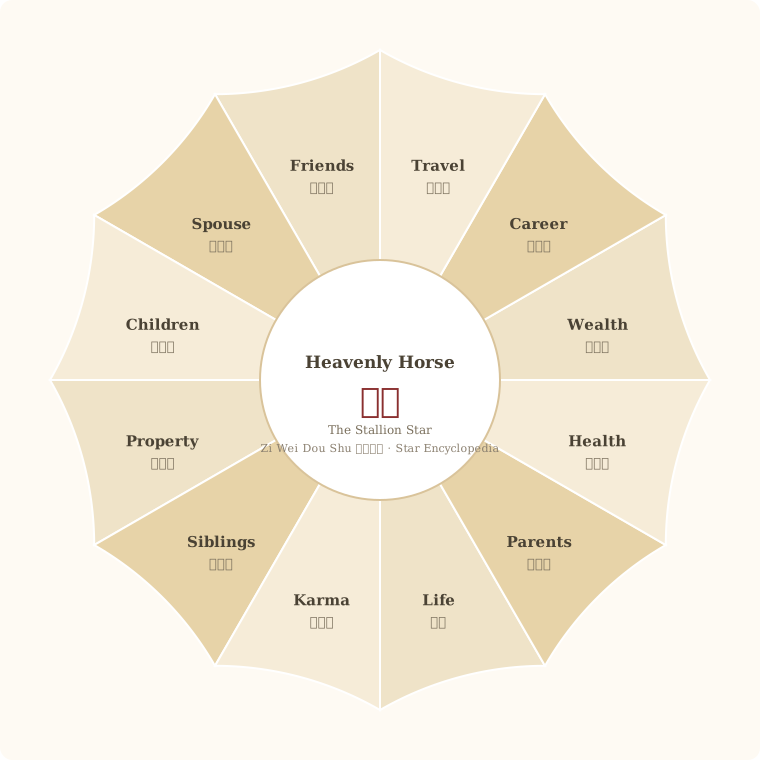
Core Attributes
| Chinese | 天马 |
|---|---|
| Pinyin | Tian Ma |
| English | Heavenly Horse |
| Archetype | The Stallion |
| Element | Yang Water |
| Category | Lu Ma |
Personality & Temperament
The Heavenly Horse describes someone who needs motion: new places, new roles, new problems. Fixed routines drain them; a changing environment charges them. Classical texts call this floating (浮动) — not a flaw but a temperament of movement, the person who learns by going rather than by staying. Quick, adaptable, and impatient, they process the world through experience. In the chart, the Horse is a carrier: it moves whatever it carries. With the Prosperity Star it becomes the Lu-Ma pattern — wealth through movement, the trader, the expatriate, the logistics empire. With the Sun it becomes the stallion of daylight — public, ambitious movement; with the Moon, the mare of the night — steady, financial movement. Its classical image is the courier: the one who runs, valued because something arrives because they ran. The shadow is rootlessness. Movement without cargo is the corpse-carrying horse — running hard, arriving with nothing; with Qing Yang the texts paint the exhausted runner whose credit is taken; with Tuo Luo the broken-legged horse that cannot start. The deeper caution is drift: moving to avoid decisions, changing jobs to avoid commitment, mistaking motion for progress. The tradition's advice: pack before you ride — skills, resources, contracts — and know where the stable is.
Heavenly Horse in the Twelve Palaces
| Palace | Meaning |
|---|---|
| Life | A restless, adaptable temperament that thrives on change and wilts in routine. Learning by doing, living in transit. The direction is set by what the Horse carries: with auspicious stars, opportunity; with adverse stars, motion without gain. |
| Siblings | Siblings scattered by distance — studying, working, or living abroad; the family gathers rarely. Classical texts note brothers and sisters who meet and part (聚少离多), and with Sky Mechanism or Heavenly Beam, separation becomes the permanent pattern. |
| Spouse | A partner who moves often — a job that travels, a relocation, or long-distance phases. The marriage itself may cross regions or cultures. The classical caution: the Horse here can mean separation by distance; the bond must survive the gaps. |
| Children | Children who leave home early — study abroad, distant jobs, independent lives. The parent watches from afar. The bond is maintained by movement: visits, calls, reunions. Fewer children, or children raised partly away from home. |
| Wealth | Income from movement: sales, trade, logistics, consulting — anything that requires being somewhere new. The Lu-Ma pattern concentrates here, wealth earned in distant places. Money flows through activity; sitting still dries the source. |
| Health | A body built for motion that suffers when confined. Classical texts link the Horse to travel accidents and foot or leg complaints, especially with Fire stars. The discipline: rest at intervals; treat travel as a health matter. |
| Travel | The Horse's home palace: constant travel, foreign connections, a life defined by distance. Travel is not leisure here but the main channel of life — work, relationships, and fortune move along the road. |
| Friends | Friends from many places: classmates abroad, colleagues from past cities, a network that spans geography. Friendships are kept alive by travel. The shadow: the network is wide but shallow — many acquaintances, few who stay. |
| Career | A career of movement: transport, trade, sales, media, international business — fields that relocate people or goods. Promotion comes through mobility, by going where the work is. With auspicious support, rising through postings; without it, changing jobs without advancing. |
| Property | Homes that change often — renting, relocating, several residences. Property may be foreign or in another city. Classical texts favor movable assets over fixed ones; the advice is to keep holdings liquid and easy to leave. |
| Fortune | Inner satisfaction found in motion and novelty; stagnation feels like failure. The classical warning is the dead horse: a restless mind with no destination. With structure — a strong major star or the Lu-Ma pattern — the inner life becomes exploration rather than escape. |
| Parents | Parents or family originally from elsewhere; early life includes moves — schools, cities, countries. The bond with parents is maintained across distance. Family patterns of migration often repeat in this chart. |
Key Star Combinations
- Tian Ma + Lu Cun (天马禄存): The Lu-Ma pattern: prosperity through movement. The classical verse — wealth earned in distant places (禄马交驰,发财于远乡) — describes trade, logistics, international careers, and fortune made where home is not. The tradition's correction: the Horse must carry cargo — skills, product, contracts first; then miles convert into money. Without cargo, the running is just fatigue.
- Tian Ma + Zi Wei or Tian Fu (天马紫微/天府): The carriage horse (扶鸾马): the movement star carrying the Emperor or the Regent. Movement that serves an institution — postings, rotations, expatriate assignments inside a large organization — and promotion through those postings. Classical texts favor this for government, banking, and big companies: rise by going where you are sent.
- Tian Ma + Tian Ji (天马天机): Movement doubled: the strategist in transit. Restless intellect, frequent changes, study abroad, and careers in logistics, information, or international affairs. The classical warning is scattering — many starts, few finishes — unless an auspicious structure anchors the pair. With Lu Cun or a transformed Prosperity, the restlessness becomes a trading mind.
- Tian Ma + Tai Yin (天马太阴): The mare of the night (雌马): movement that earns steadily and quietly — finance, property abroad, import-export, or a career run from another city. The Moon's caution applies: in fallen positions the mare turns lazy — delays, ambiguity, half-finished moves. In strong positions, it is one of the chart's most profitable mobile patterns.
Heavenly Horse and the Four Transformations
The Heavenly Horse is an auxiliary star and does not take part in the natal Four Transformations (四化): no year stem produces its Prosperity, Authority, Recognition, or Obstruction. Its power is activated by pairing — most famously with the Prosperity Star in the Lu-Ma pattern — and by luck cycles, where the arrival of a transit horse marks a period of travel, relocation, and movement.
Classical Source
在数主奔驰、迁动。为车船、交通、道路。天马为行动星,主好动、冲动、迁动、调动、外出、远行、奔走、快速。其好坏皆随人流行,逢吉则善,逢凶则恶。
The Heavenly Horse rules galloping and movement: vehicles, boats, transport, and roads. It is a star of action — restlessness, impulse, relocation, transfer, going out, distant travel, and haste. Its quality follows the company it keeps: with auspicious stars it is good; with inauspicious stars it turns harmful.
Common Questions
Is the Heavenly Horse a sign that I will travel?
It describes movement as a life pattern: relocations, study abroad, frequent business travel, or a career that moves people and goods. The classical texts treat it as the star of mobility, and transit years mark periods of active movement. But the Horse is a carrier, not a destiny — its direction depends on what it carries. With the Prosperity Star it moves toward wealth; with adverse stars it moves without gain. In one city, the Horse may simply mean an active, mobile working life rather than emigration.
What is the Lu-Ma pattern and does it guarantee wealth?
It is the meeting of the Prosperity Star and the Heavenly Horse — classically, wealth earned in distant places (禄马交驰). It describes income that comes through movement: trade, logistics, expatriate work, sales in new markets. The tradition is explicit that this wealth is hard-won — the image is the whip-breaking horse, running so hard the whip snaps. It accumulates gradually, order by order, not overnight. And it requires the Horse to carry something: skills, capital, or contracts. Empty, it is just exhaustion.
Does the Heavenly Horse have adverse combinations?
Yes, and the classical texts give them vivid names. With Qing Yang it is the corpse-carrying horse — exhausting work whose credit goes to others; with Tuo Luo the broken-legged horse — plans that stall just before departure; with Mars the war horse — impulsive movement and accident risk in transit. These are warnings, not curses: contracts in writing, preparation early, impulse control on the road. The Horse amplifies whatever it meets — that is its whole nature.
Related Stars
Explore how Heavenly Horse works with other stars: