Core Attributes
| Chinese | 华盖 |
|---|---|
| Pinyin | Hua Gai |
| English | Canopy Star |
| Archetype | The Canopy |
| Category | Minor |
Personality & Temperament
The name comes from the ceremonial canopy that sheltered emperors and deities, and the tradition reads it as the mark of extraordinary talent and unconventional vision. People with Hua Gai in the Life Palace tend to be intelligent, quick, and gifted with unusual abilities: an excellent memory, a sharp original mind, and a taste for ideas against the crowd. They are proud, self-contained, and selective about company — aloof and unyielding by the old texts, yet quietly generous: quick to help the vulnerable, slow to join the herd. The same canopy that marks their brilliance also shades them, and the old texts expect loneliness in middle and late years — at least the feeling of it — and notes that Canopy charts find their deepest comfort in art, philosophy, or the study of the five arts (五术).
The shadow is the pivot: when life disappoints, isolation can harden into pessimism or withdrawal. The classical remedy is direction — religious or metaphysical study, where the temperament that felt like exile becomes a vocation. Hua Gai is a star of affinity rather than destiny: it measures how a person relates to the unseen, and whether that relation becomes loneliness or sanctuary.
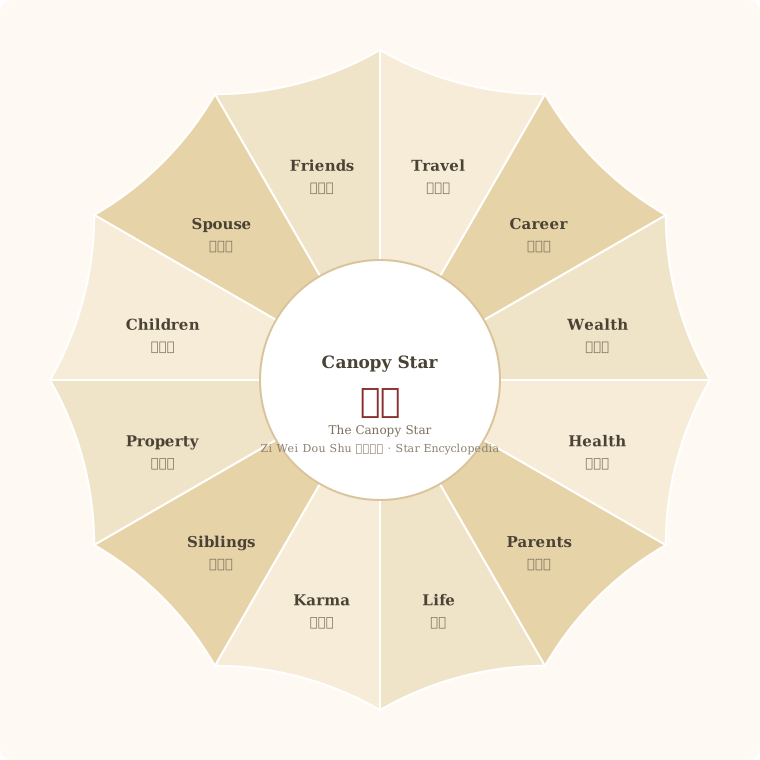
Canopy Star in the Twelve Palaces
| Palace | Meaning |
|---|---|
| Life | Independent, brilliant, self-contained: an unusual mind with strong opinions and little need for approval. Solitary by temperament; kinship comes easier with art, philosophy, or religious study than with crowds. |
| Spouse | A marriage of depth rather than convenience; the bearer needs a partner who respects solitude. Late marriage is traditionally favored. The bond is intense when it forms, but inner space is guarded. |
| Wealth | Money is not the canopy's native language; material concerns feel secondary to inner life. Income often arrives through talent — writing, art, or specialized skill — rather than commerce. |
| Health | Generally robust, with stress gathering in the mind: overthinking, insomnia, nervous tension under pressure. Solitude restores; forced sociability drains. |
| Travel | Travel tends to be purposeful and inward: study, pilgrimage, artistic retreats, or work away from home. Unusual places — temples, libraries, remote landscapes — leave a deep impression. |
| Friends | Few friends, deep ones: a selective circle of unusual, intelligent people rather than a wide network. Superficial socializing exhausts. |
| Career | Careers with depth and meaning: research, writing, art, law, or the healing and metaphysical professions. Stands out for originality; may prefer independent work to large organizations. |
Key Star Combinations
- Hua Gai + Zi Wei (紫微华盖): The Canopy is, by name, the royal umbrella, and the classical texts say it rejoices beside the Emperor. Together they describe a person with authority over the inner life: a natural leader of spiritual or philosophical movements, often with a genuine religious calling — temple, teaching, or a lifelong study of the unseen. The tradition singles out this pairing for the strongest religious affinity of any minor-star combination.
- Hua Gai + Ju Men (华盖巨门): Ju Men, the star of speech, turns the Canopy's solitary brilliance into words. The classical texts record that this combination gives exceptional eloquence: a sharp tongue, a philosophical bent, and the ability to articulate ideas most people only sense. Careers in writing, teaching, analysis, or debate fit naturally. The shadow is a tendency to argue from pride.
- Hua Gai + Tian Wu (华盖天巫): Tian Wu is the minor star of sorcery, medicine, and inherited arts. With the Canopy it forms the classic monk-and-eccentric signature: technical genius, curiosity about the esoteric, and real skill in the five arts. Hua Gai leans toward literature and metaphysics, Tian Wu toward medicine and ritual — together, a full toolkit for the study of the unseen.
- Hua Gai + Di Kong / Di Jie (华盖空劫): The Void stars dissolve attachment, and with the Canopy they tip the chart decisively toward religion and philosophy. With the Emperor and the Breaker (Zi Wei and Po Jun) also present, the classical texts call it a religious formation — the pattern of a teacher, priest, or founder. Material ambition fades; inner seeking dominates.
Common Questions
Is the Canopy Star auspicious or inauspicious?
Neither, cleanly. Hua Gai describes a temperament — brilliance, solitude, and affinity for the esoteric — that becomes blessing or burden depending on the stars around it. With auspicious stars and strong palaces it produces artists, scholars, and spiritual teachers. Alone or with adversity stars, the same temperament can become isolation, pessimism, or withdrawal. The tradition's advice is consistent: give the Canopy direction through art, philosophy, or religious study, and its shadow turns into vocation.
What does Hua Gai with Zi Wei mean for religion?
Classical texts call this the strongest religious affinity among the minor-star combinations. Zi Wei lends authority and the Canopy lends the sacred umbrella: together they describe someone who leads rather than follows in spiritual matters — often a temple connection, a teacher, or a serious lifelong student of metaphysics. It does not predict ordination; it describes the shape of the calling if the person chooses to answer it.
Why is Hua Gai associated with loneliness?
The canopy shelters one figure. Classical readings expect a proud, self-contained temperament that stands apart from the crowd, and a middle-to-late life that is solitary at least in spirit. This is why the texts pair Hua Gai with late marriage and with religious or artistic direction: the loneliness is real, but it is also the raw material of depth. Understood this way, the solitude becomes chosen rather than imposed.
Related Stars
Explore how Canopy Star works with other stars: