Core Attributes
| Chinese | 阴煞 |
|---|---|
| Pinyin | Yin Sha |
| English | Dark Spirit |
| Archetype | The Hidden Malice |
| Category | Minor |
Personality & Temperament
In the Life Palace, Yin Sha describes a person who perceives more than is said: an instinct for motives, moods, and hidden agendas, sometimes reaching into genuine psychic sensitivity. The classics give the star two faces - the sixth-sense face, valued in divination and the esoteric arts, and the shadow face, an atmosphere of suspicion, secrecy, and unexplained friction. People with Yin Sha prominent tend to be private, observant, and hard to read: they know things before they are told, and they rarely show their full hand.
Its harm is conditional, and the tradition is explicit about the condition. A minor star has no independent voice, so the destructive side of Yin Sha only manifests when it is entangled with harmful stars - the Sword, the Lasso, the Emptiness group, or a jealousy transformation. Where it sits, it marks the palace where invisible resistance gathers: hidden enemies in the human-relations palaces, inexplicable friction at work, a sense of something behind the curtain that hard work alone cannot move. The classical image is a hidden companion: not the enemy itself, but the shadow that warns an enemy is near.
The shadow temperament mirrors the star: suspicion that curdles into paranoia, secrecy that isolates, and a habit of reading plots into coincidence. But the same sensitivity, handled well, becomes the asset - intuition, discretion, and early warning. The textbooks' practical counsel is consistent: keep the main star strong, keep auspicious helpers close, and treat Yin Sha as a radar that needs calibration rather than a curse.
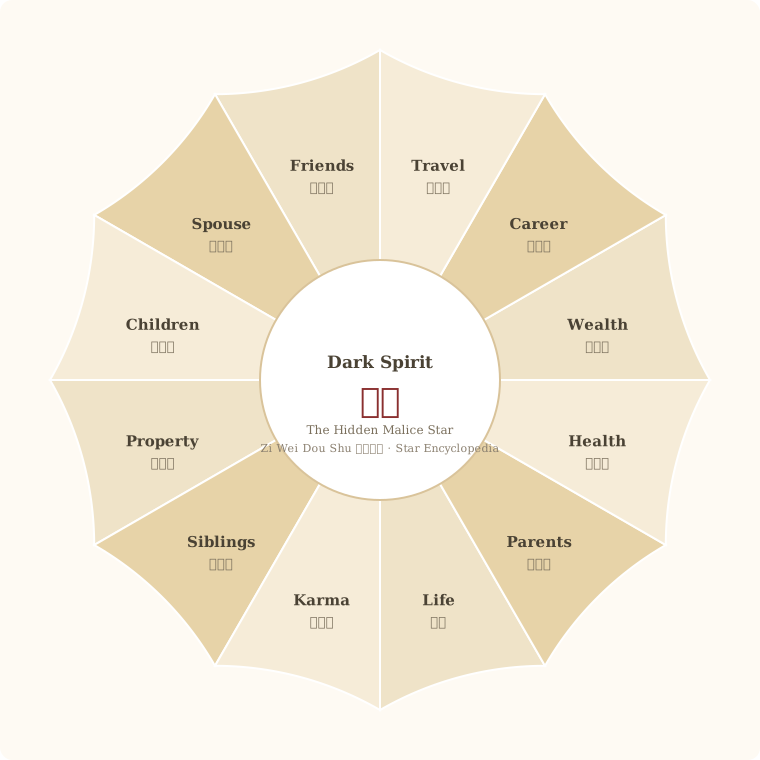
Dark Spirit in the Twelve Palaces
| Palace | Meaning |
|---|---|
| Life | A private, observant nature with genuine intuition: reads people quickly and dislikes exposure. The same gift can become suspicion and secrecy if the main star is weak or harmful stars crowd the palace. |
| Spouse | The classical note: inexplicable quarrels and hidden tensions in the marriage - small misunderstandings neither side can quite name. With the Relief Star or strong auspicious stars the friction dissolves instead of accumulating. |
| Wealth | The risk is hidden loss rather than open failure: fraud, theft, unexplained drains, deals that turn out differently than promised. Careful record-keeping and trusted advisors are the traditional countermeasure. |
| Health | The classical reading: complaints that resist diagnosis - hidden ailments, chronic unease, and in the old texts a karmic-illness tint when the Health Palace is involved. Good doctors and transparent habits help more than speculation. |
| Travel | Travel carries a caution note in the classics: hidden hazards abroad, petty schemes, and a need for vigilance with strangers and belongings. With auspicious stars the same trips simply feel watchful and turn out fine. |
| Career | Invisible friction in the workplace: hidden rivals, leaked information, credit stolen quietly. With strong auspicious support the same position reads as sharp political instinct - the person who sees the play before it is made. |
Key Star Combinations
- Yin Sha + Tian Xing / Tian Wu (阴煞天刑天巫): The classical metaphysical triad: the Punishment and the Shaman with the Dark Spirit make 'something very mysterious' - strong psychic sensitivity, karmic themes, and a serious pull toward the esoteric. Powerful for study, demanding on the psyche; the Relief Star in the chart softens the darkness.
- Yin Sha + Hua Gai (阴煞华盖): Two 'unseen' stars together: intense intuition and spiritual curiosity, often with real talent for divination and inner work. The Canopy lends brilliance and direction to the Dark Spirit's sensitivity - the combination reads as a gift for the esoteric rather than a curse.
- Yin Sha + a jealousy transformation (阴煞逢化忌): The classical activation frame: a jealousy transformation ignites the hidden malice - plots, deception, and suspicion become active rather than dormant. This is the context in which the texts warn seriously; without it, Yin Sha mostly describes atmosphere.
- Yin Sha + Lu Cun / Tian Ma (阴煞逢禄马): The classical remedy: the Treasury and the Horse dissolve the Dark Spirit's hold - resources, movement, and auspicious energy break the hidden resistance, turning potential enemies into non-issues or even helpers. The texts say hidden malice yields where fortune flows.
Common Questions
Does the Dark Spirit mean hidden enemies?
It marks a tendency - a palace where invisible friction can gather - but the classical sources are explicit that Yin Sha only becomes harmful when activated by harmful stars or a transformation. With auspicious stars it describes intuition and discretion instead: the person who senses trouble before it arrives.
How is the Dark Spirit placed?
Yin Sha is a month-based star of the lunar group. It cycles through the Yin, Zi, Xu, Shen, Wu, and Chen palaces: the Yin (Tiger) palace in the first lunar month, then stepping backward two palaces per month, with the same six-palace cycle repeating for the second half of the year.
Can Yin Sha be useful?
Yes - the tradition values it as a sixth-sense star: in the Life or Body Palace it can give excellent intuition, early warning of danger, and real talent for the esoteric arts. The same sensitivity that reads hidden malice can read hidden opportunity. The difference is the company it keeps: activated by harm it corrodes; supported by good stars it sharpens.
Related Stars
Explore how Dark Spirit works with other stars: