Core Attributes
| Chinese | 天官 |
|---|---|
| Pinyin | Tian Guan |
| English | Heavenly Officer |
| Archetype | The Official |
| Category | Minor |
Personality & Temperament
The classical name is the office granted by heaven (天赐之官): a star of clean refinement and official standing rather than wealth. In the Life Palace it describes someone born with an official seal - a person who naturally directs, delegates, and organizes, and whose words carry weight even without a title. The tradition calls this nature clear-minded, principled, far-sighted, and quietly intelligent, with a strong instinct for rank and structure.
As a minor star, the Officer only expresses what the main star allows. With a strong, well-placed main star it becomes genuine authority: leadership, promotion, and the respect of superiors. The classical texts pair it with the Heavenly Beam (Tian Liang); together they describe the bearing of a cultivated official whose reputation rests on refinement rather than force. In modern terms, think of management, public institutions, or any role where credibility is the working currency.
The shadow is refinement without drive. The same text that praises the officer's principles notes a love of ease: this person can be lazy, impatient with long grinding work, and reluctant to share private troubles. Pride can outrun substance when no strong main star supports the palace, and the tradition adds that when the Officer meets harmful stars, rank becomes entangled with secrecy, disputes, and gossip. It is a star of position - and position, without support, is only a title.
Heavenly Officer in the Twelve Palaces
| Palace | Meaning |
|---|---|
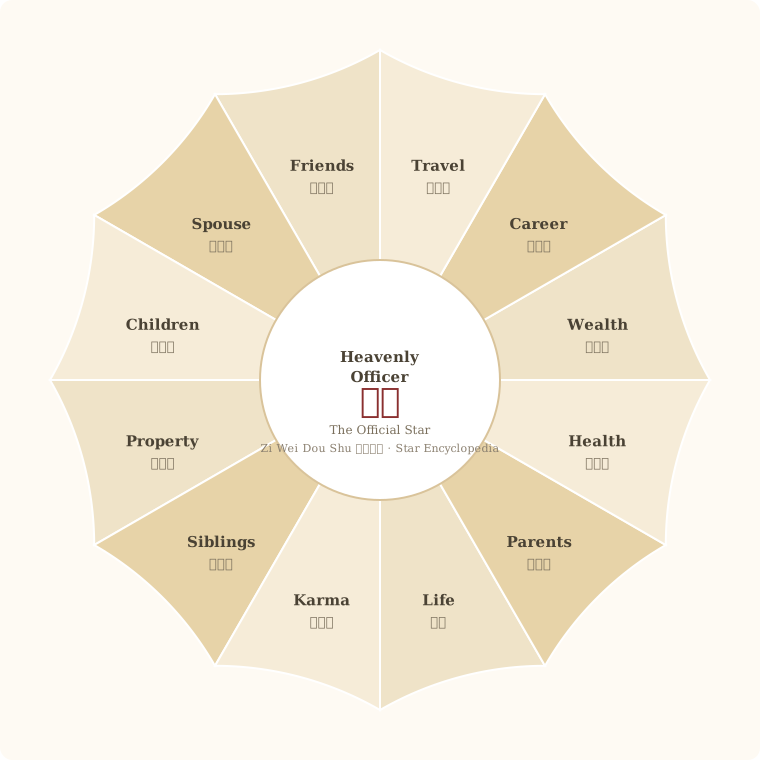
| Life | A composed, principled presence with an instinct for rank. Directs others naturally and expects order; can be aloof and secretive about private worries. Refinement shows, but so does a certain distance. |
| Spouse | A relationship with form and standing, often with a partner of rank or reputation. The bond is dignified but emotionally reserved - duty expressed clearly, feelings admitted sparingly. |
| Wealth | The tradition groups the Officer with the noble stars that do not directly produce money: income arrives through favor, promotion, and trust, rather than speculation or trade. |
| Travel | Moves well in formal settings - delegations, conferences, institutional business. Recognized abroad more for office and bearing than for warmth; adapts through propriety. |
| Friends | Attracts people of position and influence; connections tend to be formal and purposeful. Peers respect this person's judgment, but close friendship comes slowly. |
| Career | The classical seat for this star: official honor, promotion by merit, and respect from superiors. Leadership roles suit it, especially with a strong main star; without support, position can exceed achievement. |
| Fortune | Rewards that arrive late, through others' recognition: honors, titles, and quiet favors. Comfort in later life depends on the main star's strength; ease without effort is the risk. |
Key Star Combinations
- Tian Guan + Heavenly Beam (天官天梁): The classical pairing of the officer with the mentor: the bearing of a cultivated official and a reputation for fairness. With a strong Heavenly Beam it supports advisory and leadership roles - law, teaching, public service - where wisdom earns authority. Fame of the quiet kind: respected more than feared.
- Tian Guan + Heavenly Blessing (天官天福): Rank with comfort. The Officer supplies position, the Blessing supplies the ease and favor that make office pleasant. Together they describe promotion with good fortune attached - a superior who trusts, a post that suits, and rewards that match the effort.
- Tian Guan + Emptiness stars (天官逢空亡): The tradition notes that when the Officer meets the Emptiness group, rank loses its outer form: authority without a title, influence that works informally, or a post in an unorthodox field. Real command that never quite becomes public office.
- Tian Guan + adversity stars (天官逢煞): With harmful stars the same authority turns secretive: confidential work, sensitive information, roles that require discretion. The classical text adds that disputes and gossip follow. Usable - intelligence and secrecy - but costly for peace of mind.
Common Questions
Does the Heavenly Officer guarantee a government career?
No. As a minor star it has no independent voice - it colors the main star in its palace, and its expression depends on that star's strength. With a strong main star and a well-supported Career Palace, it points to leadership and official recognition; in a weak palace it describes dignity without traction. Modern equivalents include management, institutions, and any field where credibility is the currency.
How is the Heavenly Officer placed?
Unlike year-branch stars, the Officer is anchored by the year stem: Wei in Jia years, Chen in Yi, Si in Bing, Yin in Ding, Mao in Wu, You in Ji, Hai in Geng, You in Xin, Xu in Ren, and Wu in Gui. Stem placement makes it a fixed personal star: the same chart always carries the same Officer, and its meaning still depends on the main star sharing its palace.
Is Tian Guan auspicious everywhere?
The classical texts list it among the seventeen auspicious mid-heaven stars and say it is favorable in the Life, Body, and Career Palaces. But for a minor star, auspicious means it adds a good color: the Officer contributes dignity and rank only where the main star can support it, and its shadow - pride, secrecy, love of ease - shows where the main star is weak.
Related Stars
Explore how Heavenly Officer works with other stars: