Core Attributes
| Chinese | 天贵 |
|---|---|
| Pinyin | Tian Gui |
| English | Heavenly Nobility |
| Archetype | The Nobility |
| Category | Minor |
Personality & Temperament
Tian Gui assists the Heavenly Axe (Tian Yue), most auspicious in the same palace: a star of noble bearing that strengthens reputation and connection - the honored, the risen, the blessed of heaven. In the Life Palace it paints a person of heavy, honest character: trustworthy, sparing with speech, rational and single-hearted - and, the tradition adds, proud, solitary, hard to mix with.
Its register is quality that draws favor without effort. Tian Gui is auspicious in every palace, and the palace it occupies is where one is honored: in the Life Palace, a lifetime of noble assistance and gifts; in youth, good grades and attention. It favors examinations - with the literary stars, success in the examination hall is the note - and modern reading adds the near-noble constant: with Tian Gui in the Life or Body Palace, people keep finding themselves near the influential, and danger softens. With the Heavenly Beam (Tian Liang) and the Heavenly Minister (Tian Xiang), the texts count it among stars of noble birth.
The shadow is nobility without warmth. The same text calls its bearer aloof, opinionated, unapproachable - the aristocrat who cannot sit with common people. The classical caveat: its force is small on its own - refinement without a strong main star is only a manner, and 'noble' does not mean 'wealthy'; the register is the air of the palace, not its treasury. The luck is real, but it is the luck of being received, not fed.
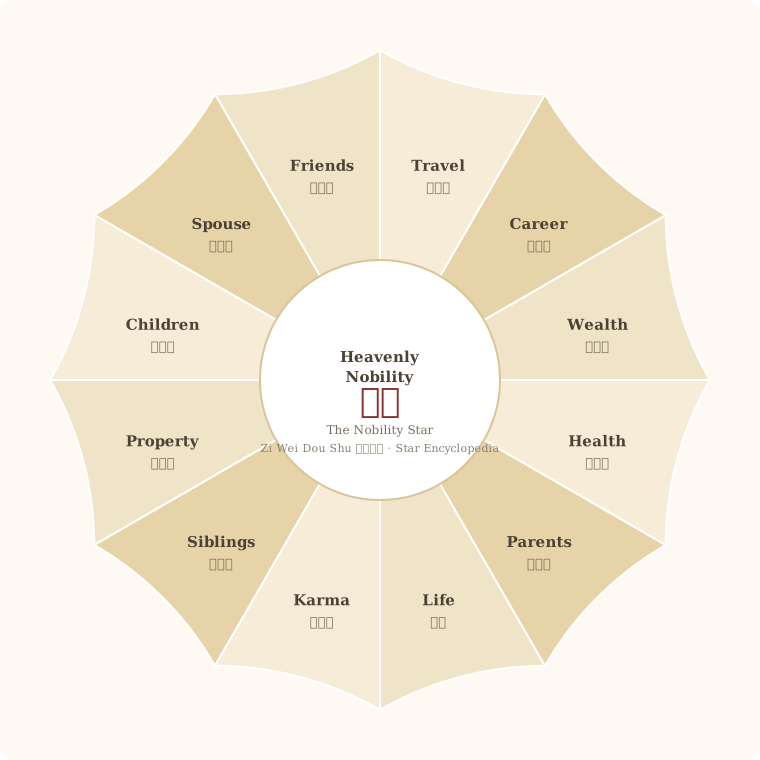
Heavenly Nobility in the Twelve Palaces
| Palace | Meaning |
|---|---|
| Life | Honest, dignified, and reserved: a person of quality with natural access to influential circles. Proud and solitary by temperament; the air of nobility shows before its substance. |
| Spouse | A partner of quality: the tradition says a woman with this star marries a man of standing, with honor in view. The bond is dignified, formal, and loyal. |
| Wealth | Nobility, not wealth: income arrives through reputation, favor, and access rather than speculation. The register is high but the treasury is the main star's business. |
| Travel | Honored abroad: reception by people of standing in other places, and protection that softens trouble on the road. The noble air travels well. |
| Friends | The near-noble circle: influential friends and mentors appear without being sought. Connection is easy, intimacy is not - the star stands apart even among its own. |
| Career | The palace of honor: commendations, notice from superiors, and a reputation for integrity. With a well-placed main star, leadership and standing; the classical texts note strength in the Yin and Chen palaces. |
| Fortune | A life that is not overworked: the tradition says Tian Gui in the Life Palace means ease from strain, awards, and the help of others across the years. Danger softens; the main star decides the depth of the cushion. |
Key Star Combinations
- Tian Gui + En Guang (天贵恩光): The paired stars of nobility and grace: together they carry special honor and rank and are counted far stronger than either alone. Reputation rises, rewards follow, and the palace they grace becomes a place of visible favor - most auspicious with the Emperor, the Sun, and the Moon in support.
- Tian Gui + Heavenly Axe (天贵会天钺): The classical pairing: Tian Gui serves Tian Yue and is most auspicious with it in the same palace. The Axe's noble patronage gives the star's air a hand to hold - favor from above becomes concrete, and the chart's nobility gains a protector.
- Tian Gui + Literary stars (天贵会昌曲): The examination formula: with Wen Chang and Wen Qu, success in the examination hall is the classical note - and in modern terms, credentials, competitions, and public honors. The tradition adds that with a well-placed main star, even harmful stars cannot block the pass.
- Tian Gui + Heavenly Beam (天贵会天梁): The classical texts count Tian Gui with Tian Liang and Tian Xiang among the stars of naturally noble birth: the Beam's rectitude plus the star's quality describes a person honored by character - integrity that attracts protection, favor, and standing without the pursuit of either.
Common Questions
Does Tian Gui mean I was born noble?
It describes a tone, not a biography: the tendency to carry an air of quality, to be received by influential people, and to receive help without asking. As a minor star it has no independent force - the substance of the nobility follows the main star's strength, and the classical texts note the star's own power is small.
How is Tian Gui placed in the chart?
Tian Gui is a day-based star: begin at the palace of the Literature Music star (Wen Qu) as the first day of the lunar month, count forward clockwise to the birth day, and then step back one palace - the star lands there. Its meaning follows the main star that shares its palace.
What is the difference between Tian Gui and En Guang?
Both belong to the pair of conferred grace, but the emphasis differs: En Guang is favor received - the borrowed light, the patron's hand - while Tian Gui is quality possessed, the noble air that attracts the favor in the first place. En Guang serves the Heavenly Noble (Tian Kui); Tian Gui serves the Heavenly Axe (Tian Yue). Together they describe being both worthy and noticed.
Related Stars
Explore how Heavenly Nobility works with other stars: