Core Attributes
| Chinese | 天刑 |
|---|---|
| Pinyin | Tian Xing |
| English | Heavenly Punishment |
| Archetype | The Punisher |
| Element | Yang Fire |
| Category | Minor |
Personality & Temperament
Tian Xing carries the heaviest reputation among the minor stars, and the least deserved. The tradition classes it as a star of punishment, but its nature depends entirely on company: auspicious, it disciplines others; inauspicious, it punishes the self. In a strong chart it is the law — iron principle, fierce intolerance of injustice, authority one can trust to judge; judges, officers, surgeons, and enforcers belong to its house. The temperament is solitary and serious: strong-willed, proud, hard to approach, unexpectedly kind beneath the shell. A signature turn: bearers are drawn, sooner or later, to religion or the esoteric — the star is karmic, and they feel the weight of consequence early. The shadow is the same force without a frame: punishment without justice turns inward. The month-school tradition is precise: harm comes only with stars of the same meaning — Precious Blade, Mars, the Sha-Po-Lang trio — and only when the transformations activate it. Alone, or with auspicious company, it is discipline, not doom.
The remedy the old texts give is the star's own medicine: law, medicine, or religion — a vocation that turns the blade outward and gives the conscience a purpose.
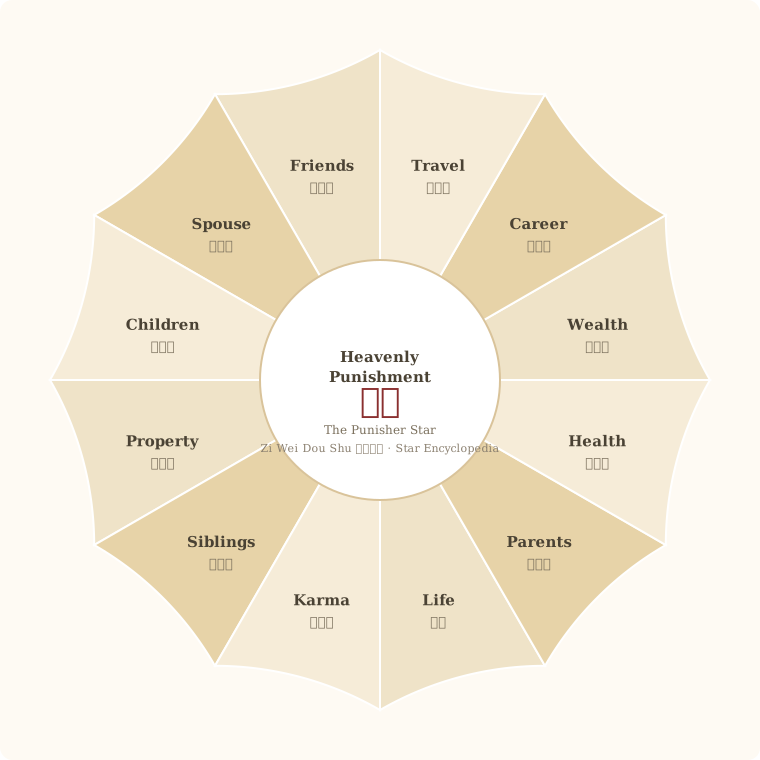
Heavenly Punishment in the Twelve Palaces
| Palace | Meaning |
|---|---|
| Life | Serious, principled, and solitary: an inner law that judges both self and others. Strong-willed, proud, with a soft core; drawn to justice, medicine, or the esoteric. |
| Spouse | A marriage of weight and loyalty: both partners take commitment seriously. The star's solitude must be respected — space is love here. With strong adversity stars, strain requires deliberate gentleness. |
| Wealth | Money handled with discipline: earned by rule, spent by principle, protected by caution. Gains through law, medicine, or enforcement of standards; wealth built, not gambled. |
| Health | A constitution that runs hot — Yang Fire — with classical cautions about surgery, injury, and accidents. Harm appears mainly when adversity stars and transformations join; a clean chart reads as resilience. |
| Travel | Travel with purpose and risk management: the road is checked before it is walked. Trips serve duty — work, study, family. With auspicious stars journeys are safe; alone, prepare. |
| Friends | Few friends, chosen for character: loyal, serious company that respects boundaries. The Punishment star thins the circle — neutral: fewer, deeper bonds. |
| Career | The star's natural stage: law, policing, military, surgery, or religion — roles with authority over consequence. Discipline marks the work; the danger is harshness without context. |
Key Star Combinations
- Tian Xing + Tai Yang (天刑太阳): The classical pairing for enforcement: Sun with Heavenly Punishment is the traditional signature of police and military careers. With a strong Sun or its Authority transformation, the reading is martial honor — command, law, public protection. The month-school caution: the combination grants authority to correct; whether it corrects justly depends on the chart.
- Tian Xing + Tian Liang / Zi Wei (天刑天梁紫微): The month-school tradition is explicit: with Sun, with Heavenly Beam in Authority, or with the Emperor, Tian Xing carries judicial authority — the right to judge. Modern terms: judges, regulators, ethics boards, anyone whose word carries consequence. The old texts insist such power requires what Tian Xing demands — principle before preference.
- Tian Xing + Tian Wu + Yin Sha (天刑天巫阴煞): The esoteric signature: with Tian Wu, the sorcerer's star, and Yin Sha, the shadow star, Heavenly Punishment becomes the chart's karma reader — deep affinity for the unseen, for cause and consequence, for the study of fate. The texts call it genuinely mysterious: people drawn to metaphysics, healing, or the priesthood, often with real sensitivity. The shadow: the same currents without discipline.
- Tian Xing + Adversity Stars (天刑会煞): The month-school rule is the most precise in the minor-star tradition: Heavenly Punishment produces injury or legal harm only with stars of the same meaning — Precious Blade, Mars, Seven Executives, Breaking Army, Greedy Wolf — and only when the transformations activate them. Without them, the star is discipline; with them, the texts advise care: law, roads, blades, temper.
Common Questions
Is Heavenly Punishment a dangerous star?
It is a stern star, not a doomed one. The month-school tradition is precise: Tian Xing's harms — injury, lawsuits, karmic setbacks — require two conditions: adversity stars of the same meaning, and activation by the four transformations. Alone, or with auspicious stars, it reads as discipline, principle, and authority. The classical advice: give the star a frame — law, medicine, military, or religion — and its severity becomes its strength.
What does it mean that Tian Xing is a karmic star?
The tradition reads Heavenly Punishment as the chart's internal sense of cause and consequence — the star that tracks what is owed, in both directions. With Tian Wu and Yin Sha it deepens into affinity for the unseen: metaphysics, healing, religion, the study of fate. In practice: a person who feels consequence early, takes responsibility seriously, and is drawn to justice and meaning. The karmic reading is descriptive, not predictive.
Why does Tian Xing combine with religion in the classical texts?
The tradition repeatedly pairs the Punishment star with the monastery and the shrine: it is listed among the stars with affinity for the five arts, and its bearers often turn to religion in middle age, especially after hardship. The reason is structural — the star is karmic, and religion is the system that makes karma navigable. In modern terms: they need a coherent answer to why things happen, and find it in law, philosophy, or faith.
Related Stars
Explore how Heavenly Punishment works with other stars: