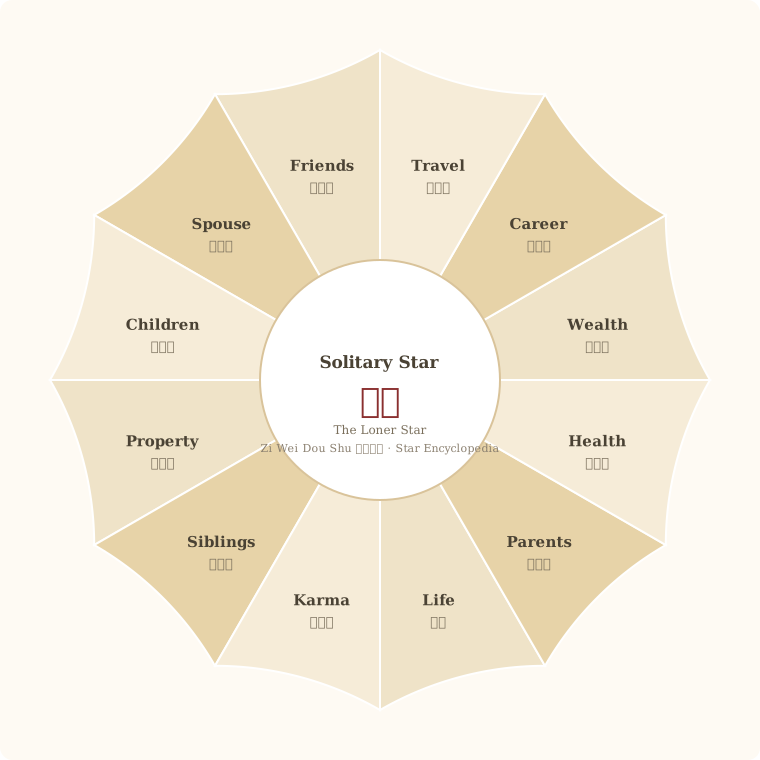
Core Attributes
| Chinese | 孤辰 |
|---|---|
| Pinyin | Gu Chen |
| English | Solitary Star |
| Archetype | The Loner |
| Category | Minor |
Personality & Temperament
The Solitary Star describes a self-sufficient temperament: independent, quiet, and happiest working alone. Classical texts sketch a person who dislikes crowds, keeps their own counsel, and may feel more at ease outdoors or with animals than in small talk. Independence is the gift: such people finish work without supervision, organize their own affairs, and do not depend on others for emotional fuel.
The star's role in a chart is to mark where solitude becomes a pattern. It often appears in the Life or Spouse Palace of people who marry late, marry at a distance, or simply value their private space. With strong main stars and helpful minor stars alongside, the reading softens into inner independence with little effect on career or relationships.
The shadow is distance that becomes a habit. Pride, stubbornness, and a refusal to explain oneself can turn independence into isolation, and classical texts warn that the star's harsher readings, estrangement from family, separation from children, only surface when austere main stars activate it. The Solitary Star reports the pattern of aloneness; the main stars decide how heavy it feels.
Solitary Star in the Twelve Palaces
| Palace | Meaning |
|---|---|
| Life | A person who values independence and may live alone by choice. Social life is quiet rather than empty; the recharge happens in solitude, and being managed feels like a violation. |
| Spouse | Tends toward late marriage, marriage at a distance, or a partnership with generous personal space. Classical texts advise later timing or separate rhythms; the bond works best when both sides respect solitude. |
| Travel | Comfortable away from home: thrives in unfamiliar places, drawn to open landscapes and remote settings, and may build a life far from the family home. |
| Friends | Few but deep connections. Social invitations get declined often and networking feels like effort; the friendships that remain are loyal and long. |
| Career | Independent work suits this placement: research, technical specialties, field assignments, solo responsibility. The person is often praised for completing tasks without supervision and for quiet reliability. |
| Fortune | A contemplative inner life: philosophy, religion, or spiritual practice as genuine comfort. Solitude here is sanctuary rather than loss. |
Key Star Combinations
- Solitary Star + Widow Star (孤辰寡宿): The full solitude axis. When both appear, the classical framework expects pronounced emotional independence, late marriage, or relationships with unusual distance. The combination also favors religious or philosophical interests. Its weight, however, depends on the main stars: with warm main stars it reads as a private person; with austere ones, as separation.
- Solitary Star + Seven Executives or Breaking Army (孤辰七杀): Austere main stars switch the star on. The classical texts say the solitary nature then expresses fully: time apart from family, marriage at a distance, children living elsewhere, and a life led on one's own terms. The same combination gives fierce independence and an unusual capacity to endure hardship alone.
- Solitary Star + Canopy (孤辰华盖): A strong marker of philosophical, religious, or esoteric interests. The Canopy deepens the star's detachment into contemplative genius: original thinking, study of the occult arts, and a life measured by inner growth rather than social standing. Late marriage is common in this combination.
Common Questions
Does the Solitary Star mean I will end up alone?
No. Most of the time it describes introversion, independence, and a need for personal space rather than a destiny of solitude. The classical texts themselves note that with strong main stars and helpers present, the star only adds inner independence while leaving career and relationships intact. Its heavy readings appear only when austere main stars activate it.
Why do classical texts call it an inauspicious star?
Because the classical framework valued family harmony and early marriage above all, and a star of distance seemed threatening to that ideal. The same trait, self-sufficiency, reads differently in modern life, where solo living and quiet temperament are ordinary choices. The respectful modern reading keeps the pattern and drops the alarm.
Does the Solitary Star hurt my career?
Usually the opposite. The star supports independent, focused, and self-directed work, and classical texts praise the person's ability to complete tasks alone with high standards. Career effects turn negative only when destructive stars crowd the same palace; by itself, solitude is a working style, not a handicap.
Related Stars
Explore how Solitary Star works with other stars: