Core Attributes
| Chinese | 地劫 |
|---|---|
| Pinyin | Di Jie |
| English | Earth Robbery |
| Archetype | The Depletion |
| Element | Fire |
| Category | Six Adversity |
Personality & Temperament
Earth Robbery people are bold, quick, and stubbornly unconventional. The tradition describes them as clever and decisive with real nerve, but careless with details and given to leaving things half-finished. Their distinctive trait is the maverick streak — a love of going against the current in business, fashion, and thought. Classical texts say they 'dare to do and dare to act,' and with the right main star this becomes genuine innovation; the traditional career list is telling: craft, carving, technical work, medicine, and the five arts.
The shadow is depletion by design: money spent and lost in patterns — theft, deception, failed deals, obligations that drain — and the psychology that goes with it, alternating between stinginess and waste, pessimism after setbacks, and the sense that success is a boat sailing in waves, always arriving late. The tradition says Earth Robbery losses come from outside, unlike the Void's inner drift, and that the person may watch their own earnings 'cut off by others.'
The old texts do not call it fatal, but they do not call it free either: with a strong main star and auspicious support, Di Jie charts are 'broken but not defeated' — entrepreneurs who spend first and earn later, technicians who build what others cannot. The same star with a weak chart is chronic leakage. Loss is the tuition; the question is what the person learns.
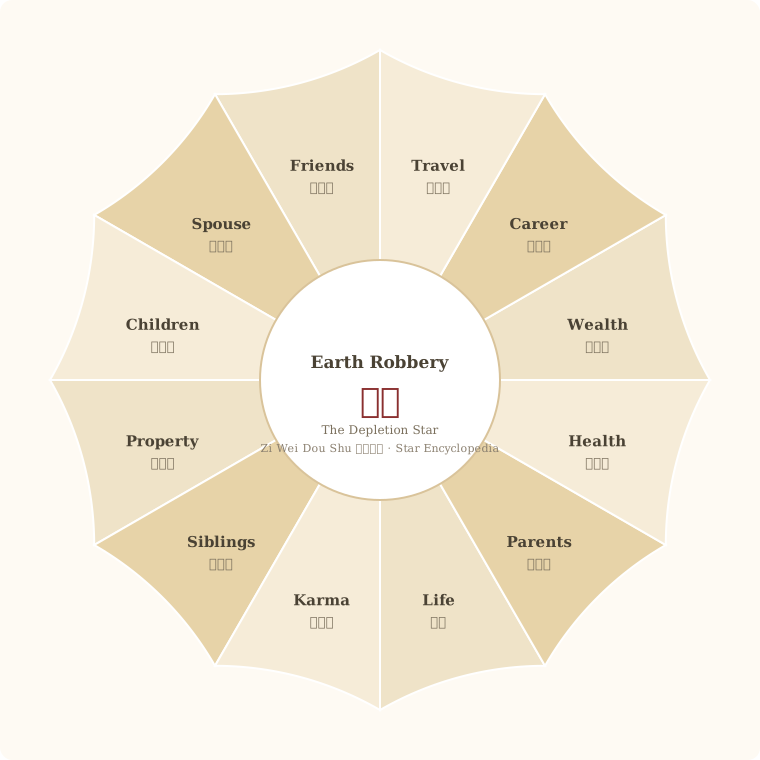
Earth Robbery in the Twelve Palaces
| Palace | Meaning |
|---|---|
| Life | Bold, unconventional, and restless: acts on instinct, resists orthodoxy, spends energy in bursts. Strong charts: founder and craftsman; weak charts: repeated material loss and pessimism. Money and trust need extra safeguards. |
| Siblings | Siblings who are individualistic and may drain resources — loans, disputes, dependence; boundaries are essential. Bonds exist but are tested by money; shared inheritance needs careful handling. |
| Spouse | A partner whose finances or lifestyle bring fluctuation; the marriage is unconventional in timing, background, or arrangement. Money disagreements are the main stress point; clarity beats romance. |
| Children | Children with maverick creativity — artistic, technical, or rebellious; they need freedom and mentorship, not control. Their path zigzags and blooms late; education in craft or technology serves them best. |
| Wealth | The signature palace of the star: income that leaks, deals that fail, theft and fraud risk, expenses that outrun earnings. The classical advice is blunt: avoid business speculation, avoid relying on promises, and convert income into skill and inventory rather than cash. |
| Health | Loss-themed health concerns: depletion, chronic fatigue, and injuries from haste or risky activity. The tradition ties the star to material strain affecting the body; regular rest and stable routines are the remedy. |
| Travel | Travel marked by mishap and expense — lost luggage, stolen goods, plans cut short — yet also by discovery: the maverick finds opportunity where others see trouble. Travel for craft, trade, or study repays the risk. |
| Friends | Friends who are unconventional and sometimes opportunistic; the tradition warns of being cheated or exploited by associates. Choose partners who have survived their own losses; generosity needs limits. |
| Career | Careers in craft, technology, surgery, mining, carving, and the arts — the tradition's list for the star. Work that produces tangible skill survives the drain; speculative and commission-based roles amplify it. |
| Property | Property that fluctuates: repairs, disputes, sales at bad moments, or loss through others' claims. The tradition advises flexible ownership — renting can beat owning when the star is fallen. |
| Fortune | An inner life of restless ambition and intermittent pessimism: high hopes followed by crashes, and the habit of 'thinking oneself inferior' after failures. The spiritual path of the star is acceptance — losing well — which turns the maverick into a sage. |
| Parents | Parents or mentors who are unconventional, hard-working, or financially struggling; family money is unreliable. Early lessons in loss teach self-reliance; inheritance matters are prone to dispute and delay. |
Key Star Combinations
- Sky Void + Earth Robbery (空劫同守): Both emptiness stars together create the most intense depletion pattern in the tradition: wealth lost, plans broken, 'a boat sailing in waves' with no safe harbor — the classical texts place the worst of it in youth and inheritance. Yet this pair is also the strongest unconventional wiring in the system: innovators, artists, and founders often carry it. Strong main stars make it 'broken but not defeated'; weak ones make it chronic drift. The double emptiness demands a craft or a calling.
- Earth Robbery + Salary Horse (空劫禄马): Modern masters describe a striking reversal of the usual reading: when the Depletion meets the Salary and Horse stars in the right structure, academic and technical workers gain promotion and achievement through research and theory — the emptiness becomes the space where knowledge is built. For officials and salespeople the same pattern warns of chances missed and gains absorbed. Context decides: the star rewards builders of intangible value more than traders of tangible one.
- Greedy Wolf + Earth Robbery (贪狼地劫): Appetite meets depletion: the classical tradition warns bluntly of fraud, theft, and deals that never land when Greedy Wolf and Earth Robbery combine — the person who wants everything and keeps losing it at the exchange. In strong charts the same combination is the daring entrepreneur: the texts note that many business founders carry the Void stars, spending first, earning later, giving generously and fighting to recover. Read it as a risk-management lesson: keep reserves, vet the deal, and expect to spend before you earn.
Earth Robbery and the Four Transformations
Di Jie has no place in the annual Heavenly Stems transformations (生年四化) and does not transform: it never turns to Prosperity (Hua Lu), Authority (Hua Quan), Recognition (Hua Ke), or Obstruction (Hua Ji). As one of the six adversity stars it supplies energy, friction, and pressure rather than transformation, so its expression is shaped entirely by the major star it accompanies and by the transformations already present in the chart.
Classical Source
中天凶星,劫杀之神,又名断桥煞。地劫为败坏之星,主物质损耗、负担重、暗患、破败、障碍、仇恨、阴谋、断魂、暗沟、地府。
The Earth Robbery is a hostile star of the Central Heaven, the god of robbery, also named the Broken Bridge. It is a star of ruin: material loss, heavy burden, hidden trouble, failure, obstruction, hatred, and scheming — the severed soul, the dark ditch, the underworld.
Common Questions
Does Di Jie mean a life of poverty?
No — it means a life of fluctuation around material things. The tradition's own examples are not paupers: many entrepreneurs carry the star, spending first and earning later, and with a temple-bright main star and auspicious support the charts are 'broken but not defeated.' The star taxes cash flow, not destiny: losses come from outside — theft, fraud, failed deals — and gains must be re-earned. Discipline converts the leakage into tuition.
How is Di Jie different from Di Kong?
The tradition separates the pair cleanly: Di Kong empties the inner world — spirit, emotions, stability — and its losses come from the person's own decisions, oversight, and overconfidence; Di Jie empties the material world — money, property, possessions — through external events: robbery, fraud, cheating, and expense. Di Kong is the hole inside; Di Jie is the leak outside. One is philosophical; the other is practical.
Can Earth Robbery be useful?
Yes, in exactly three ways the tradition acknowledges: it strengthens unconventional, creative, and maverick thinking; it suits craft, technology, and the five arts, where skill is the product and cannot be robbed; and in certain structures with the Salary and Horse stars it favors academic and technical careers, where theory is built in the empty space. The star rewards what cannot be stolen — skill, knowledge, and nerve.
Related Stars
Explore how Earth Robbery works with other stars: