Core Attributes
| Chinese | 地空 |
|---|---|
| Pinyin | Di Kong |
| English | Sky Void |
| Archetype | The Emptiness |
| Element | Fire |
| Category | Six Adversity |
Personality & Temperament
Sky Void people think differently, and the tradition admires them for it: original ideas, strong intuition, and a natural bent for innovation, philosophy, religion, and the arts. Classical texts say the Void stars 'both think uniquely and have excellent inspiration,' and that their people often turn to metaphysics or spiritual practice after a zigzag career — work at which they genuinely excel. In modern terms this is the designer, the scientist, the founder of a new school of thought.
The shadow is the emptiness itself: fantasy without follow-through, plans that dissolve mid-course, and the 'half-broken wing' feeling — talent that rises and collapses at its peak. The tradition warns of wealth that comes and goes, decisions that waver, and an inner restlessness that no possession fills. People with the Void can abandon their own interests, hand advantages away, and drift when the main star is weak.
The Void is the only star the tradition describes as neutral: 'meet misfortune, not misfortune; meet fortune, not fortune' — it cancels both. That neutrality is the key. With a strong main star and auspicious support it becomes breakthrough vision; with a weak chart it becomes chronic loss. The question is never whether Di Kong is present, but what surrounds it.
Sky Void in the Twelve Palaces
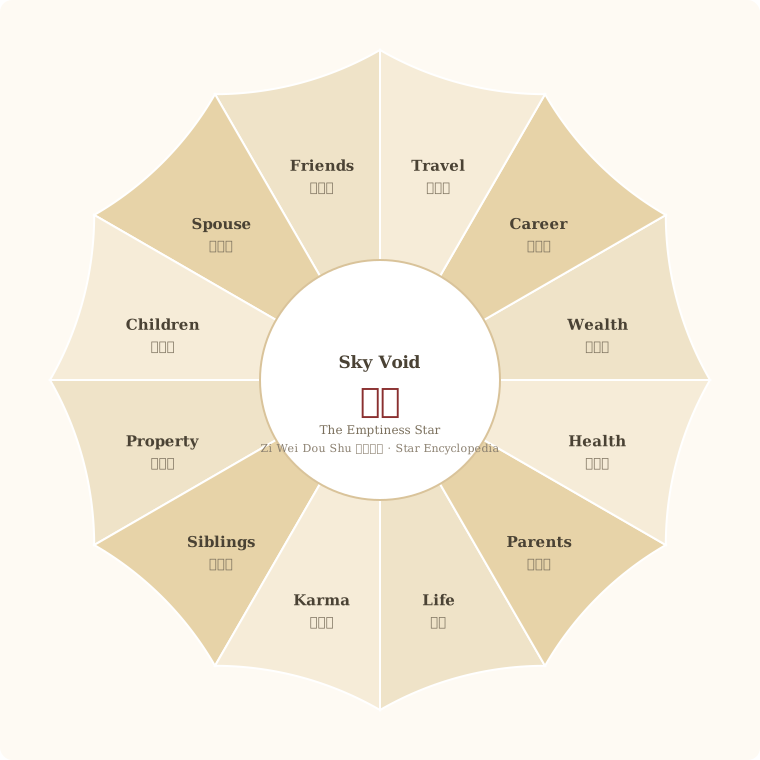
| Palace | Meaning |
|---|---|
| Life | A philosophical, imaginative, unconventional mind: original ideas, spiritual interests, and low attachment to material status. Restless and hard to pin down. Strong charts: visionary; weak charts: drifting, with plans that rarely land. |
| Siblings | Siblings who are individualistic and hard to organize; family bonds are loose but genuine. Relationships deepen through shared interests rather than obligation; distance — physical or emotional — is part of the pattern. |
| Spouse | A partner who values freedom and inner space; the marriage works when both sides respect solitude. The Void here favors late or unconventional unions and warns against possessive expectations. |
| Children | Children with artistic, spiritual, or scientific imaginations; they need freedom to explore and do poorly under rigid pressure. Fewer, later children are common; education should follow their curiosity. |
| Wealth | Wealth that does not accumulate by orthodox means: income flows in and out, windfalls evaporate, savings mysteriously shrink. The classical advice is to avoid speculation and invest in skill, knowledge, and innovation — the only currencies the Void respects. |
| Health | Conditions that are hard to diagnose: vague fatigue, nervous complaints, insomnia, and the mental exhaustion of overthinking. The tradition ties the Void to mental strain; grounding routines and physical discipline are the remedy. |
| Travel | Travel as spiritual or intellectual pilgrimage: journeys that change the way a person thinks, often involving temples, remote places, or study abroad. Plans change mid-route; the journey matters more than the itinerary. |
| Friends | Friends in creative, spiritual, and unconventional fields; a circle that values ideas over status. Attachments are free-floating — friends come and go with life phases, and that is accepted. |
| Career | Careers in innovation, research, media, design, philosophy, and metaphysics — the tradition's own list: aviation, meteorology, science, advertising, writing, and new product development. Orthodox ladders feel hollow; mission-driven work anchors. |
| Property | Property that changes hands repeatedly, is sold at the wrong moment, or carries unusual history. The Void dislikes over-investing in real estate; renting and flexibility often serve it better than ownership. |
| Fortune | The natural palace of the Void: a rich inner life of meditation, ideas, and spiritual seeking. Peace comes from embracing emptiness rather than filling it; the mind is happiest detached from outcomes. |
| Parents | Parents or mentors who are unconventional, spiritually inclined, or distant in practical matters; inheritance and family assets may be unstable. Early home life encourages reflection more than ambition. |
Key Star Combinations
- Fire Star + Sky Void (火空则发): The most celebrated Void formula: 'golden void rings — fame; fiery void erupts — fortune.' When the Void meets Mars in favorable positions — the texts specify Si and Wu for Mars, with fire-stem years — emptiness becomes a launchpad: sudden fame or fortune arriving out of nothing. The condition is strict: the position must be favorable and the main star strong; otherwise the explosion is only the sound of collapse.
- Bell Star + Sky Void (金空则鸣): The other half of the classical formula: the Bell rings through the Void — reputation born of emptiness. In favorable positions with metal-stem years this describes sudden public resonance: the writer who is discovered, the singer who goes viral, the scholar whose empty page becomes a field. In fallen positions the same ring is hollow: fame without foundation, applause that evaporates.
- Sky Void + Earth Robbery (空劫同守): Both Void stars together double the emptiness: the tradition calls it the most unstable of configurations — wealth lost, plans broken, a boat sailing in waves with no calm harbor — yet grants it the strongest unconventional wiring in the system. Many innovators and founders carry this pair. The classical reading is blunt: strong main stars make it 'broken but not defeated'; weak ones make it chronic drift.
- Sky Void + Salary Horse (空劫禄马): When the Void meets the Salary and Horse stars in the right structure, modern masters note a striking reversal: for academic and technical workers the pattern signals promotion and achievement through theory-building and research — the void's emptiness becomes the space where knowledge is constructed. For officials it warns of missed chances: the same emptiness that lifts a scholar swallows a bureaucrat. Context decides the meaning.
Sky Void and the Four Transformations
Di Kong has no place in the annual Heavenly Stems transformations (生年四化) and does not transform: it never turns to Prosperity (Hua Lu), Authority (Hua Quan), Recognition (Hua Ke), or Obstruction (Hua Ji). As one of the six adversity stars it supplies energy, friction, and pressure rather than transformation, so its expression is shaped entirely by the major star it accompanies and by the transformations already present in the chart.
Classical Source
中天凶星,劫杀之神,又名断桥煞。代表虚耗破败、高空、空亡、失踪、精神困扰、跌倒、坠楼、从高处跌下、健忘、自己疏忽遗失等事物。天空,好坏均被空,吉星逢之不能为福,恶星逢之不能为祸,故为逃亡避灾星。
The Sky Void is a hostile star of the Central Heaven, the god of robbery, also named the Broken Bridge. It represents void, loss, and ruin: heights, disappearance, mental distress, falls from high places, forgetfulness, and loss through one’s own neglect. Sky Void empties both good and bad: auspicious stars cannot bring fortune, evil stars cannot bring harm — a star of escape and avoidance.
Common Questions
Is Di Kong really a disaster star?
It is one of the six adversity stars, but the tradition is unusually precise about its neutrality: 'meet misfortune, not misfortune; meet fortune, not fortune' — the Void cancels both. It drains material luck, stability, and orthodox success, but it also cancels disaster, and it is classically auspicious for study, examination, and spiritual pursuit. The practical reading: terrible for speculation, excellent for thinking.
What does 'fiery void erupts, golden void rings' mean?
It is the classical shortcut for the Void's best face: in favorable positions, the Void combined with Fire produces sudden wealth, and combined with the Metal family it produces sudden fame. The texts specify Mars in Si and Wu palaces with fire-stem years, and the Bell in Shen and You with metal-stem years. These are the narrow windows where emptiness becomes a launchpad instead of a hole.
Why are so many creative and spiritual people said to have the Void?
Because the Void is the star of detachment and imagination: it loosens attachment to convention, status, and money — painful in worldly terms and liberating in creative ones. The tradition says Void people 'turn to religion and metaphysics' after career zigzags and succeed there, and modern practice finds them among designers, writers, and innovators. The condition: the talent must be trained, or the imagination stays fantasy.
Related Stars
Explore how Sky Void works with other stars: