ZWDS vs BaZi: Which System Answers Which Question?
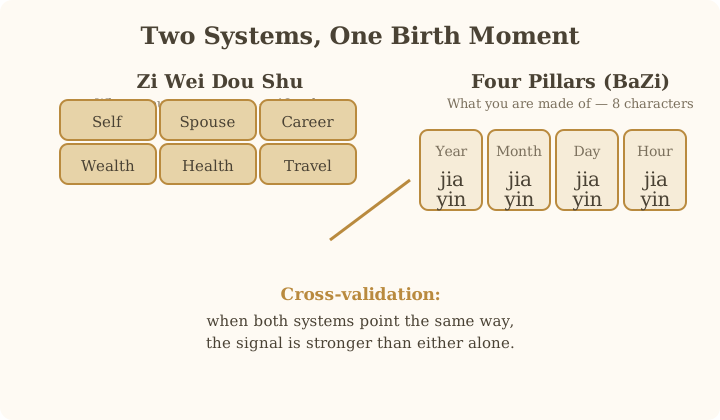
Zi Wei Dou Shu and BaZi are the two major systems of Chinese destiny analysis: ZWDS maps stars across twelve life palaces, BaZi reads eight characters of your birth moment. This guide shows which one answers which question.
Key Takeaways
- Two instruments, one life: BaZi reads structure and timing; ZWDS reads domains and placement.
- BaZi for “who am I”: Day Master, elemental balance, and Luck Cycles answer personality and timing questions.
- ZWDS for “where does my life happen”: Palaces and stars answer domain questions — career, money, marriage, health.
- Same direction = strong signal: When both maps agree, the reading is robust — that is cross-validation.
- Contradictions are prompts: Different layers and conventions mean a clash is a reason to look closer, not to discard.
Two systems. One life. Here is how to know which one to reach for.
If you have spent any time on Imperial Astrology, you have noticed we offer two different tools: the Star Chart (Zi Wei Dou Shu) and the Four Pillars (BaZi). They look different. They use different language. But they are describing the same thing — you.
So why two systems? And which one should you use? The palace-based Star Chart tradition comes from the Zi Wei Dou Shu Quan Shu (紫微斗數全書); the element-based BaZi framework comes from the Yuan Hai Zi Ping (淵海子平) and San Ming Tong Hui (三命通會). Here is the practical difference.
The Short Answer
-
Use ZWDS when you want to understand a specific life area. Career. Relationship. Health. Money. ZWDS maps stars into twelve palaces, each governing a domain of your life. Want to know what energy is at work in your Wealth Palace? ZWDS shows you.
-
Use BaZi when you want to understand yourself. Your core personality. Your emotional wiring. Your natural strengths and the environments where you thrive. BaZi is element-based — it describes what you are made of and how your inner ecology works.
-
Use both when you want the strongest signal. When ZWDS and BaZi agree on something — when your Career Palace and your Day Master both point toward the same pattern — that signal is hard to ignore.
The Deeper Difference
ZWDS is a star-based system. Imagine a theater with twelve stages. Each stage represents a life area. On each stage, different actors — stars — are performing. Some are leads. Some are supporting cast. The Four Transformations tell you which actors are delivering the most dramatic performances.
BaZi is an element-based system. Imagine an ecosystem — a garden with your Day Master as the dominant plant. Everything else in the garden — the soil, the water, the sunlight, the other plants — is either supporting or challenging your growth. Your Luck Cycles are the changing seasons.
Neither metaphor is perfect. But they get at the essential difference: ZWDS is spatial and domain-focused. BaZi is elemental and personality-focused.
When They Agree
The most powerful moments in a chart reading happen when both systems converge.
When ZWDS places a powerful Wealth star in your Wealth Palace and BaZi shows a strong Wealth structure in your pillars, you have a clear, unambiguous signal about your relationship with resources. This is not coincidence. Two independent systems, using entirely different methods, arriving at the same conclusion.
When they diverge — when ZWDS shows strength in an area that BaZi shows weakness — that is also useful information. It tells you that the area is complex. It will not be straightforward. You will experience both sides.
What Most People Get Wrong
The most common mistake is treating either system as predictive. Neither ZWDS nor BaZi tells you what will happen. They describe the conditions you are moving through. The difference matters.
A strong Wealth signal does not mean you will be rich. It means you have a natural relationship with resources. What you do with that relationship — whether you build, invest, spend, share, or ignore — is entirely yours.
A difficult Luck Cycle does not mean you will suffer. It means the current is against you. You can still swim. You will just need to swim differently.
So Which One Should You Start With?
Start with whatever question brought you here.
- "Who am I, really?" → BaZi
- "Why does my career feel this way?" → ZWDS
- "Why do my relationships follow the same pattern?" → Either — ZWDS for the Spouse Palace, BaZi for the Day Master's relationship to Authority and Output
- "I want the full picture" → Both. Our Complete Bundle synthesizes both readings.
Five Questions, Answered Twice
The fastest way to internalize the difference is to see the same question answered by each system.
| Your question | BaZi looks at | ZWDS looks at |
|---|---|---|
| "Why does my career feel this way?" | Your Officer and Wealth structures, and whether the current Luck Cycle supports them | Your Career Palace, its ruling stars, and its interaction with the Life Palace |
| "Why do I keep repeating the same relationship pattern?" | Your Day Master's relationship to the Wealth star (for men) or Officer star (for women), in the classical framework | Your Spouse Palace and the stars sitting in it |
| "Why is money a struggle for me?" | Your Wealth element's strength and its place in the five-element balance | Your Wealth Palace and its opposite, the Karma Palace |
| "Why am I always exhausted?" | Your element balance — specifically a weak Day Master without sufficient Resource | Your Health Palace and the constitutional pattern of the stars within it |
| "Is this the right time to make a change?" | Your current Luck Cycle: what the decade rewards and what it demands | Your decade progression: which palace is activated and which stars are moving |
Notice the pattern. BaZi answers with structure and timing; ZWDS answers with domains and placement. The same life, read through two different instruments.
What a Combined Reading Actually Looks Like
Here is the shape of a real cross-read, using an illustrative composite rather than a real client.
A chart shows a strong Career Palace with a powerful star of transformation, while the BaZi side shows an Officer structure that is present but not yet activated — waiting on a Luck Cycle that arrives in the chart's forties. The ZWDS reading says: career is a central domain and it will become prominent. The BaZi reading says: the structural capacity is there, but the timing activates it in the fourth decade, not the third.
Neither statement is a prediction. Together they are a plan: build the competence in the twenties and thirties, expect the public shift in the forties, and do not conclude in the thirties that the career palace was wrong. That is what cross-validation buys you — not certainty, but calibration.
Learning Both Without Overwhelm
The most common reason people study one system and not the other is intimidation: two vocabularies, two maps, two traditions. The fix is to learn them in the right order.
- Learn BaZi's Day Master first. It is the smallest complete idea in either system — one stem, one element, one default way of operating. The Day Master guide covers all ten in a single read.
- Then learn ZWDS's twelve palaces. Same size of idea: twelve boxes, each naming a life domain. The 12 Palaces guide is the whole map in one article.
- Then let the two systems teach each other. Every time you read a palace, ask what the BaZi structure says about the same domain. The comparison becomes a habit, and the habit becomes the skill.
Common Questions
Is one system more accurate than the other? Neither is "more accurate" — they are accurate about different things. ZWDS is sharper on life domains and their interactions; BaZi is sharper on personality structure and decade timing. Accuracy in both depends on correct input (especially birth hour and true solar time) and honest interpretation. The strongest accuracy test is the same one used throughout this site: when two independent systems agree, the signal is robust.
Can I use only one system? Yes. Both systems are complete on their own, and many practitioners specialize in one. What you give up is the cross-check: the confirmation that comes when two different instruments point the same direction. For most people the practical path is to read one system well and use the other as a second opinion on big decisions.
Why do the two systems sometimes seem to contradict each other? Two reasons. First, they are reading different layers: a strong Career Palace and a weak Officer structure are not contradictory, they are two facts about the same life. Second, the traditions use different conventions — the classical BaZi gender rules for relationship reading, for example, are not mirrored in ZWDS. A contradiction between the systems is usually a prompt to look more carefully, not a reason to discard one of them.
Do I need both charts to get value from either? No — start with whichever question brought you here. Generate one chart, read it with the guides, and add the second system when a question is important enough to want a second opinion. Both calculators are free, so the second opinion costs nothing but ten minutes.
Sources and Further Reading
- Zi Wei Dou Shu Quan Shu (紫微鬥數全書) — the foundational Star Chart text behind the palace-based approach.
- Yuan Hai Zi Ping (淵海子平) and San Ming Tong Hui (三命通會) — the classical BaZi texts behind the Day Master and Ten Gods approach.
- Zi Wei Dou Shu (Wikipedia) and BaZi (Wikipedia) — https://en.wikipedia.org/wiki/Zi_wei_dou_shu and https://en.wikipedia.org/wiki/Four_Pillars_of_Destiny
- What Is Zi Wei Dou Shu? A beginner's guide
- What Is BaZi? A beginner's guide
- The Ten Gods in BaZi explained
Explore your Star Chart → · Explore your Four Pillars → - Chinese Astrology (Wikipedia) — overview of the Chinese astrological tradition: https://en.wikipedia.org/wiki/Chinese_astrology
Discussion