Core Attributes
| Chinese | 三台 |
|---|---|
| Pinyin | San Tai |
| English | Three Towers |
| Archetype | The Three Towers |
| Category | Minor |
Personality & Temperament
San Tai is the other half of the 'towers and seats' pair, and the assistant of the Sun (Tai Yang): a star of position, of the category and direction of one's office, and of reputation built by writing and culture. Its nature is soft and meticulous where its partner Ba Zuo is brave and spirited. The texts call the pair assistants of the Purple Star (Zi Wei) , carrying official seals and presiding over the advancement of articles and rank.
Its register is elevation through reputation: being known for what you write and organize, and how you appear before refined institutions. With the main stars well placed, the pair raises social standing and charge of organization; with the literary stars (Wen Chang, Wen Qu) and the transformation of Ke it produces fame - the classical intelligence formula gathers it with the literary and noble stars around the Life and Parents Palaces. It loves the auspicious six and the Sun, Moon, and Emperor above all, adding light to the Sun even when it falls.
The shadow is the tower without a foundation. San Tai has no notable strength of its own; the pair loves union and dislikes separation, and a lone San Tai describes early departure from home, poor reception abroad, and isolation. Reputation can also run ahead of substance - the image includes fanfare that raises a name beyond its merits. With a weak main star, the towers are stage scenery: impressive, hollow, cold to climb.
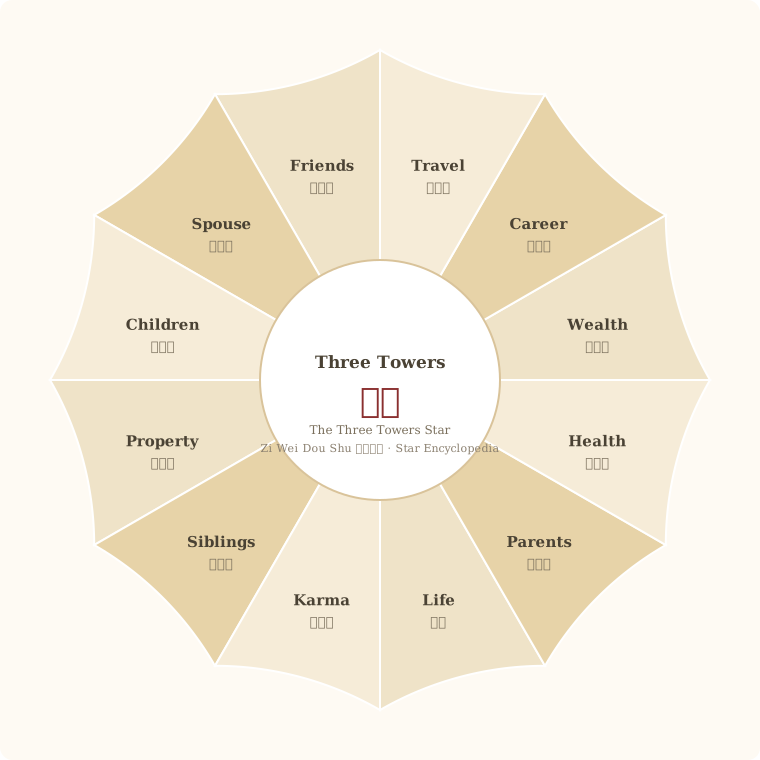
Three Towers in the Twelve Palaces
| Palace | Meaning |
|---|---|
| Life | Refined, meticulous, and reputation-minded: a person of culture who rises through writing, manners, and visible achievement rather than force. |
| Wealth | Name first, profit after: income that follows reputation and position. The classical reading is nobility rather than wealth - the name pays, but indirectly. |
| Travel | The classical note of early departure applies: leaving home young and building a name abroad. Reputation travels before the person; the road itself can feel isolated. |
| Friends | The palace of reputation's audience: esteem flows where this star sits, and the circle raises or cools a name. In relatives' palaces it marks the standing of the relative in question. |
| Career | The advancement of articles and rank: organization, refined management, and position earned by reputation. Fame in the field depends on the literary stars and the main star's strength. |
| Fortune | A reputation that compounds into late-life standing. Honor without wealth is the frame - the towers are high, the treasury is another star's business. |
| Parents | The intelligence configuration of the tradition gathers San Tai with the literary and noble stars around the Parents Palace; it marks a bright early record and the approval of teachers and elders. |
Key Star Combinations
- San Tai + Ba Zuo (三台八座): The classical pair of towers and seats: together they raise social standing, carry official seals, and mark charge of refined organization. Most beautiful with the Purple Star (Zi Wei) in the Life Palace; separated, the force is small and the texts add notes of isolation and early departure from home.
- San Tai + Literary stars (三台会昌曲): The fame configuration: with Wen Chang and Wen Qu, and the transformation of Ke, the star's reputation becomes literary and public - examinations won, articles read, honors granted. This is the pattern the tradition cites for scholars who rise young.
- San Tai + Sun (三台会太阳): San Tai serves the Sun, and the tradition says the pair adds brilliance to the Sun even in its fallen positions. With the Sun in a strong palace this is elevation in the public eye - visibility, promotion, and a name that carries.
- San Tai + transformation of Ke (三台会化科): The examination formula: Ke makes the name honorable and San Tai makes it known. Together they describe merit that is seen and certified - in classical terms, advancement through articles; in modern terms, credentials and public recognition.
Common Questions
What is the difference between San Tai and Ba Zuo?
The tradition splits the pair by nature and office: San Tai is soft and meticulous and describes the category and direction of a position - where and what you preside over; Ba Zuo is brave and spirited and describes the grade - how high the seat is. Together they form the full picture of rank; apart, each has little force.
How is San Tai placed in the chart?
San Tai is a day-based star: begin at the palace of the Left Assistant (Zuo Fu) as the first day of the lunar month and count forward clockwise to the birth day, where the star lands. It is anchored to the birth day and expressed through the main star that shares its palace.
Does San Tai guarantee fame?
No. It describes the tendency for reputation to rise - through writing, culture, and recognition - but as a minor star it has no independent voice. Fame materializes where the literary stars and the main star support it; alone, it paints elevation without substance, and the classical texts themselves note that a lone star can be isolated rather than celebrated.
Related Stars
Explore how Three Towers works with other stars: