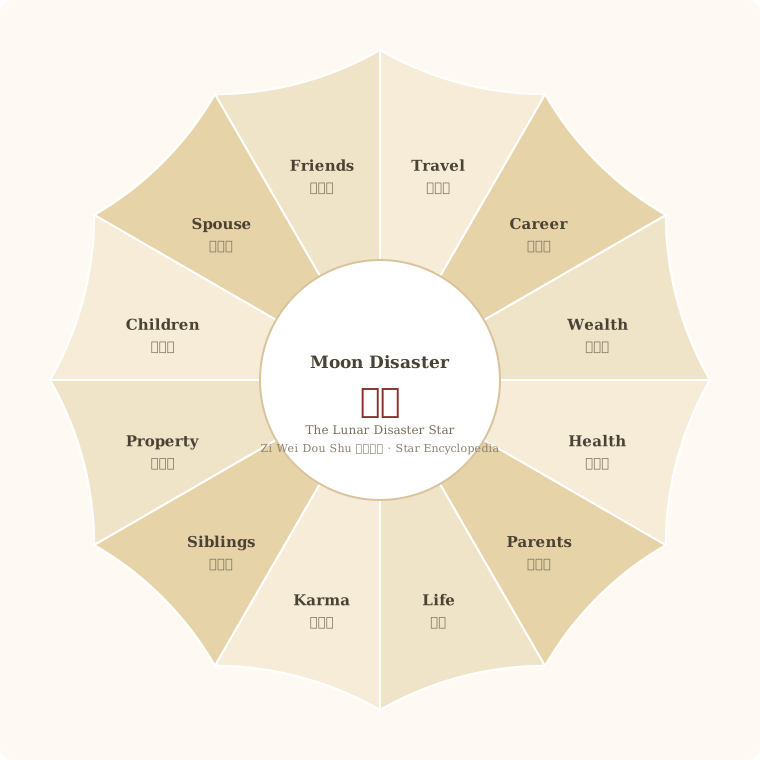
Core Attributes
| Chinese | 月煞 |
|---|---|
| Pinyin | Yue Sha |
| English | Moon Disaster |
| Archetype | The Lunar Disaster |
| Category | Year Deity |
What Moon Disaster Means
The Twelve Preceding Generals (Jiang Qian Shi Er Shen) step forward one palace per star from the General Star at the pivot branch of the birth-year trine; the Moon Disaster holds the eleventh position, one palace before the cycle closes. Classical texts class it with the solitary and restraining stars: it dislikes the Life, Father, and Spouse palaces; for a man without good stars it is traditionally tied to difficulty for mother and wife; for a woman, to money spent through the mother; and its images include falling and revenge. The name joins the moon — darkness, the hidden — with disaster, and the working reading is covert harm: not the open blow of the Disaster Star but the shadowed one, resentment that moves quietly, small accidents, and losses whose cause is hard to trace. Read as a yearly reminder, the Moon Disaster marks the palace where the year asks for caution in the indirect: stairs and roads at night, agreements made verbally, relationships where resentment has been sitting unspoken. With auspicious stars it fades to small frictions; with Hua Ji it concentrates and asks for early honesty; with the Heavenly Beam the hidden trouble finds its protector. The framework's emphasis is awareness rather than fear — the dark is only dangerous when it is ignored.
Moon Disaster in Practice
In practice the Moon Disaster favors transparency in its palace. In the Life palace it asks for care in small risks and honesty about accumulated stress; in the Spouse palace it warns against unspoken resentment — talk early and plainly; in the Parents palace it flags money and care involving the mother or older women; in the Travel palace, night travel and minor accidents deserve attention. With the Heavenly Beam or Hua Ke the shadows resolve quietly; with Hua Ji they press until spoken; with the Heavenly Disaster the family themes of the pair stack. The practical rule: bring the hidden into the light before the year's end — the star loses its force when nothing is left in the dark.
Key Star Combinations
- Moon Disaster + Heavenly Disaster (月煞+天煞): The classical family-pressure pair: hidden and external harm in the same yearly corner. The reading favors early, open handling of family finances and relationships — the pair's force is mostly silence.
- Moon Disaster + Hua Ji (月煞+化忌): Shadow with friction: resentment or small losses that accumulate. The classical advice is honesty and small repairs early, before the silence grows.
- Moon Disaster + Heavenly Beam (月煞+天梁): The hidden harm meets its protector: covert trouble that surfaces gently and resolves. The Heavenly Beam turns the shadowed year into one of quiet rescue and recovered safety.
Common Questions
What is the difference between the Moon Disaster and the Disaster Star?
The Disaster Star (Zai Sha) is the open, unexpected blow — illness, accidents, reversals. The Moon Disaster (Yue Sha) is the covert one: resentment, small accidents, indirect loss. One arrives with noise, the other with silence.
Does it really predict a fall?
The classical image of falling is part of its profile — small accidents and losses whose cause is hard to trace — and the modern reading extends it to any hidden risk: unspoken conflict, verbal agreements, night travel. The emphasis is awareness, not a prediction of injury.
Related Stars
Explore how Moon Disaster works with other stars: