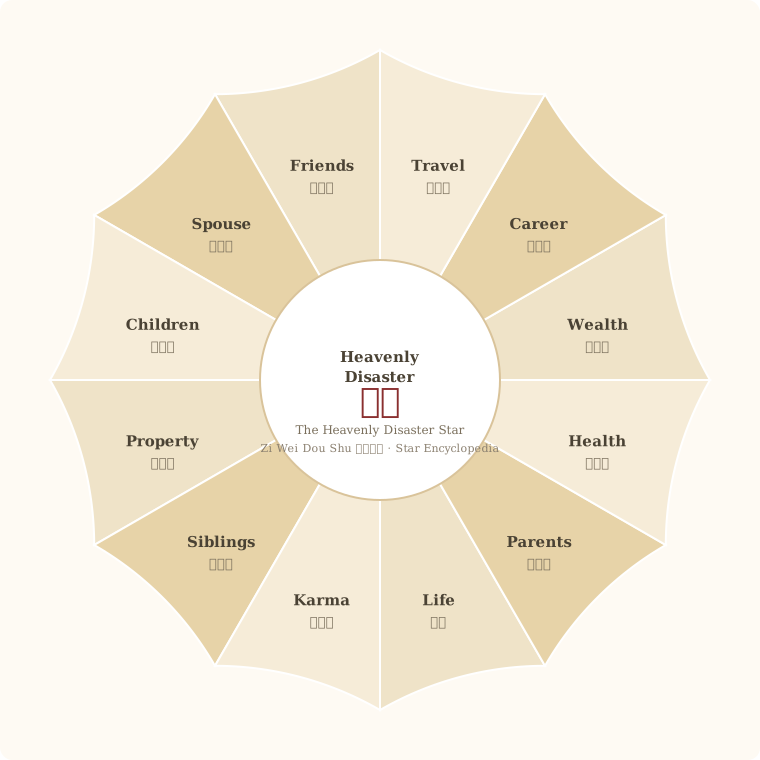
Core Attributes
| Chinese | 天煞 |
|---|---|
| Pinyin | Tian Sha |
| English | Heavenly Disaster |
| Archetype | The Heavenly Disaster |
| Category | Year Deity |
What Heavenly Disaster Means
The Twelve Preceding Generals (Jiang Qian Shi Er Shen) step forward one palace per star from the General Star at the pivot branch of the birth-year trine, and the Heavenly Disaster holds the eighth position of the sequence. Classical texts class it with the solitary and restraining stars: it dislikes the Life, Spouse, and Father palaces; for a woman without good stars it is said to bring difficulty to her father and husband; it marks separation and the draining of wealth; for a man it is traditionally tied to money spent through the father. The modern reading keeps the structure and softens the tone: the Heavenly Disaster is the star of external pressure — events that come from outside the person's choices, usually through family, elders, or fixed obligations, and that cost either money or closeness. Its classical name means the calamity sent from heaven: not caused by the person, not prevented by the person, and therefore best managed rather than fought. With auspicious stars it becomes a year of obligations discharged and distances managed; with weak stars it reads as separation in the practical sense — busy parents, distant partners, finances entangled with elders. The framework asks only for transparency: family money handled in writing, and relationships given their due attention.
Heavenly Disaster in Practice
In practice the Heavenly Disaster concentrates on family and external obligation. In the Parents palace it favors clear communication and written arrangements with elders; in the Spouse palace it warns against silent drift between partners; in the Wealth palace it flags money flowing to family causes, voluntarily or not; in the Life palace it colors the year with duties that come from outside. With the Heavenly Beam or Hua Ke the pressure softens into duties that end well; with Hua Ji it tightens into obligation and worry. Its practical rule is to bring the external into the open: the star loses most of its force when the family matters it touches are discussed early and plainly.
Key Star Combinations
- Heavenly Disaster + White Tiger (天煞+白虎): The classical adversity pairing in the family palaces: external pressure with a sharp edge. The yearly reading favors early planning around elders, partners, and shared finances rather than reaction.
- Heavenly Disaster + Heavenly Beam (天煞+天梁): Pressure with protection: the rescue star receives the family burden and turns it into a resolved duty. Separation becomes distance managed; losses become expenses planned.
- Heavenly Disaster + Hua Ke (天煞+化科): The year of duties that ends in reputation: family obligations handled well become a source of respect. Hua Ke turns external pressure into a visible, honorable discharge of responsibility.
Common Questions
Does the Heavenly Disaster predict the death of a father or husband?
No. Its classical profile is separation and wealth outflow through elders and partners — distance, busyness, financial entanglement — not death. The traditional wording reflects an older household structure; the working reading is about family pressure and clear communication.
How is it different from the Disaster Star?
The Disaster Star (Zai Sha) flags unexpected personal trouble — illness, accidents, reversals. The Heavenly Disaster (Tian Sha) flags external and family-driven pressure: obligations, separation, and money tied to elders. One is surprise, the other is duty.
Related Stars
Explore how Heavenly Disaster works with other stars: