Core Attributes
| Chinese | 天月 |
|---|---|
| Pinyin | Tian Yue |
| English | Heavenly Moon |
| Archetype | The Ailment |
| Category | Minor |
Personality & Temperament
Tian Yue is the quietest voice in the lunar group, and the tradition gives it a narrow job: the Ailment star, tied to epidemics, recurring illness, and low vitality. In the Life Palace it describes a constitution that looks fine on the outside but tires easily - the classical phrase is 'strong outside, hollow within.' In the Body or Health Palaces it points to frequent small ailments and chronic conditions that linger, and the textbooks add a practical rule: whatever palace Tian Yue occupies is where the recurring complaint tends to arise.
It is a weather report, not a judgment, and its severity tracks the company it keeps. With the Heavenly Beam, the Joy star, the Treasury, or the auspicious transformations, it means light and treatable complaints, good doctors, and even a natural fit for healing professions - the classics allow a career in medicine and care work. With the Sword, the Lasso, the Fire and Bell stars, or a jealousy transformation, the same star reads as serious or lingering illness.
The shadow is mental as much as physical: worry, melancholy, and hypochondria - the classics describe trouble without cause and a habit of magnifying small discomforts. There is also a lesser-known second face: the old texts call Tian Yue a star of adjustment and mediation, and in the Life or Body Palace it can mark a natural matchmaker or broker. The practical reading is simply vigilance: regular care, rest, and attention to health, without treating the chart as a judgment.
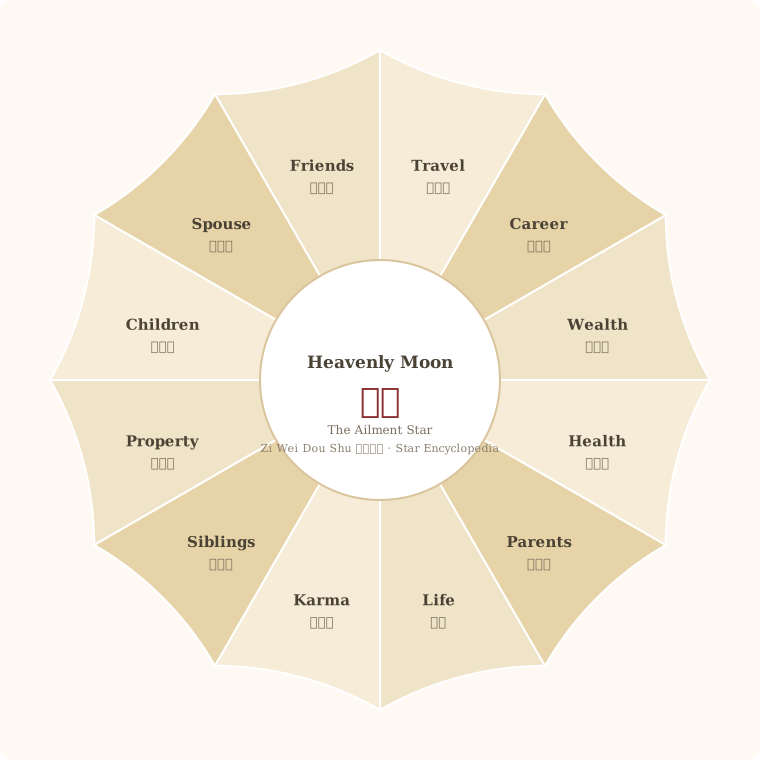
Heavenly Moon in the Twelve Palaces
| Palace | Meaning |
|---|---|
| Life | Anxious and sensitive by temperament: tends to worry, to feel things deeply, and to complain of small discomforts. Vitality looks normal from outside but flags under strain; rest is a discipline, not a luxury. |
| Spouse | Two classical readings: a partner with a delicate constitution whose health touches the marriage, or an emotional bond that lingers and repeats - a love that is hard to end cleanly. With strong stars the reading softens to mutual care. |
| Wealth | The classical warning: money spent on health - medical bills, remedies, and lost earning during illness. With strong auspicious stars the drain stays small; with harmful stars it grows, so health savings are the practical hedge. |
| Health | The classical seat: a constitution prone to fatigue, weak resistance, and chronic or epidemic illness. Severity follows the surrounding stars - mild with auspicious support, serious with harmful stars or a jealousy transformation. |
| Travel | The tradition notes discomfort abroad: seasonal illness, unfamiliar food and water, and complaints that flare on journeys. Travel plans work best with extra rest and a known doctor's advice - prevention rather than prediction. |
| Career | Fits healing and care vocations - medicine, nursing, wellness, and even funeral services per the old texts. With adverse stars the risk is occupational burnout: work that saps health faster than it builds it. |
Key Star Combinations
- Tian Yue + Tian Liang (天月天梁): The Beam's healing presence lightens the Ailment star: the classical texts say illness becomes treatable and 'turns ghost into life' - recoveries happen, doctors are good, and the combination even favors a healing career. The most auspicious frame for Tian Yue.
- Tian Yue + Lu Cun / Hua Lu (天月禄存化禄): Auspicious wealth energy softens the disease star: ailments remain minor, resources cover treatment, and recovery is well supported. The tradition counts the Treasury and the wealth transformation among the stars that keep Tian Yue's damage small.
- Tian Yue + Yang / Tuo / Huo / Ling (天月羊陀火铃): The classical severe frame: with the fierce killers the Ailment star reads as serious, recurring illness - the texts speak of surgery and hospitalization in extreme charts. Read only with the main star's strength; minor stars do not rule alone.
- Tian Yue + Yin Sha (天月阴煞): Hidden ailment: complaints that doctors cannot quite name, chronic conditions with a mysterious tint, and a sense of being drained by invisible influences. The Relief Star's presence in the chart is the traditional counterweight.
Common Questions
Does the Heavenly Moon predict serious illness?
No. Tian Yue is a minor star with no independent voice: its severity depends entirely on the main star and on harmful stars or transformations in the palace. With strong auspicious support the tradition reads only minor, treatable complaints; the dark reading requires an adverse frame. The practical counsel is unremarkable: rest, regular care, and attention to health - good advice with or without the star.
How is the Heavenly Moon placed?
Tian Yue is a month-based star of the lunar group, with a fixed sequence the classical texts note has no simple pattern: starting from the first lunar month it runs Xu, Si, Chen, Yin, Wei, Mao, Hai, Wei, Yin, Wu, Xu, and Yin palaces across the twelve months. As a fixed personal star it always occupies the same palace in a given chart.
Is the Heavenly Moon only about disease?
Mostly, but not only. The old texts also call Tian Yue a star of adjustment and mediation: in the Life or Body Palace it can describe a natural matchmaker, broker, or introducer - someone who connects people and deals. The disease reading dominates, but the mediating face explains why the star is sometimes called an adjusting star.
Related Stars
Explore how Heavenly Moon works with other stars: