Core Attributes
| Chinese | 天伤 |
|---|---|
| Pinyin | Tian Shang |
| English | Heavenly Wound |
| Archetype | The Wound |
| Category | Cycle Deity |
What Heavenly Wound Means
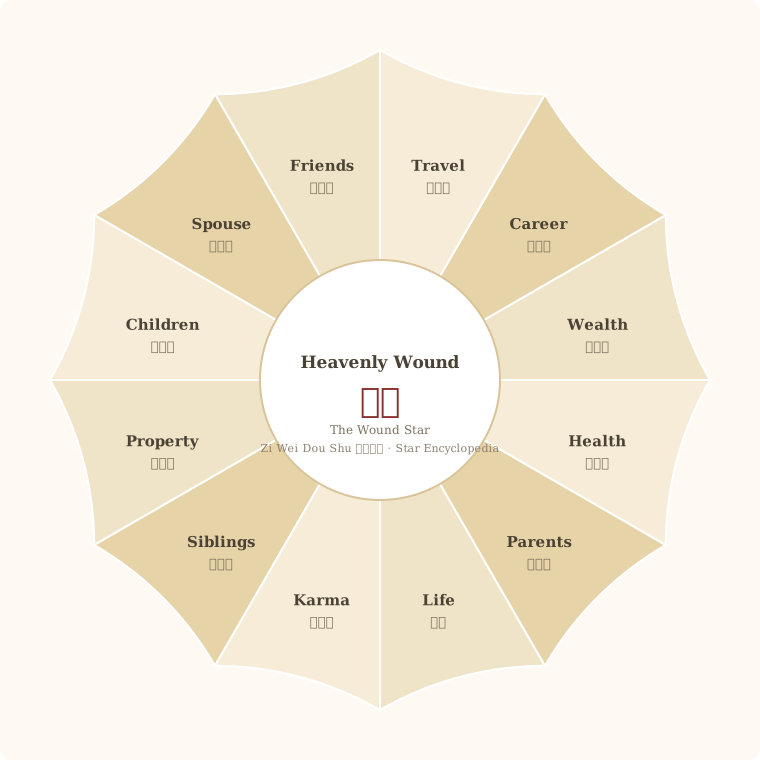
The Heavenly Wound is not placed by calculation: it is fixed in the Friends Palace of every chart, while its partner, the Heavenly Messenger (Tian Shi), is fixed in the Health Palace. Because the Friends and Health palaces sit on either side of the Travel Palace, the two stars always clamp it, the classical formation called wound and messenger flanking the limit (Shang Shi Jia Xian). The Wound's register is depletion, injury, and mishap. Old texts treat it as a middle-tier star whose effects appear mainly in fortune periods (Da Xian) and yearly readings rather than in the natal chart itself. When a limit or year enters the clamped Travel Palace, the reading asks for caution: with the main star weak and adversity stars or a transformation of obstruction present, old texts expect mishaps, injury, or loss; with strong main stars and auspicious support, they say plainly that the harm is light, many auspicious, no adversity, the disaster small. The star's fixed position means every chart carries it somewhere; the reading is therefore about recognizing its trigger conditions, a weak main star, a harsh palace, bad timing, rather than treating its mere presence as doom.
Heavenly Wound in Practice
In practice the Wound is read through its clamped palace and its timing. The Travel Palace reading is the classic focus: under a fortune period or year that reaches it, favor caution with journeys, vehicles, tools, and surgery, and avoid reckless scheduling. In the Friends Palace itself, the star colors relationships with associates and servants, and old texts say problems of associates can surface during such periods. The textbook gives an explicit rescue rule: when the main star of the clamped palace is well placed, or auspicious stars guard its three directions, the period is saved and the harm stays small. The practical posture is therefore not fear but inspection: check the main stars, the Four Transformations, and the current period before judging the Wound's weight.
Key Star Combinations
- Heavenly Wound + Heavenly Messenger (天伤天使): The pair always appears together in fixed positions, clamping the Travel Palace. Their combined reading is strongest when a fortune period enters the Travel Palace with a weak main star and adversity, and light when auspicious support fills the three directions.
- Heavenly Wound + Heavenly Punishment (天伤天刑): Injury themes doubled. Classical texts mention the pair in health and accident readings, caution with surgery, vehicles, and sharp tools. The effect still depends on the main star; with a strong one, it reads as care needed rather than harm certain.
Common Questions
Is the Heavenly Wound always bad?
No. Its classical force appears mainly in fortune periods and years, not in the natal chart, and the textbooks are explicit: with many auspicious stars and no adversity, the harm is small or absent. Its fixed position in every chart would make little sense as a universal doom.
Why does it always sit in the Friends Palace?
The classical framework fixes it there so that it and the Messenger flank the Travel Palace. The image is watchfulness around movement and change, the areas of life where mishap and depletion are classically said to strike.
Related Stars
Explore how Heavenly Wound works with other stars: