Core Attributes
| Chinese | 太岁 |
|---|---|
| Pinyin | Tai Sui |
| English | Grand Duke |
| Archetype | The Year Lord |
| Category | Year Deity |
What Grand Duke Means
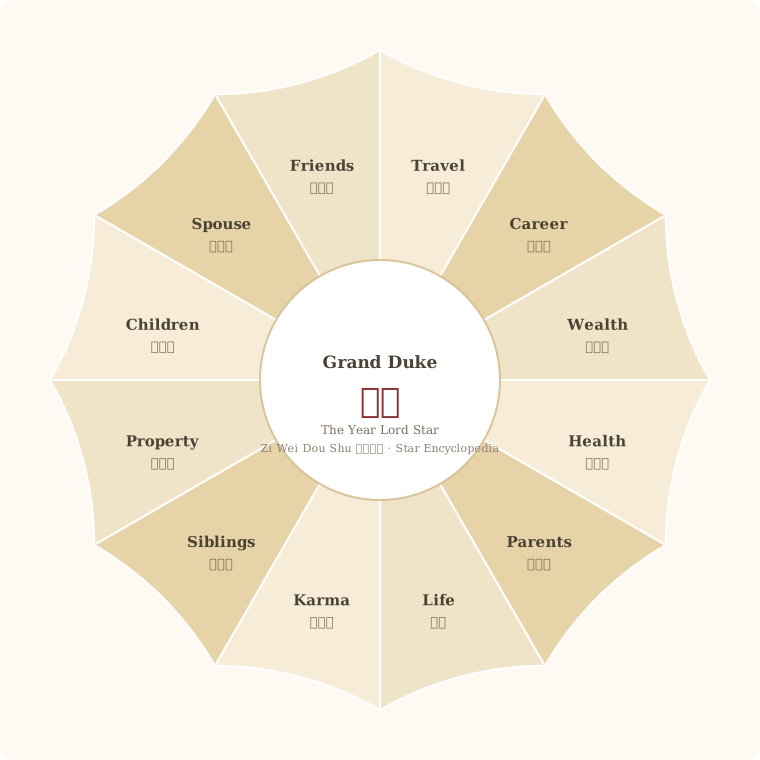
The Grand Duke is the first and most important of the Twelve Year Deities. In the natal chart it sits in the palace ruled by the birth-year earthly branch, and from that anchor the other eleven deities follow one by one in the forward order of the branches (Zi, Chou, Yin, Mao, Chen, Si, Wu, Wei, Shen, You, Xu, Hai), each occupying one palace. In annual readings the same sequence is re-anchored to the current year's branch, which is why the Grand Duke appears to move each year. Older tables call it the Year Founder (Sui Jian, 岁建). The tradition calls the Grand Duke the sovereign of the year: it surveys the general fortune and misfortune of the twelve months and marks where the year's story concentrates. Its palace functions as a secondary Life palace, read alongside the natal Life palace to weigh a year's tone. Auspicious stars gathered there amplify the year's promise; heavy adversity stars there color the year with friction. As a coordinate rather than a judge, the Grand Duke only points at the arena; the main stars and transformations occupying that palace decide the outcome.
Grand Duke in Practice
When the Grand Duke's palace carries a strong auspicious main star or receives Hua Lu or Hua Ke, readers treat the year as centered and supported; when it holds a weak or afflicted star, the year asks for caution in that palace's domain. If the Grand Duke falls in the Career palace, work dominates the year; in Wealth, money management; in Travel, movement. A common discipline compares Life palace and Grand Duke palace: both strong, a banner year; both weak, a year to keep low and prepare. The classical texts give the same rule in four strokes: strong plus strong adds glory, strong plus weak subtracts, weak plus strong softens, weak plus weak doubles the caution.
Key Star Combinations
- Grand Duke + Zi Wei / Tian Fu (紫微/天府): When the year's sovereign palace hosts the Emperor or the Regent, the year reads as high-centered and durable: authority, stability, and visibility dominate the twelve months, and setbacks are easier to absorb.
- Grand Duke + Hua Lu / Hua Ji (化禄/化忌): The year's coordinate takes its color from the transformations: Hua Lu brightens the palace's domain with growth and recognition, while Hua Ji concentrates friction and worry there. The same palace, two very different years.
- Grand Duke + adversity stars (擎羊/陀罗/火星/铃星): With the sharp or eruptive stars crowding the sovereign palace, the year's tone turns combative. The classical advice is defense: fewer risks, better records, earlier decisions.
Common Questions
Is the Grand Duke the same as the folk concept of “offending Tai Sui” (犯太岁)?
The folk tradition treats Tai Sui as a yearly authority to be respected, and this star shares that name, but in Zi Wei Dou Shu it is a coordinate, not a curse. It marks where the year's events concentrate, and its quality is set by the main stars and transformations in that palace. The folk taboo is a simplified version of the same intuition: be careful in the year's dominant arena.
Why does the Grand Duke move every year?
Within your own natal chart it never moves, because it is fixed to your birth-year branch. Annual charts, however, re-anchor the whole Twelve Year Deities sequence to the current year's branch, so for any specific calendar year the Grand Duke appears in the palace of that year's branch.
Related Stars
Explore how Grand Duke works with other stars: