Core Attributes
| Chinese | 擎羊 |
|---|---|
| Pinyin | Qing Yang |
| English | Blade Star |
| Archetype | The Blade |
| Element | Yang Metal |
| Category | Six Adversity |
Personality & Temperament
Blade Star people move fast, decide fast, and refuse to be managed. The texts describe the star as Yang Metal carrying fire: metal refined by flame — auspicious, it becomes a finished blade; inauspicious, it is tortured in the heat. In strong positions this is the person who cuts through deadlock, speaks the truth others avoid, and acts with an authority that startles the room. The tradition praises the pairing of Blade and Fire as prestige that overawes the crowd, and notes that at its best the star seizes power and fame by audacity — always through hard struggle rather than ease.
The shadow is the blade turned on the self: quick temper, blunt speech, litigation-prone friction, and the injuries and surgery that the texts tie to the star's punishment (刑) quality. People with Qing Yang are proud to a fault; they eat soft words but never hard pressure, and can burn bridges with one outburst. In fallen positions the texts describe the sharp tongue turning to deception and brutality, and money won and lost in the same breath.
Qing Yang never works alone: the same palace's main star and transformations decide whether the blade cuts for you or against you. With strong major stars it is the engine of breakthrough; without them, friction becomes repeated loss. It is also the fixed companion of Lu Cun, the Salary Star — fortune is always flanked by friction.
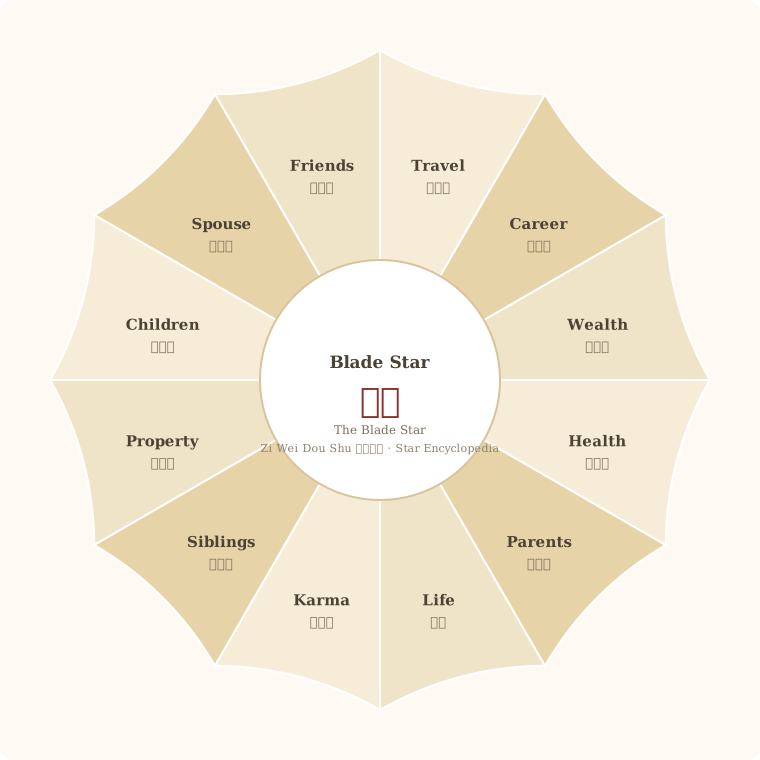
Blade Star in the Twelve Palaces
| Palace | Meaning |
|---|---|
| Life | Quick, blunt, courageous, impatient; a person who decides instantly and hates hesitation. Strong self-will and a sharp tongue; prone to friction with authority. Temple positions: commanding; fallen positions: hot-tempered and accident-prone. |
| Siblings | Frequent friction with siblings: rivalry, sharp words, quick reconciliations. The family may include a forceful, outspoken figure who provokes growth. Loyalty is real but expressed through conflict. |
| Spouse | A passionate, assertive partnership with loud arguments and quick reconciles; separations are possible when the star is fallen. Strong charts produce a protective, fiercely loyal spouse who defends the family's interests. |
| Children | Headstrong, competitive children who need clear rules rather than soft persuasion; discipline is learned through sharp lessons. Education needs patience, and childhood injury or surgery is a classical caution. |
| Wealth | Money earned by audacity and speed — deals closed fast, competition won by nerve. Income comes in bursts and can leave the same way; fallen positions warn of losses through disputes, robbery, or careless contracts. |
| Health | Classic concerns are accidents, cuts, surgery, inflammation — sharp, sudden injuries rather than slow illness. Head and limbs are the traditional focus; caution with tools, vehicles, and haste. |
| Travel | Sudden plans and sharp experiences: moves made on impulse, journeys with minor mishaps, strong first impressions. Good for competitive or mission-driven work abroad; the faster the decision, the better. |
| Friends | A circle of direct, competitive people who tell hard truths. This is also the palace of open enemies — the visible attack of the tradition — so disputes surface publicly and resolve loudly. |
| Career | Careers that reward speed and nerve: surgery, military, law enforcement, litigation, entrepreneurship, competitive trading. Advancement comes through decisive action and needs a strong main star to endure. |
| Property | Property acquired quickly, sometimes through sharp negotiation, with sudden moves and repairs. Contracts signed in haste deserve review; fallen positions warn of property disputes. |
| Fortune | An inner life of strong convictions and little patience for ambiguity; action is relief, stillness is hard. The mind is clear and decisive but can be brittle under prolonged pressure. |
| Parents | A strict, demanding parent or mentor who teaches by discipline rather than tenderness. This palace also rules documents — contracts and litigation involving elders deserve care. |
Star Brightness Levels
Brightness (庙旺平陷) describes how strongly Blade Star expresses in each palace position. The table below follows the traditional brightness table of the Zi Wei Dou Shu Quan Shu (紫微斗數全書), as compiled in Zi Wei Dou Shu Jing Cheng (紫微斗数精成). Some schools vary.
| Level | Chinese | English | Palaces |
|---|---|---|---|
| Miao | 庙 | Temple | 丑, 辰, 未, 戌 |
| Wang | 旺 | Prosperous | 子, 酉 |
| Xian | 陷 | Fallen | 寅, 卯, 巳, 午, 申, 亥 |
In the classical brightness table the Blade Star is at temple strength in Chou, Chen, Wei, and Xu (庙丑辰未戌), strong in Zi and You (旺子酉), and fallen in Yin, Mao, Si, Wu, Shen, and Hai (陷寅卯巳午申亥).
Key Star Combinations
- Blade Star + Fire Star (擎羊火星): The classical pattern 'prestige that overawes the crowd' (威权压众): when the Blade meets Mars, speed doubles into explosive authority. The tradition says this pairing at the four tomb palaces is the most forceful of all adversity combinations — the commander who acts while others deliberate, the entrepreneur who seizes a market overnight. In fallen positions the same energy turns reckless: sudden violence of temper, accidents, gains lost as fast as they came. The key is the main star: with a strong ruler it is an engine of breakthrough; without one, a blade without a handle.
- Martial Music + Blade Star (武曲擎羊): Martial Music brings the money, the Blade brings the edge: a combination of financial decisiveness and risk. The classical text warns that when Martial Music sits with Fire or Bell and the Blade and Spiral join from the three directions, greed can seize the heart — 'holding a knife over money' (因财持刀): disputes over funds, theft, financial violence. Strong charts turn it into the fiercest of finance operators; the modern caution is simple: contracts written clearly, anger kept out of deals.
- Chaste Purity + Heavenly Minister + Blade Star (刑囚夹印): One of the best-documented adversity patterns: Chaste Purity is the prisoner, Heavenly Minister the seal, and the Blade the punishment — together they clamp the seal of office. The tradition warns of lawsuits, criminal entanglement, discipline when the pattern activates, yet notes that when Chaste Purity transforms to Prosperity the head stays clear and the pattern becomes legal skill: the lawyer, judge, or compliance officer who turns the threat of litigation into a profession.
- Blade + Spiral flanking an Obstruction (羊陀夹忌): When the Blade and the Spiral clamp an Obstruction star between them, the texts call it a losing formation: trapped friction, repeated setbacks, in extreme readings litigation and ruin. But the same squeeze, with a temple-strength main star and auspicious support, describes the fighter whose obstacles became credentials — the person who has never known an easy road yet still advances.
Blade Star and the Four Transformations
Qing Yang has no place in the annual Heavenly Stems transformations (生年四化) and does not transform: it never turns to Prosperity (Hua Lu), Authority (Hua Quan), Recognition (Hua Ke), or Obstruction (Hua Ji). As one of the six adversity stars it supplies energy, friction, and pressure rather than transformation, so its expression is shaped entirely by the major star it accompanies and by the transformations already present in the chart.
Classical Source
擎羊星属庚金,象阳,又带火,具火炼金之性,故吉则成器,凶则煎熬;为北斗浮星,在数主凶厄,化气曰刑,为四恶煞之一,主刑罚伤灾之宿,刑克六亲。属过激性质,具杀伤性与攻击性,其破坏性很强,易动摇根基,为顽劣凶残之星。
The Blade Star belongs to Yang Metal and carries fire: metal refined by flame — auspicious, it becomes a vessel; inauspicious, it is smelted away. A floating star of the Northern Dipper, it rules calamity; its qi is called Punishment, one of the four evil stars, governing penalty, injury, and harm to relatives. Extreme by nature, aggressive and destructive, it can shake one’s foundations.
Common Questions
Is the Blade Star always a bad star?
No. The tradition is explicit that adversity stars have both a destructive and a stimulating face: they make people capable, innovative, hard-working, and when temple-bright, well-helped, or controlled they can bring sudden fame and rank — earned through labor. The Blade in a strong palace with a strong main star is an engine of decisive action; the same star in a fallen palace with weak support describes friction, disputes, and injury. Read the palace, not the label.
What is it like to live with Qing Yang in the Life Palace?
Fast, proud, direct: the person refuses to be pressured, speaks without sugar-coating, and acts while others hesitate. They are 'eaten soft, never hard' — kindness disarms them, force only hardens them. The shadow is a hot temper, blunt words that wound, enemies made through frankness. In strong charts these traits read as leadership; in weak charts as conflict.
Why is the Blade Star always next to the Salary Star?
Placement rule: Lu Cun, the Salary Star, is always flanked by Qing Yang ahead and Tuo Luo behind — 'the Blade, the Salary, and the Spiral are born together.' The classical logic is elegant: fortune never arrives without friction. Wealth is guarded by a blade and trailed by a rope — gain comes with disputes to win and delays to endure. That is why readers examine the flanks before judging any Lu Cun.
Related Stars
Explore how Blade Star works with other stars: