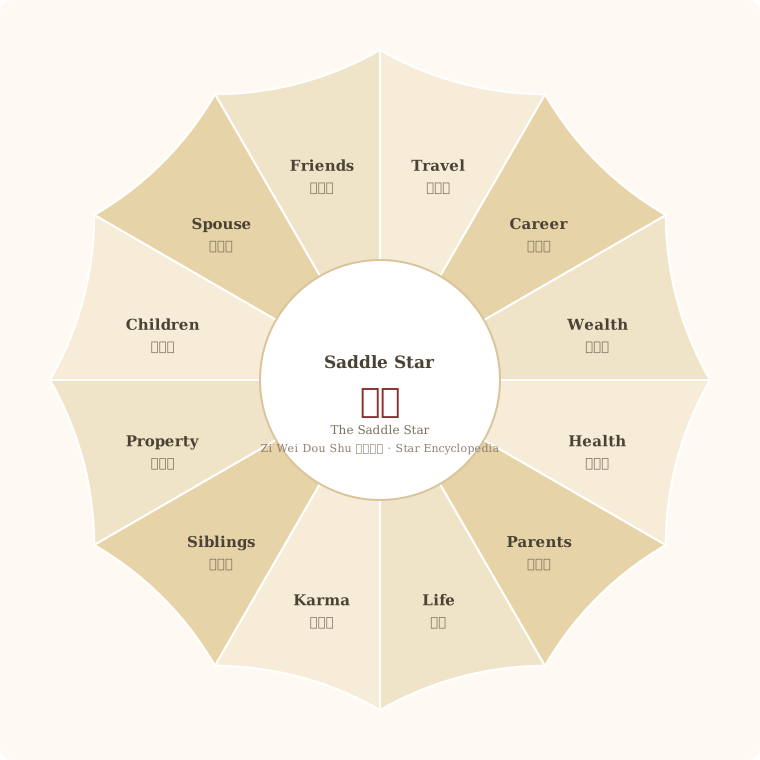
Core Attributes
| Chinese | 攀鞍 |
|---|---|
| Pinyin | Pan An |
| English | Saddle Star |
| Archetype | The Saddle |
| Category | Year Deity |
What Saddle Star Means
Like the rest of the Twelve Preceding Generals (Jiang Qian Shi Er Shen), the Saddle Star is anchored to the birth-year trine. The General Star takes the pivot branch — Wu, Zi, You, or Mao for the four trines — and each following star steps one palace forward through the earthly branches, which places the Saddle Star directly after the General Star in every chart. Classical texts describe it as the star of official honor and achievement: the image is a rider preparing to mount, the very beginning of a journey, martial distinction, access to the powerful, success in one's career, and a power to soften ill fortune. The saddle is what allows a horse to be ridden: the equipment that turns movement into controlled progress. Where it sits, the yearly cycle marks a launching point — a position from which a person climbs onto a larger stage, through promotion, a new appointment, or a public step forward. Its shadow is the hurry of the ascent: restlessness, overreaching, or starting before the saddle is fastened. The classical framework reads it as an auspicious but preparatory star whose outcome still depends on the main stars and transformations around it.
Saddle Star in Practice
In practice the Saddle Star favors beginnings. In the Career palace it supports promotion, appointment, and the launch of projects; in the Travel palace it marks departure and transfer, sometimes with more bustle than rest; in the Life palace it colors a year of ambition and self-presentation. With the General Star nearby it forms the classic rise-and-command pair; with the Heavenly Horse it favors movement-based opportunity; with Hua Ke it strengthens recognition and title. Its caution is the shadow of the start itself: momentum before preparation, or a step taken for show rather than substance.
Key Star Combinations
- Saddle Star + General Star (攀鞍+将星): The ascent-and-command pair of the sequence: promotion into a position of authority. Classical texts favor this combination for advancement in career and public standing, with the saddle supplying the step up and the General Star the grip on power.
- Saddle Star + Heavenly Horse (攀鞍+天马): Movement as the vehicle of advancement: transfer, foreign work, or relocation that becomes a step up. The classical image is the mounted rider leaving the gate, success arriving through motion rather than stillness.
- Saddle Star + Hua Ke (攀鞍+化科): Reputation rides with the star: honors, titles, and recognition that arrive with the new position. Hua Ke turns the step up into a step that is publicly seen and remembered.
Common Questions
Why is it called the Saddle Star?
The image is the saddle placed before the ride: preparation for departure. Classical texts extend it to the beginning of a rise — a new post, a new journey, the first stage of achievement — and to making useful connections on the way up.
Does it always mean promotion?
Not literally. It marks a launching point in the palace it occupies: in Travel it can mean relocation and busy roads, in Wealth a new income channel, in Career a promotion. The scale of the event is set by the main star, and the quality by the transformations.
Related Stars
Explore how Saddle Star works with other stars: