Core Attributes
| Chinese | 将星 |
|---|---|
| Pinyin | Jiang Xing |
| English | General Star |
| Archetype | The Commander |
| Category | Year Deity |
What General Star Means
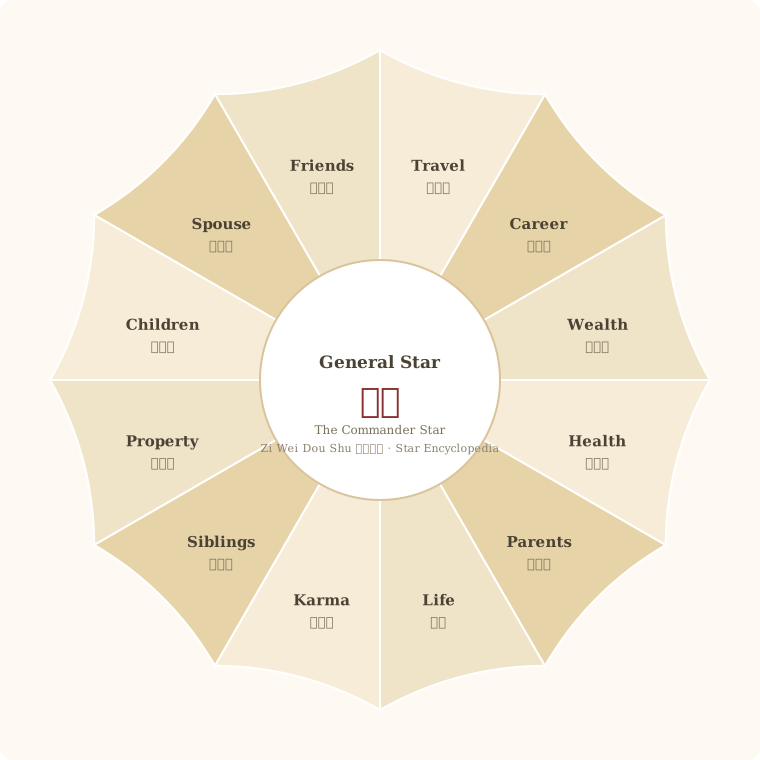
The Twelve Preceding Generals (Jiang Qian Shi Er Shen) are placed from the birth-year branch: the General Star takes the pivot branch of the year's trine — Wu for Yin-Wu-Xu years, Zi for Shen-Zi-Chen, You for Si-You-Chou, and Mao for Hai-Mao-Wei — and the remaining eleven stars step forward one palace at a time through the earthly branches in fixed order. Because every star of the cycle is read from this single anchor, its position in the natal chart never changes. Classical texts call the General Star the star of martial honor: a commander among the yearly deities, delighted to sit in the Career palace with other stars of command, favoring martial over literary matters, raising status and authority, and carrying the power to turn minor adversity into advantage. Where it sits, it lends presence: the palace becomes a place of leadership, competition, and responsibility. Its shadow is the shadow of command itself: pride, stubbornness, and the habit of fighting battles that need not be fought. The classical framework treats the star as neutral in itself — authority is only as sound as the stars around it.
General Star in Practice
In practice the General Star concentrates authority in one palace of the yearly cycle. In the Career palace it favors leadership roles, competition for position, and steady command; in the Life palace it sharpens decisiveness and self-presentation; in the Travel palace it favors taking the lead in unfamiliar settings. Paired with the Seven Executives (Qi Sha) or Martial Music (Wu Qu) it reads as a strong command signature; with Hua Quan or Hua Lu, authority that delivers; with the sharp adversity stars, a year of rivalry where restraint wins. Its warning is only the trap of over-command: delegating less, listening less, and turning colleagues into subordinates.
Key Star Combinations
- General Star + Seven Executives / Martial Music (将星+七杀/武曲): The command trio of the chart: decisiveness, pressure resistance, and visible authority. Classical texts praise the General Star with martial-command stars for leadership; in a yearly reading the pair points to responsibilities won by bold, disciplined action.
- General Star + Hua Quan / Hua Lu (将星+化权/化禄): Transformation energy makes the star's authority productive: power that leads to results, recognition, and elevation. Hua Quan sharpens command; Hua Lu turns authority into growth and gain.
- General Star + Qing Yang / Tuo Luo (将星+擎羊/陀罗): Command under pressure: competition, rivalry, and the risk of stubbornness. The classical advice is to lead with discipline rather than force, and to keep a record of decisions.
Common Questions
Is the General Star only about military careers?
No. Classical texts say it favors martial over literary themes, but in modern reading it describes authority and decisiveness in any field: management, competition, surgery, even teaching. What matters is the palace it occupies and the main star it accompanies, not the literal profession.
Why does the General Star sit in a different palace for every person?
Because it is anchored to the birth-year trine. A Yin, Wu, or Xu birth year places it in Wu; Shen, Zi, or Chen in Zi; Si, You, or Chou in You; Hai, Mao, or Wei in Mao. The remaining eleven Preceding Generals then follow in fixed order, one palace each.
Related Stars
Explore how General Star works with other stars: