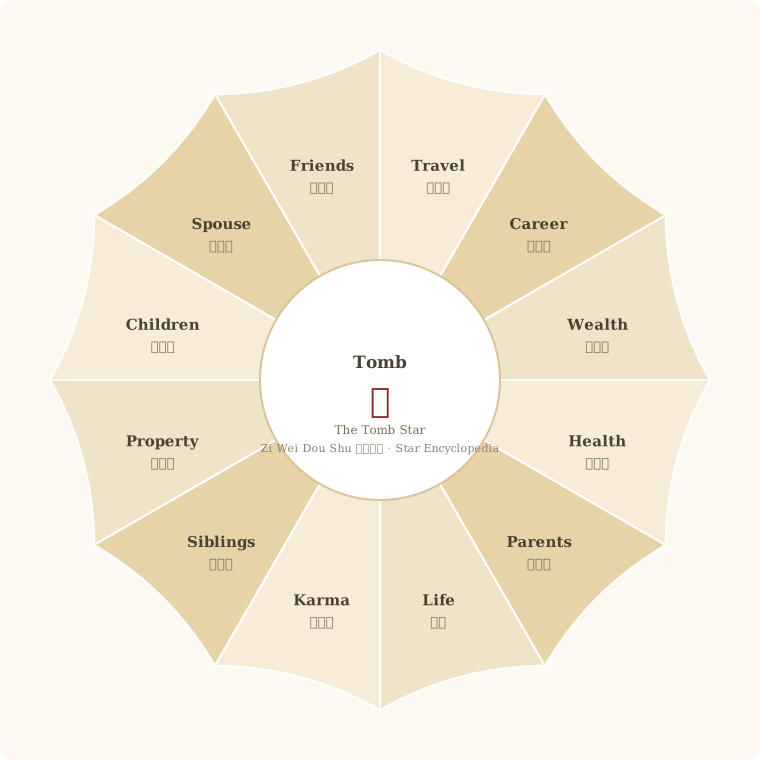
Core Attributes
| Chinese | 墓 |
|---|---|
| Pinyin | Mu |
| English | Tomb |
| Archetype | The Tomb |
| Element | Metal |
| Category | Cycle Deity |
What Tomb Means
Tomb is the ninth station of the Twelve Life Stages, the point where the energy of a completed matter is gathered and stored. Its image is the granary as much as the grave: what the cycle produced is sealed away, preserved, and held in silence. It is placed in sequence from the anchor set by the Five Elements Bureau (Water at Shen, Wood at Hai, Metal at Si, Earth at Shen, Fire at Yin), read forward for men and in reverse for women. Classical texts group it with the declining states and list it among the inauspicious deities, yet the tradition also treasures its storage image: in the three-harmony view the ninth palace is the outcome of a matter, the settlement where Longevity's seed and Imperial Peak's deeds finally rest, and the four tomb palaces (Chen, Xu, Chou, Wei) are considered solid bases when strong main stars sit in them. The stage governs storage, harvest, secrecy, and accumulation: archives, savings, property, and anything that is kept for later. Its shadow is the sealed door: resources locked away can become inertia, secrecy can become isolation, and a chart with malefics here shows a treasury that leaks. The classical reading weighs the lock against the key: Tomb preserves, but the cycle demands that what is stored eventually be reopened at Conception.
Tomb in Practice
In a Life palace, Tomb favors an inward, discreet, and accumulative temperament: people who reveal little and keep much, natural archivists and savers. In Wealth palaces it is a strong storage signature, favoring saving, property, and long-term investment; with the Heavenly Treasury (Tian Fu) it is the classic granary pairing. In Career palaces it suits managing existing assets, archives, and institutions that preserve value. In decade cycles it is a settlement decade: paying off, sealing deals, and preparing retirement. With the Breaking Army (Po Jun) the pattern is destroy-then-store, wealth gathered after upheaval. The shadow is the locked vault: excessive secrecy and hoarding.
Key Star Combinations
- Tomb + Heavenly Treasury (Mu + Tian Fu): Double storage: wealth and resources gather and are guarded. The strongest granary pairing among the stages, favoring finance, property, and long-term accumulation.
- Tomb + Conception (Mu + Tai): Storage hands what it preserved to the new seed: the Tomb's reserve becomes the Conception stage's foundation. Charts with this flow store experience and resources, then restart from a solid base.
- Tomb + Heavenly Beam (Mu + Tian Liang): The Mentor's archive: elder wisdom, heritage, and institutional memory. Good for teaching, law, and caretaking roles that pass stored knowledge forward.
Common Questions
Does the Tomb mean loss or wealth?
Both readings come from the same image of storage. Sealed well, it is a treasury; broken by malefic stars and voids, it leaks. The classical tradition also reads the four tomb palaces (Chen, Xu, Chou, Wei) as favorable bases when strong main stars sit there.
What does the triad of Longevity, Peak, and Tomb describe?
In the three-harmony frame, the first, fifth, and ninth palaces form a triangle of being, deeds, and outcome: Longevity is the seed, Imperial Peak the performance, Tomb the settlement. It describes how a matter is born, how it runs, and how it concludes. This follows the classical framework.
Related Stars
Explore how Tomb works with other stars: