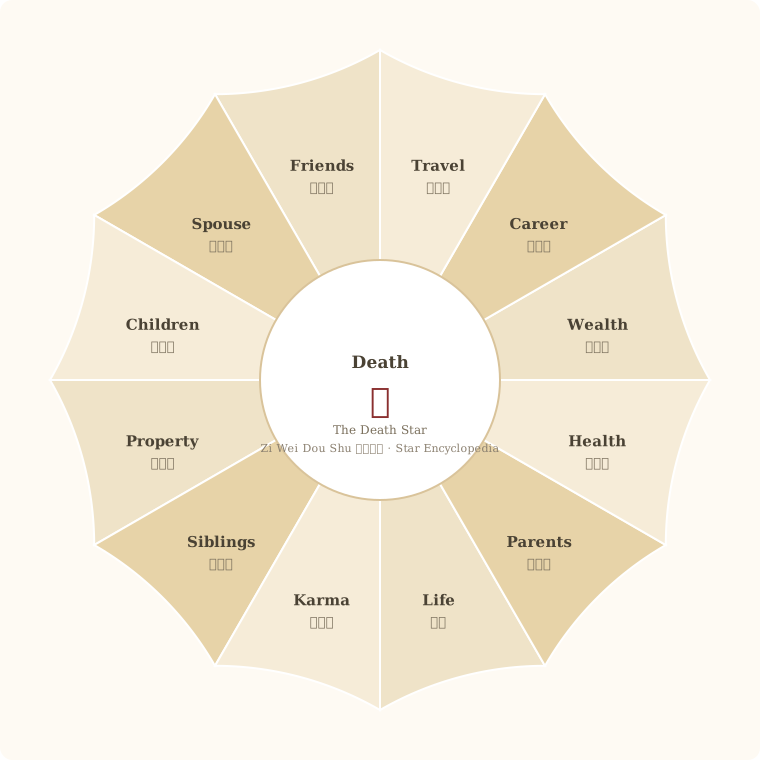
Core Attributes
| Chinese | 死 |
|---|---|
| Pinyin | Si |
| English | Death |
| Archetype | The Death |
| Element | Earth |
| Category | Cycle Deity |
What Death Means
Death is the eighth station of the Twelve Life Stages, the point of full standstill: the matter, role, or pattern that the cycle has been describing ceases to act. It is placed in sequence from the anchor set by the Five Elements Bureau (Water at Shen, Wood at Hai, Metal at Si, Earth at Shen, Fire at Yin), read forward for men and in reverse for women. Classical texts group it with the declining states and list it among the inauspicious deities, and the textbooks warn against a Life palace in dead and severed places; but in the neutral frame the stage is a phase of the energy cycle, not a lifespan forecast. What Death governs is closure: endings, withdrawals, silence, and the clearing of ground. In career it is the project that concludes, the post that is left; in wealth, the account that is closed; in relationships, the chapter that is done. Because the sequence continues through Tomb, Severance, Conception, and Nurture, the stage always carries the memory of the wheel: an ending here is the precondition of the next beginning. The classical maxim that a chart in a depleted place can still be saved by generation from the palace element or by auspicious stars applies with full force at this station, so the reading depends on what surrounds the silence.
Death in Practice
In a Life palace, Death favors a quiet, deep, and observant temperament: low tolerance for social noise, strong capacity for research, sorting, and behind-the-scenes work. In Career or Wealth palaces it marks closure: ending projects, settling accounts, and exiting cleanly; expansion is discouraged while completion is rewarded. In decade cycles it is a closing decade, well used for finishing, moving, and letting go of what has ended. With Sky Mechanism (Tian Ji) it shows overthinking that stalls; with Seven Executives (Qi Sha) it steadies the blade into calm resolve.
Key Star Combinations
- Death + Tomb (Si + Mu): Closure into storage: after the standstill, the Tomb gathers what remains. Together they complete the harvest of a cycle, finishing, archiving, and preserving value before the reset.
- Death + Sky Mechanism (Si + Tian Ji): The Strategist stalled: overthinking meets standstill, producing mental loops and analysis paralysis. Advises cutting the knot and letting the next stages clear the field.
- Death + Severance (Si + Jue): The two quietest stages describe a full reset: complete closure before the new Conception. The classical ground floor of renewal, where nothing is left to drag into the next cycle.
Common Questions
Does the Death star mean the person will die?
No. In the twelve-stage system it names the phase where a matter, habit, or life chapter ends; the same logic maps the death of enterprises, roles, and relationships. Charts with Death in a palace are read through the palace theme, not as a lifespan forecast.
Is Death worse than Illness?
In sequence, yes: Illness is strain, Death is standstill. In practice Death is often the cleaner of the two, a full stop permits a clean restart, whereas Illness drags on. Both belong to the cycle's low corridor and both are colored by the main stars present.
Related Stars
Explore how Death works with other stars: