Core Attributes
| Chinese | 华盖 |
|---|---|
| Pinyin | Hua Gai |
| English | Canopy Star |
| Archetype | The Canopy |
| Category | Year Deity |
What Canopy Star Means
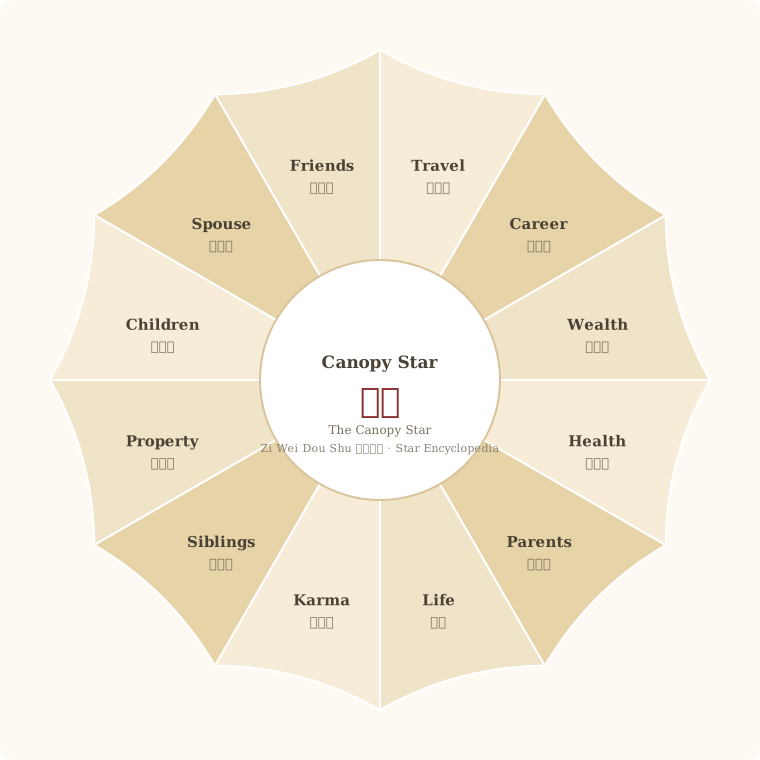
In the fixed sequence of the Twelve Preceding Generals (Jiang Qian Shi Er Shen), which steps forward from the General Star at the pivot branch of the birth-year trine, the Canopy Star holds the fifth position. That position always falls on a burial palace of the trine — Chen, Xu, Chou, or Wei — the classical storage corner of the earthly branches, and the same placement used for the minor star of the same name. Classical texts call it the star of talent and solitude: refined and lofty by nature, skilled in the arts, suited by temperament to monastic life and the five esoteric arts, able on daily levels to dissolve small troubles, and fond of scripture and philosophy. The canopy is the ceremonial umbrella of the emperor: a height that shelters and also separates. Where it sits, the yearly cycle marks a palace of interior life — study, art, belief, and ideas that the person holds above the crowd. Its shadow is the height itself: aloofness, loneliness, and a detachment that becomes coldness. The classical framework treats it as a gifted but solitary star, softened by literary stars and deepened by emptiness stars; its practical question is whether the height keeps the person company or keeps people away.
Canopy Star in Practice
In practice the Canopy Star favors the interior palaces. In the Life palace it marks a temperament of talent and independence; in the Fortune palace it supports philosophy, religion, and creative study; in the Career palace it favors scholarship, the arts, and fields that reward depth over networking. With the literary stars Wen Chang and Wen Qu it strengthens learning and reputation; with the Sky Void (Di Kong) or Earth Void (Di Jie) it deepens the pull toward the esoteric and the contemplative. Its caution is isolation; the year needs at least one social anchor.
Key Star Combinations
- Canopy Star + Wen Chang / Wen Qu (华盖+文昌/文曲): Talent with polish: literary skill, scholarship, and public recognition of depth. Classical texts favor the canopy with literary stars for writing, art, and study that carries name and reputation.
- Canopy Star + Sky Void / Earth Void (华盖+地空/地劫): The classical signature of religion and the esoteric: detachment, inspiration, and a mind drawn to metaphysics rather than markets. The same combination asks for practical anchors, since wealth and routine lose interest.
- Canopy Star + Purple Star (华盖+紫微): The canopy under the emperor: the ceremonial umbrella image in its purest form. Authority with an air of distance — a leader whose aura is part of the position, and whose solitude is part of the role.
Common Questions
Is the Canopy Star only about religion?
Its classical profile is solitary talent: art, scholarship, philosophy, and the five esoteric arts. Religion is the most visible channel, but the star describes a mind that works at altitude, not a required vocation. Literary stars keep it productive in the world.
How does it differ from the minor Canopy Star (Hua Gai)?
They share the name, the same burial-palace placement, and the same core reading. In this encyclopedia the two are catalogued separately because the Twelve Preceding Generals version belongs to the yearly sequence anchored to the General Star, while the minor version belongs to the lesser stars placed independently by year branch.
Related Stars
Explore how Canopy Star works with other stars: