Core Attributes
| Chinese | 红鸾 |
|---|---|
| Pinyin | Hong Luan |
| English | Red Phoenix |
| Archetype | The Red Phoenix |
| Element | Yang Fire |
| Category | Minor |
Personality & Temperament
The Red Phoenix describes a naturally sociable temperament: warm, lively, eager to please, and quick to make friends. Classical texts portray the person as likable from childhood, with a bright manner and a real gift for bringing people together. There is usually a refined sense of beauty, an eye for color, style, and celebration, and genuine pleasure in helping others mark their own milestones. The star works like a social catalyst: it draws helpful attention, opens doors through charm rather than force, and often points to an early or prominent marriage timeline when it sits in the Life Palace.
Its gifts are timing and matchmaking. The star is traditionally linked to courtship, engagement, weddings, and luck that arrives through people, introductions, agreements, and contracts sealed over goodwill. Texts also associate it with mediation roles and with prosperity that flows from popularity and good relations.
The shadow side is equally real. Because the star craves attention, it can show as vanity, restless flirtation, or a habit of measuring self-worth by being desired. Romance may begin easily and cool quickly, especially when heavier peach-blossom stars such as the Greedy Wolf, Salty Pool, or Tian Yao gather nearby. The Red Phoenix amplifies whatever relationship material the main stars provide; it rarely writes the story alone.
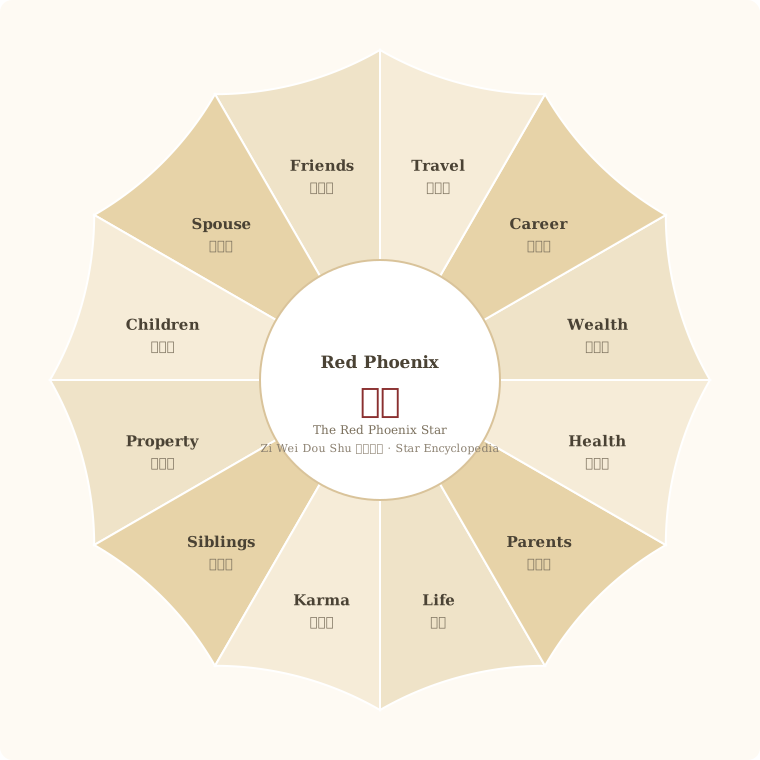
Red Phoenix in the Twelve Palaces
| Palace | Meaning |
|---|---|
| Life | Sharpens charm, popularity, and an early relationship timeline. The person tends to be liked quickly and to attract romantic interest young. With strong main stars this reads as a sociable, well-liked life; the shadow is a tendency to let attention define self-worth. |
| Spouse | Supports a warm, attractive partnership and often an earlier-than-average marriage. Classical texts say the spouse is handsome or beautiful, but the star only enhances; the final reading still rests on the main stars of the Spouse Palace. |
| Children | The classical reading points to daughters more often than sons, and to affectionate, lively children who are well liked socially. The bond tends to be warm rather than strict. |
| Wealth | Income that flows through people: commissions, introductions, hospitality, and celebration industries. When it meets Hua Lu or the Emptiness stars the reading turns cautious - money made through charm can also be spent through impulse. |
| Travel | Romance found away from home, travel courtships, warm welcomes abroad. Social ease turns strangers into allies quickly, and journeys often carry memorable encounters. |
| Career | Public-facing work: events, ceremonies, matchmaking, hospitality, anything requiring social warmth. Reputation is built on being liked. Distraction follows when flirtation becomes the work itself. |
Key Star Combinations
- Red Phoenix + Heavenly Joy (红鸾天喜): The classic pair: courtship in one palace, celebration in the opposite one. Together they cover the full arc from meeting to wedding, and any year that activates both often carries a major life event, a wedding, a birth, or a formal announcement. The combination also raises general popularity, since the two stars reinforce each other through the chart axis.
- Red Phoenix + Greedy Wolf (红鸾贪狼): Two of the strongest peach-blossom influences in one place. Charisma, artistic flair, and romantic magnetism are high, and relationships start easily. The shadow scales up too: emotional entanglements multiply unless strong main stars and helpful companions stabilize the picture.
- Red Phoenix + Tian Yao (红鸾天姚): Heavy romantic coloring. Classical texts warn of love affairs, jealousy, and reputation risk when these two gather, but the same combination gives remarkable social charm. With auspicious stars present, the effect softens into popularity and a lively love life; with destructive stars, discretion is the practical advice.
Common Questions
Does the Red Phoenix mean I will definitely marry young or have an affair?
No. The Red Phoenix describes a pattern of attraction and social opportunity, not a promise. It appears every twelve years by placement, yet few people marry every twelve years, so the star alone is never enough to predict an event. The main stars of the Life and Spouse Palaces, the Four Transformations, and the yearly chart decide whether its energy becomes marriage, popularity, or simply a festive year.
What does the Red Phoenix do in a yearly chart?
When activated in a Liu Nian (yearly) chart, it tends to bring a red-letter event: courtship, engagement, a wedding, a birth, a move, or an announcement. The classical framework treats it as a marker of celebratory timing rather than a specific prediction, so the reader looks at which palace it enters and which main stars answer it.
Is the Red Phoenix a good or a bad star?
Neither, in itself. It is an amplifier of relationship and celebration themes whose quality depends on its company. With strong main stars and helpers it reads as charm, good timing, and marriage luck; with destructive stars it can add infatuation, jealousy, or rash decisions. The star reports the weather, so to speak; the main stars set the climate.
Related Stars
Explore how Red Phoenix works with other stars: