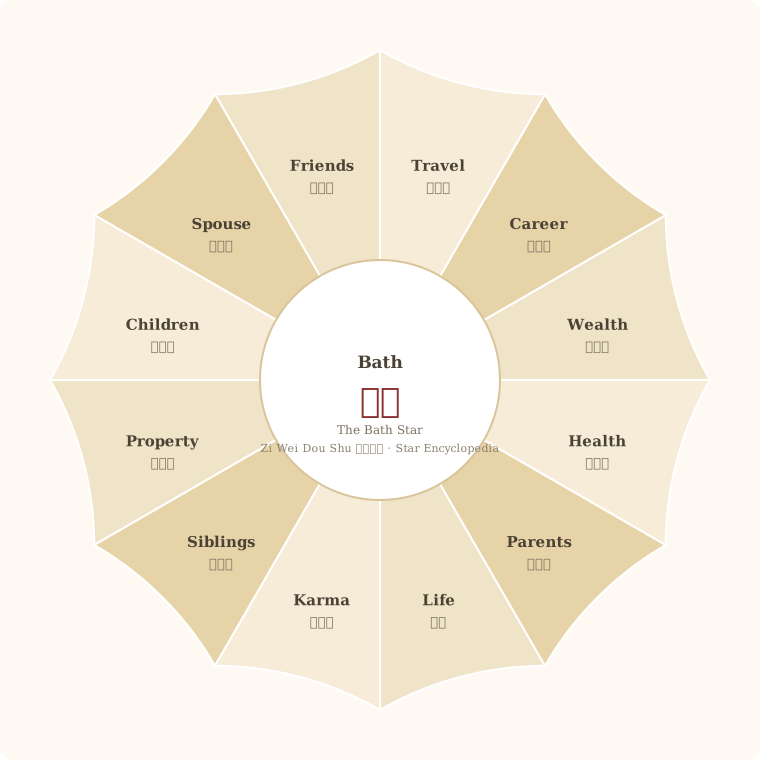
Core Attributes
| Chinese | 沐浴 |
|---|---|
| Pinyin | Mu Yu |
| English | Bath |
| Archetype | The Bath |
| Element | Water |
| Category | Cycle Deity |
What Bath Means
In the sequence of the Twelve Life Stages, Bath follows Longevity as the first wash after birth: what was hidden begins to show, and the person becomes visible to others. It is placed one palace after Longevity along the fixed order, which itself is anchored by the Five Elements Bureau (Water at Shen, Wood at Hai, Metal at Si, Earth at Shen, Fire at Yin), then read forward for men and in reverse for women. Classical texts classify Bath as a broken or defeated state, the one stage that falls outside both the prosperous group and the middle states, and list it among the inauspicious deities. What it governs is exposure: charm, emotional openness, attraction, and the display of ability before it has hardened into skill. This is why the tradition associates it with romance and with the peach-blossom flavor of a chart. The neutral reading is a phase of vulnerability: energy at this point is easily scattered by pleasure, praise, or infatuation, but the same openness that can be dissipated is also what makes talent visible to an audience. Whether the Bath becomes a love affair or a stage career is decided by the main star and the palace it occupies.
Bath in Practice
In a Life palace, Bath suggests an early and visible social life, charisma, and a gift for being noticed; combined with the Greedy Wolf (Tan Lang), Chaste Purity (Lian Zhen), or peach-blossom helpers such as Salty Pool (Xian Chi), the romantic reading strengthens. In Career or Wealth palaces it often shows as work that trades on display: performance, marketing, hospitality, or public-facing roles where being seen is the product. The shadow is dissipation: scattered focus, emotional entanglement, and a tendency to spend energy on appearances. With stable stars like Heavenly Minister (Tian Xiang) or Heavenly Beam (Tian Liang) the Bath stays a polish rather than a storm. It is a phase, not a judgment: charts read the Bath through the company it keeps.
Key Star Combinations
- Bath + Salty Pool (Mu Yu + Xian Chi): Both stars carry the image of exposed attraction. Together they describe strong magnetism and early romantic episodes; the Bath softens boundaries, so the classical reading warns about discretion, while well-placed main stars turn the same energy into charisma and charm.
- Bath + Greedy Wolf (Mu Yu + Tan Lang): The Wolf's desire meets the Bath's display: potent charisma, creative and social energy. Without structure the combination scatters; with Literary stars (Wen Chang, Wen Qu) it commonly appears as performing arts, design, or entertainment.
- Bath + Longevity (Mu Yu + Zhang Sheng): The transition from hidden germination to visible exposure. Together they describe the moment a new talent first steps into public view: exciting, fragile, and full of attention that must be managed carefully.
Common Questions
Why is the Bath called the broken place (bai di)?
Because at this stage the fresh energy of Longevity has not yet solidified; it is easily scattered by emotion, pleasure, and attention. The classical system therefore places Bath outside the prosperous states and lists it among the declining deities. The metaphor is vulnerability, not catastrophe.
Does the Bath always mean romance?
Not necessarily. It describes what is exposed and attractive; whether that becomes romance depends on companion stars such as Salty Pool or the peach-blossom group, and on the palace. In a career palace the same energy shows as visible talent or public-facing work.
Related Stars
Explore how Bath works with other stars: