The Five Elements in Chinese Astrology: More Than Wood, Fire, Earth, Metal, Water
The Five Elements — Wood, Fire, Earth, Metal, and Water — are the engine beneath Chinese destiny analysis: how your chart balances them determines your strengths, your drains, and your seasons.
Key Takeaways
- Five elements, one engine: Wood, Fire, Earth, Metal, and Water power every chart and every season.
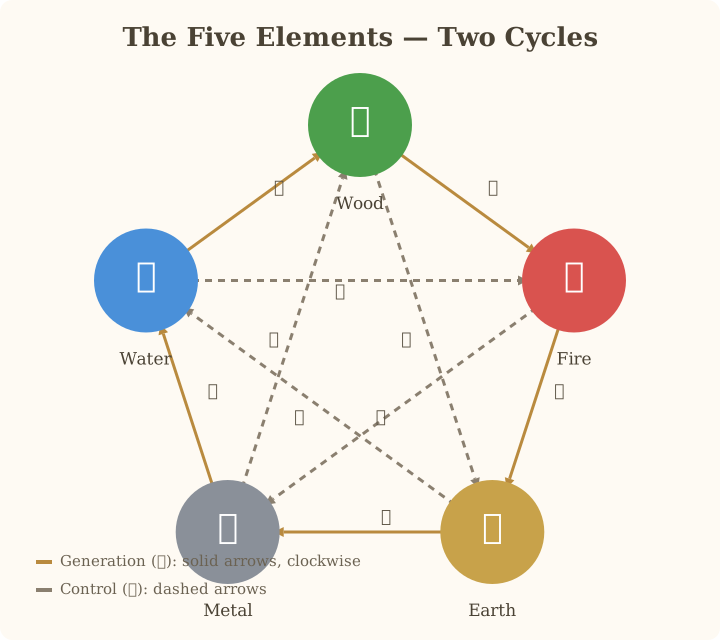
- Generation cycle: Wood feeds Fire, Fire makes Earth, Earth yields Metal, Metal enriches Water, Water nourishes Wood.
- Control cycle: Wood parts Earth, Earth dams Water, Water douses Fire, Fire melts Metal, Metal cuts Wood.
- Balance is practical: A Fire-heavy person thrives in visibility and motion; a Water-heavy person needs depth and quiet.
- Shared framework: The elements appear in BaZi, ZWDS, Feng Shui, and Chinese medicine — one language across systems.
Everyone has heard of the Five Elements. Most people get them wrong.
In Chinese metaphysics, the Five Elements — Wood, Fire, Earth, Metal, Water — are not substances. They are processes — a framework first enumerated in the Hong Fan chapter of the Book of Documents (尚書·洪範), roughly a thousand years before the common era. They describe patterns of movement, transformation, and relationship. They are a language for understanding how energy behaves.
The Generation Cycle: How Elements Support Each Other
Wood feeds Fire. Fire produces ash, which becomes Earth. Earth condenses into Metal. Metal enriches Water. Water nourishes Wood.
This is the Sheng cycle, the cycle of generation. Each element gives birth to the next. It describes supportive, nurturing relationships — what feeds you, what makes you stronger.
In your BaZi chart, the generation cycle tells you which elements support your Day Master. If you are Jia Wood, Water nourishes you and Fire gives you purpose. These are your allies. (Not sure which element you are? Find your Day Master first.)
The Control Cycle: How Elements Balance Each Other
Wood penetrates Earth (roots breaking soil). Earth absorbs Water (dams and banks). Water extinguishes Fire. Fire melts Metal. Metal cuts Wood.
This is the Ke cycle, the cycle of control. Each element restrains another. It describes balancing, limiting relationships — what keeps you in check, what challenges you.
In your chart, the control cycle tells you which elements create friction. Some friction is necessary. A tree that nothing ever cuts grows wild and weak.
The Insult Cycle: When the Weaker Overcomes the Stronger
When the balance is off, the weaker element can "insult" the stronger one. Wood normally controls Earth. But if the Earth is overwhelmingly strong and the Wood is weak, the Earth can bury the Wood. Fire normally melts Metal. But a strong blade can extinguish a weak flame.
This pattern appears often in charts where one element massively dominates. It explains why people sometimes behave in ways their Day Master would not predict — the imbalance overrides the default.
What Your Element Balance Means
Your BaZi chart shows the distribution of all five elements across your four pillars. Most charts are not perfectly balanced. That is normal and expected.
A chart with strong Wood and little Metal suggests a person who is principled, growth-oriented, and may struggle with boundaries. What they need — consciously — is more Metal energy: structure, discipline, the willingness to cut what needs cutting.
A chart with strong Water and little Earth suggests a person who is deep, intuitive, and may struggle with grounding. What they need is more Earth energy: routine, stability, a solid foundation.
The elements you lack are not flaws. They are areas where conscious effort compensates for what the chart does not provide naturally. The broader system this framework belongs to — BaZi and Zi Wei Dou Shu together — is mapped in Chinese Astrology: The Complete Guide.
The Five Elements at a Glance
The elements are not abstract. Each one maps to a season, a direction, a color, and a set of physical systems — a correspondence framework shared across Chinese metaphysics, from chart reading to medicine to Feng Shui.
| Element | Season | Direction | Color | Core quality | Balanced expression |
|---|---|---|---|---|---|
| Wood | Spring | East | Green | Growth | Principled, forward-moving, generative |
| Fire | Summer | South | Red | Expansion | Warm, visible, inspiring |
| Earth | Late summer | Center | Yellow | Stability | Grounded, reliable, nourishing |
| Metal | Autumn | West | White | Contraction | Precise, disciplined, refined |
| Water | Winter | North | Black / blue | Depth | Reflective, adaptive, persistent |
The correspondences matter for a simple reason: the same framework shows up in your chart, in the seasons you respond to, and in the environments where you function best. A Fire-heavy person does not merely "have a lot of Fire" — they tend to thrive in summer-like conditions: visibility, warmth, motion. A Water-heavy person often needs winter-like conditions: quiet, depth, space to reflect.
This is why element balance is not abstract philosophy. It is a practical language for choosing environments, timing decisions, and understanding why some seasons of life feel like home. Your own balance is visible in minutes with a free Four Pillars chart.
Elements and the Ten Gods
Each Ten God in your chart is associated with an element. The Wealth star relates to the element that your Day Master controls. The Authority star relates to the element that controls your Day Master.
This means that the same Luck Cycle affects different Day Masters differently. A Fire Luck Cycle is a Wealth cycle for someone whose Day Master controls Fire — but it is an Authority cycle for someone whose Day Master is controlled by Fire.
Same weather. Different experience.
Beyond the Chart
The Five Elements are not just in your BaZi chart. They appear in your ZWDS chart. They appear in Feng Shui. They appear in Chinese medicine. They are a unified framework for understanding dynamic systems — which is what a human life is.
Understanding your elemental balance gives you a language for what you already feel: why certain environments feel like home, why certain challenges exhaust you, why certain seasons of life feel different.
Common Questions
Is the Five Elements framework a form of divination? No. The elements are a descriptive model, first enumerated in the Hong Fan chapter of the Book of Documents — a philosophical framework, not a fortune-telling method. Charts use the model to describe patterns; they do not cast spells.
How do I know which element I am? Your Day Master — the Heavenly Stem of your Day Pillar — is your element in its yin or yang form: Jia or Yi Wood, Bing or Ding Fire, Wu or Ji Earth, Geng or Xin Metal, Ren or Gui Water. You can find yours in seconds with a free Four Pillars calculator.
If I am missing an element, should I "add" it? Not in a mechanical way. A missing element is not a defect — it is an area where you will naturally rely on conscious effort and external support. "Adding" an element is not about wearing a color; it is about cultivating the behavior the element represents: structure if you lack Metal, grounding if you lack Earth.
Do the elements change over time? Your chart is fixed, but the balance you experience shifts with every Luck Cycle and every year. A Fire-heavy chart in a Water cycle is not the same experience as a Fire-heavy chart in a Fire cycle. The elements are constant; the weather changes.
Are the Five Elements the same in BaZi and Zi Wei Dou Shu? The framework is shared, but the roles differ. BaZi uses elements as the core machinery (Day Master, Ten Gods, cycles). ZWDS uses elements inside a star-and-palace structure — stars carry element natures, and palaces map life domains. Same language, different grammar.
Sources and Further Reading
- The Hong Fan chapter of the Book of Documents (尚書·洪範) — the earliest surviving enumeration of the Five Elements, dating to roughly the first millennium BCE.
- Yuan Hai Zi Ping (淵海子平) and San Ming Tong Hui (三命通會) — the classical BaZi texts in which the generation and control cycles are applied to chart reading.
- Wu Xing (Wikipedia) — an overview of the generation, control, and insult cycles: https://en.wikipedia.org/wiki/Five_elements_(Chinese_philosophy))
See your element balance → - Chinese Astrology (Wikipedia) — overview of the Chinese astrological tradition: https://en.wikipedia.org/wiki/Chinese_astrology
Discussion